What people ask before a Fes trip

The short answers: Fes-Saïss is 16.7 km by road from Bab Boujloud, no car enters the medina, non-Muslims can visit the madrasas but not the Qarawiyyin, and every trip is quoted for your group. The rest is below, written by our Fes team.

  • 32 answers
  • Written in Fes
  • A person replies

Arriving in Fesالوصول إلى فاس

How far is Fes-Saïss airport from the medina?
16.7 km by road from the terminal to Bab Boujloud on the OpenStreetMap car route, which takes 20 to 30 minutes by car depending on traffic. Bab Ftouh is 17.3 km and Bab Guissa 18.2 km. The road runs north on the N8, through the Ville Nouvelle and up to the walls.
Can a car drive us to our riad?
No. Fes el-Bali is car-free, so every car stops at a gate or a car park on its edge. A porter with a handcart takes your bags from there, and most riads are a 5 to 15 minute walk from their nearest gate. Many riads also send someone to meet you at the gate.
Which gate will we arrive at?
It depends on the riad. Common drop points are Bab Boujloud, Bab Guissa, Bab R'cif and Bab Ftouh. Send us the riad's name and we agree the gate with the riad before you fly.
Our flight lands late at night. Is that a problem?
No. Late arrivals at Fes-Saïss are common. The driver watches your flight and waits in arrivals; we tell the riad when you are expected so someone is awake to open the door, and the porter is arranged in advance.
We fly into Casablanca instead. How far is Fes?
Casablanca Mohammed V airport to Fes is about 315 km, 3.5–4 hours by toll motorway, plus a rest stop. Rabat-Salé and Tangier are closer; each has its own transfer page with the road and the timings.

Read more: Fes airport to the medinaGetting around Fes
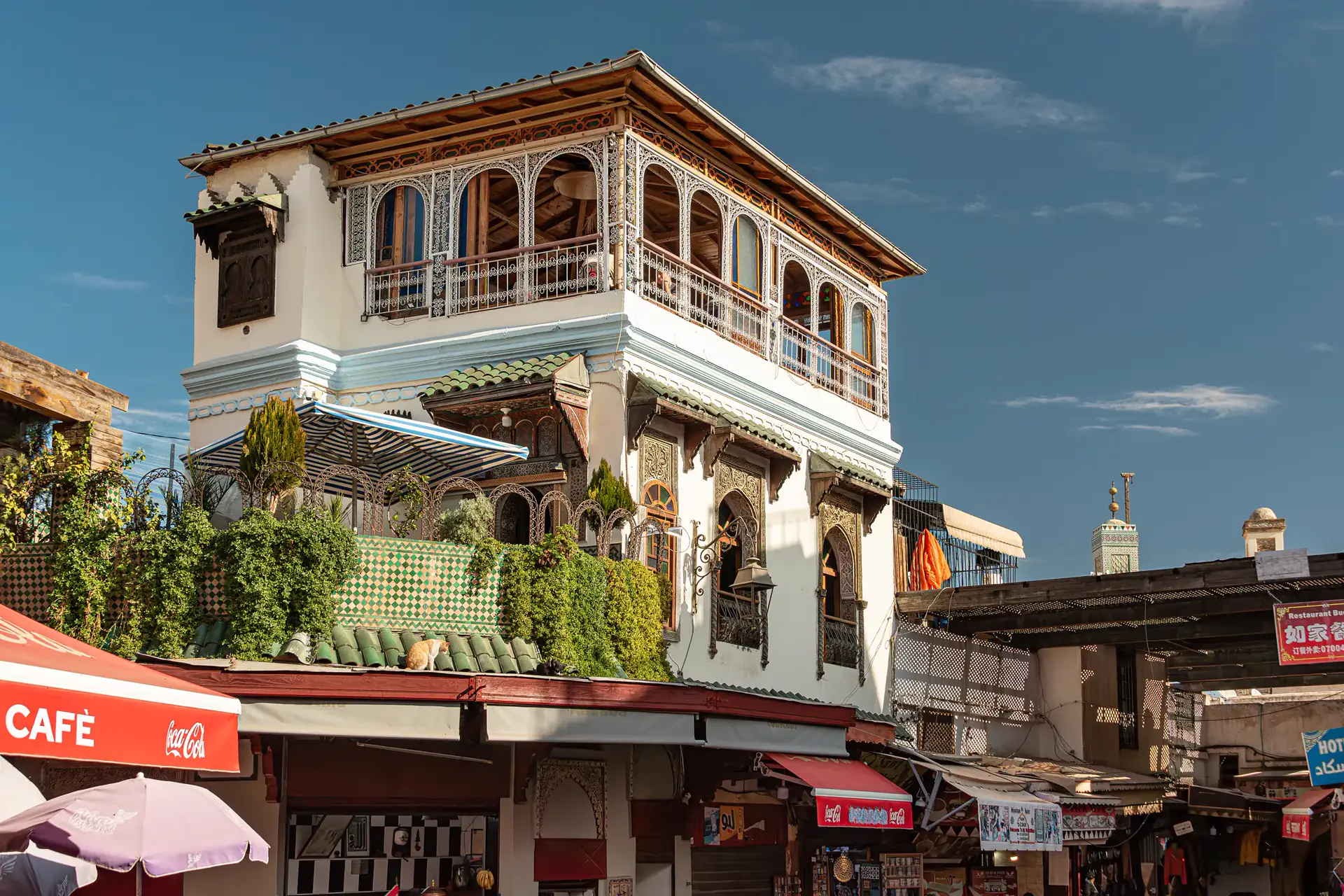
Café terraces and a carved wooden balcony house just inside Bab Boujloud, start of Talaa Kebira

Talaa Kebira, the medina's main lane, starts just inside Bab Boujloud.

Rue Talaa Kebira, Fes

Inside the medinaداخل المدينة

Can non-Muslims go inside the Qarawiyyin?
No. The Qarawiyyin is a working mosque, open to Muslims only. Visitors can glimpse its courtyard from the doorways on the lanes around it. The Attarine madrasa beside it is open to visitors, and from inside you see the same carved cedar, stucco and zellige.
Which religious buildings can we go into?
The Bou Inania and Attarine madrasas are open to non-Muslim visitors. The mosques and the shrine of Moulay Idris II are not: at the shrine, non-Muslims look into the courtyard from the doorways.
Will we get lost? Do we need a guide?
The lanes are a maze, but two main streets, Talaa Kebira and Talaa Seghira, run from Bab Boujloud down to the Qarawiyyin quarter, and many visitors find their way on those. A licensed guide earns their keep in the lanes off them, in the craft quarters and on the far bank, and saves the first day from being spent finding your way.
How do we see the tanneries?
The Chouara tannery is seen from the terraces of the leather shops around it. The shops let you up because they hope you will look at their leather; you are not obliged to buy. Mornings are when the dye pits are busiest.
Is the medina open on Fridays?
Yes. The medina never closes, but many shops shut around the Friday midday prayer and some stay shut for the afternoon. Monuments keep their own hours, so we plan a Friday around what is open.
People at the gate offer to guide us. What should we do?
A polite, firm no thank you is enough. If you have booked a guide, they meet you by name at an agreed place, so you never need to choose someone at the gate.

Read more: The QarawiyyinBou Inania madrasaSeeing the Chouara tannery

Booking with usالحجز معنا

How do we book?
Send your dates, who is travelling and what you want to see through the quote form. A person on our team reads it and writes back with a plan and one written quote, private or small-group. Fes & Imperial Cities trips are operated by Serenity Morocco Tours, under their booking terms.
Why don't you publish prices?
Because the same day costs different amounts for two people and for eight, in April and in August, with one riad or another. Every trip is quoted for your group and your dates, in writing, before you commit to anything.
How do payment, deposits and cancellations work?
They follow Serenity Morocco Tours's booking terms, which set out payment, deposit, cancellation and refund rules. Read them at www.serenitymoroccotours.com/booking-terms before you confirm.
Can we change the plan after booking?
Yes. Free changes (dates, a riad swap, a route tweak) are accepted up to 21 days before arrival. Inside 21 days, changes depend on supplier availability and any cost difference.
Private or small-group: what is the difference?
Private means the guide, driver and vehicle are yours alone, on your schedule. Small-group means sharing with a few other travellers on the same plan. We tell you honestly whether a small-group option fits your dates; when it doesn't, we plan it privately.
Can we book at short notice?
Often, especially airport transfers and day tours. Tell us your dates and we say straight away what we can still arrange. Spring and autumn fill up first.

Read more: How planning worksBooking terms

Money, visas and phonesالمال والتأشيرة والهاتف

Do we need a visa for Morocco?
It depends on your passport, and the rules change. Our visa and entry guide explains how to check for your nationality; confirm with the Moroccan consulate or your government's travel advice before you fly.
What currency is used, and where do we get it?
The Moroccan dirham (MAD). It is a closed currency, so you get dirhams once you are in Morocco: at the airport exchange desks, at banks, or from cash machines, which are easy to find in the Ville Nouvelle.
Cash or card in the medina?
Mostly cash. Porters, small cafés and stalls work in dirhams; larger shops and many riads take cards. Keep small notes and coins for porters, who work for tips.
What plugs does Morocco use?
Round two-pin European plugs (types C and E), at 220 volts. Most phone and laptop chargers handle that; check the label, and bring an adapter if your plugs are not European.

Read more: Morocco visa and entry

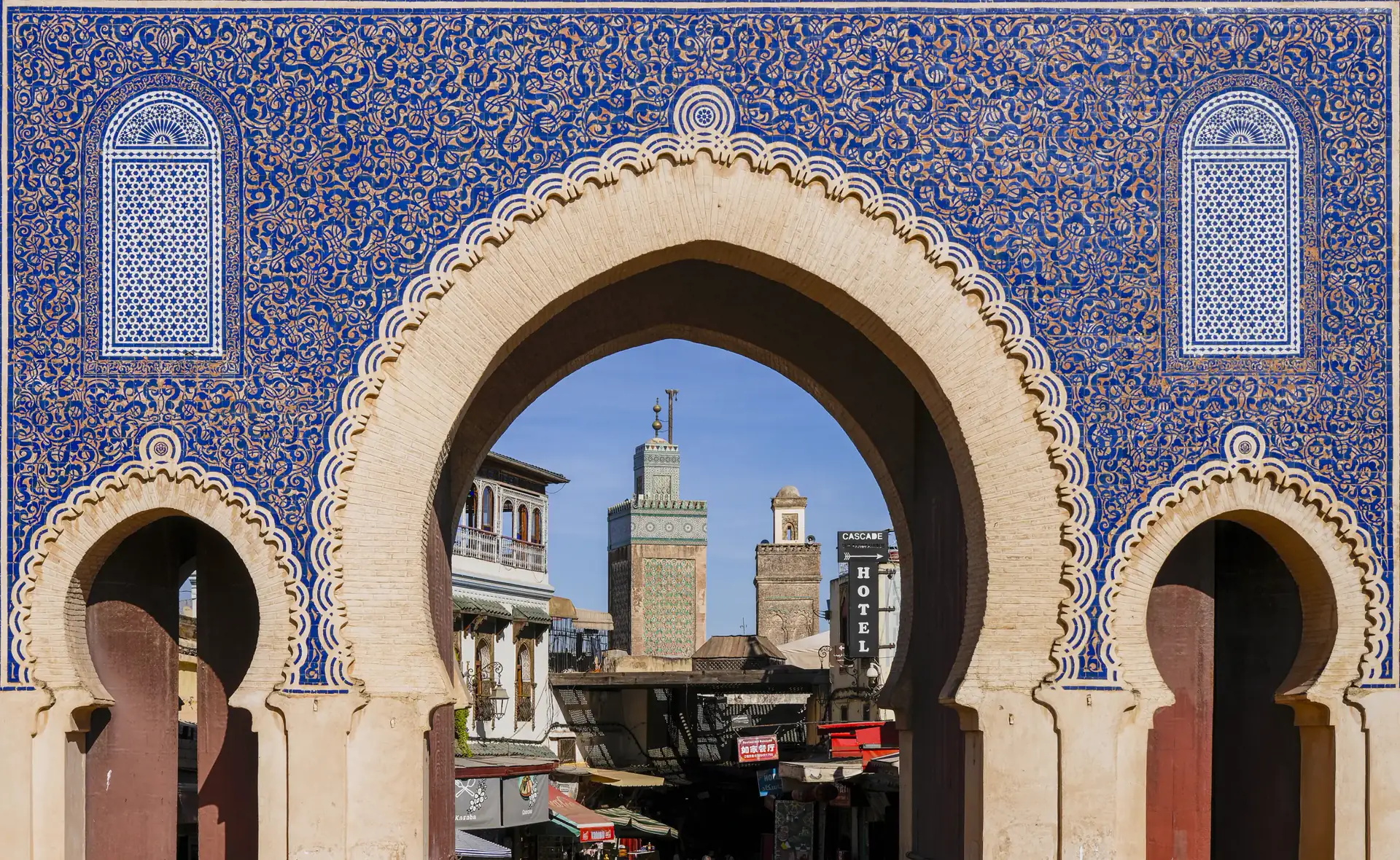
The blue-tiled horseshoe arch of Bab Boujloud framing the minaret of the Bou Inania madrasa, Fes

Through the blue arch of Bab Boujloud, the minaret of the Bou Inania.

Bab Boujloud, Fes

Seasons and Ramadanالمواسم ورمضان

When is the best time to visit Fes?
Spring and autumn are the most comfortable for walking the medina. Summer afternoons in Fes are hot, so walks start early and go indoors at midday. Winter days can be bright, but nights are cold, and riads built round an open courtyard feel it: ask about heating. Our month-by-month weather guide has the detail.
What is Fes like during Ramadan?
Ramadan follows the lunar calendar, so it starts about eleven days earlier each year. By day the medina is quieter and some cafés close; after sunset it fills for the evening meal and stays lively late. Monument opening hours can change, so we check them for your dates. Eating and drinking discreetly in the daytime is appreciated.
Are there festivals worth planning around?
The Fes Festival of World Sacred Music is the best known; its dates change each year, so check before you plan around it. Our sacred music and festivals guide covers it and the city's religious festivals.

Read more: Fes weather by monthSacred music and festivals

Getting around and day tripsالتنقل والرحلات

How do we get around Fes?
On foot inside the medina. Between the medina gates, Fes el-Jdid and the Ville Nouvelle, the red petit taxis are the usual way; ask for the meter. For day trips and transfers we send a private car and driver.
How far are Meknes and Volubilis?
Fes to Meknes is about 65 km, 45 minutes–1 hour; Fes to Volubilis is about 75 km, 1h 15–1h 30. Both fit in one day from Fes, with Moulay Idriss on the way.
Is Chefchaouen a day trip from Fes?
It can be, but it is a long one: about 200 km, 3.5–4 hours each way, through the Rif. A night in Chefchaouen makes it a calmer trip.
Can we reach the Sahara from Fes?
Yes. Merzouga and the Erg Chebbi dunes are about 470 km, 7–8 hours from Fes over the Middle Atlas, so most trips take three days: a long drive out, a night in camp, and the road on or back.

Read more: Day trips from FesAll our tours

Respect and safetyالاحترام والأمان

Is Fes safe for visitors?
Fes is a working city that receives visitors all year. The usual city care applies: watch your pockets in crowded lanes, and expect insistent offers of help or directions near the gates, which a polite no ends.
What should we wear?
Clothes that cover shoulders and knees are respectful in the medina and draw less attention. Wear shoes with grip: the lanes are cobbled, sloped and stepped, and slippery after rain.
Can we take photographs?
Buildings, lanes and views, freely. Ask before photographing people; some will say no, and some ask for a coin. In shops and workshops, ask the owner first.
Is Fes a good idea with young children?
Yes, and children are welcomed everywhere. Leave the buggy behind: the lanes have steps, slopes and crowds, and a carrier is far easier. Our Fes with kids guide has the details.

Read more: Fes with kids

Still have a question? A person on our team will answer it.

  1. Tell us what drew you in. Your dates, who is travelling and what you want to see.
  2. A person reads it. We write a day-by-day plan for your group, private or small-group.
  3. You change anything. Then we confirm the guides, drivers and riads.
Plan this with us