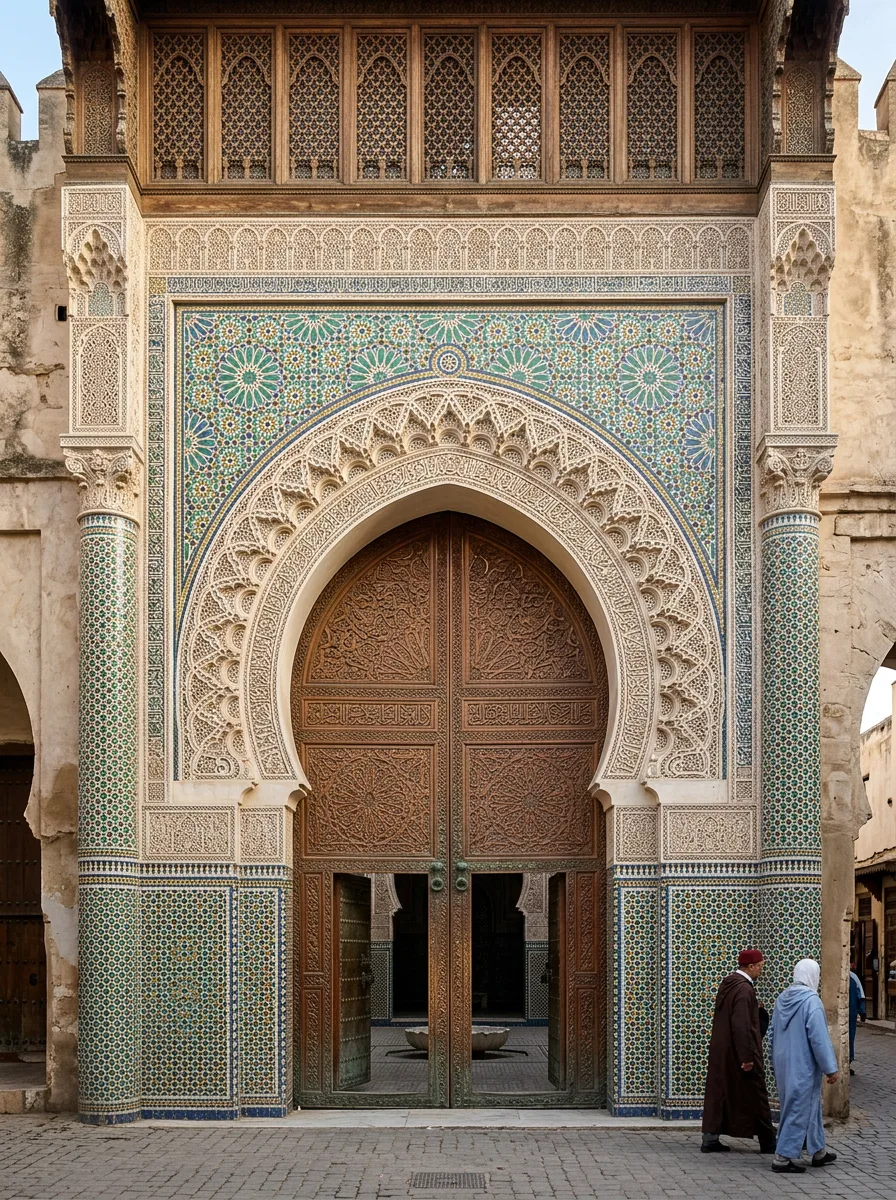
At the heart of Fes el-Bali stands al-Qarawiyyin, the great mosque and centre of learning that gives the medina much of its identity. It is traditionally said to have been founded in 859 CE by Fatima al-Fihri, a woman of a family that had migrated from Kairouan in present-day Tunisia, and it grew over the centuries into one of the most important seats of learning in the Muslim world. UNESCO and many institutions describe its associated university as among the oldest, and often as the oldest, continuously operating degree-granting educational institution in the world, and its historic library is regularly cited as one of the oldest libraries anywhere, holding a remarkable collection of manuscripts. The mosque is a working place of worship, so non-Muslim visitors may not enter the prayer hall, but you can glimpse the vast courtyard and forest of arches through its great doorways, walk the surrounding lanes that grew up around it, and visit the madrasas built nearby to house its students. This guide covers the history of al-Qarawiyyin, what you can and cannot see, the courtyard and architecture glimpsed from the doors, the restored library, the green-tiled minaret, the madrasas around it, dress and etiquette, and how to weave it into a wider medina walk.
Al-Qarawiyyin is traditionally said to have been founded in 859 CE by Fatima al-Fihri, whose family had come to Fes from Kairouan, and the name of the mosque recalls those Kairouan roots. Begun as a community mosque, it expanded under successive dynasties into a major centre of religious and scholarly life, and it remains one of the defining landmarks of the medina more than a thousand years later.
02History
One of the world's oldest universities
The teaching that grew up around the mosque is widely described as one of the oldest, and frequently as the oldest, continuously operating degree-granting university in the world, a distinction noted by UNESCO and many reference works. For centuries scholars came to Fes to study religious sciences, law, language, astronomy and more, and the institution is still part of Morocco's university system today.
03How to visit
What you can and cannot see
Al-Qarawiyyin is an active mosque, so non-Muslims are not able to enter the prayer hall and courtyard themselves. What visitors can do is approach the building from the surrounding lanes, look in through the great open doorways to glimpse the interior, and visit the nearby madrasas and library that are open to the public. Setting expectations this way avoids disappointment and keeps the visit respectful.
04What to see
Glimpsing the courtyard and arches
From certain doorways along the surrounding streets you can catch views of the mosque's large central courtyard, its fountains and the long ranks of horseshoe arches that march back into the prayer hall. These framed glimpses, often through ornate doors and past worshippers, are among the most evocative sights in Fes el-Bali, even though the interior itself is reserved for those at prayer.
05Architecture
The green-tiled minaret
Rising above the rooftops, the minaret of al-Qarawiyyin is one of the oldest surviving in Fes and a key landmark for orienting yourself in the maze of the medina. Its green-tiled cap is a recurring feature of the skyline, best appreciated from one of the medina's rooftop terraces, from which the scale of the mosque amid the dense quarter becomes clear.
06Landmark
The historic Qarawiyyin library
Attached to al-Qarawiyyin is a library often described as one of the oldest in the world, holding a celebrated collection of manuscripts including very early and rare works. After a major restoration completed in the 2010s, parts of the library complex have at times been opened, and its cafe and reading spaces have welcomed visitors; access can vary, so it is worth checking the current arrangements locally.
07Nearby
The madrasas built around it
Because students came from far away to study at al-Qarawiyyin, sultans built residential colleges, or madrasas, nearby to house and teach them. The Al-Attarine and Bou Inania madrasas are the most famous, and unlike the mosque they are open to non-Muslim visitors, offering an interior taste of the same Marinid craftsmanship of zellige, carved cedar and stucco.
08Setting
The Attarine and Nejjarine surroundings
Al-Qarawiyyin sits in the densest part of the old city, ringed by the Attarine souk of spice and perfume sellers and close to the Nejjarine quarter with its famous fondouk and tiled fountain. Approaching the mosque you thread through these working lanes, so a visit is as much about the surrounding souks and craft quarters as about the great building at their centre.
09Nearby
Place Seffarine and the metalworkers
A short walk from the mosque is Place Seffarine, the small square of the brass and copper workers, where artisans hammer trays, pots and lanterns much as they have for generations and the sound of metalwork fills the air. It is one of the most atmospheric corners near al-Qarawiyyin and a natural addition to a walk around the mosque.
10Etiquette
Dress and etiquette
Even though you are viewing al-Qarawiyyin from outside, it is a major active mosque, so dress modestly with shoulders and knees covered and keep your voice low near the doorways. Be discreet with photography, avoid blocking entrances used by worshippers, and do not attempt to step inside; behaving as you would near any working place of worship is both courteous and expected.
11Tips
How to visit and what to allow
Seeing al-Qarawiyyin itself is mostly a matter of finding the right doorways and lanes, which takes only a short time, so most visitors combine it with the nearby madrasas, library and souks to make a fuller outing. Opening hours for the madrasas and any accessible parts of the library can vary, and there are small entry fees for the madrasas, so check current prices and times locally.
12Tips
Going with a local guide
A local guide is especially valuable here, knowing which doorways give the best glimpses into the mosque, recounting the story of Fatima al-Fihri and the institution's long history, and linking al-Qarawiyyin to the madrasas, library, souks and metalworkers' square around it. A guide also makes navigating the tangle of lanes in this part of Fes el-Bali far easier.
Frequently asked
Can non-Muslims visit the Qarawiyyin Mosque in Fes?
Non-Muslims are not able to enter the prayer hall and courtyard of al-Qarawiyyin, as it is an active mosque. However, you can approach it from the surrounding lanes, glimpse the courtyard and arches through its great open doorways, and visit the nearby madrasas and, where open, parts of the historic library. Dress modestly and behave respectfully near the entrances.
Is al-Qarawiyyin really the oldest university in the world?
It is widely described, including by UNESCO and many reference works, as among the oldest and often as the oldest continuously operating degree-granting university in the world. It is traditionally said to have been founded in 859 CE by Fatima al-Fihri and grew from the mosque into a major centre of learning that is still part of Morocco's university system today.
Can you visit the Qarawiyyin library?
The Qarawiyyin library is often cited as one of the oldest in the world and holds a celebrated manuscript collection. After a major restoration completed in the 2010s, parts of the complex have at times been opened to visitors, with a cafe and reading areas. Access can change, so it is best to check the current arrangements locally before planning a visit.
What is there to see around al-Qarawiyyin?
The mosque sits in the dense core of Fes el-Bali, surrounded by the Attarine spice souk and close to the Nejjarine quarter and Place Seffarine, the metalworkers' square. The Al-Attarine and Bou Inania madrasas nearby are open to non-Muslim visitors and show the same Marinid zellige, cedar and stucco, making the area easy to explore as a single walk.
See it with a local
Turn this into a private Fes trip.
We'll build a private, guided plan around the experiences you care about — with a driver, hand-picked riads and a written quote in 24 hours.