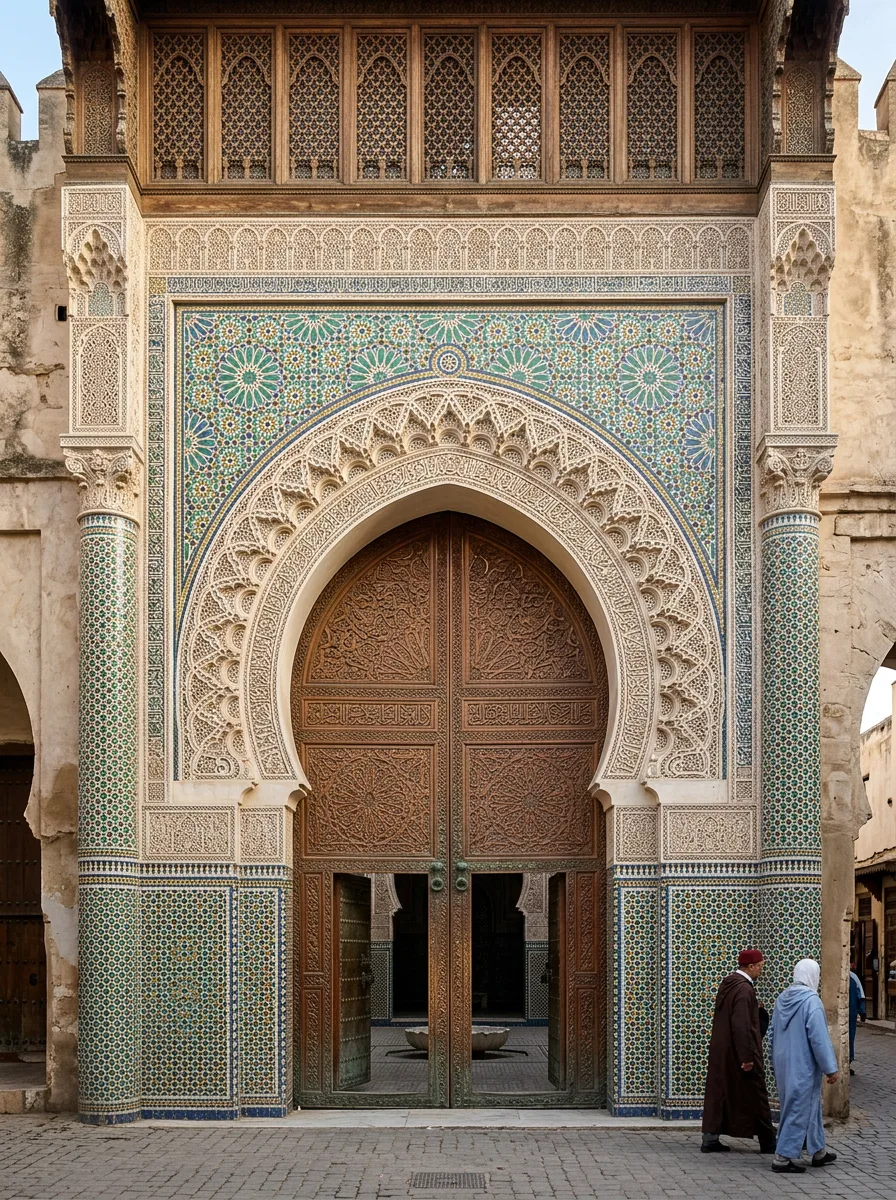
The Bou Inania Madrasa is a 14th-century Marinid college founded by Sultan Abu Inan Faris around the 1350s, set just off Talaa Kebira in Fes el-Bali. It is widely considered one of the finest surviving examples of Marinid architecture, with exceptional carved cedar, deep stucco work and tile mosaic (zellige) framing a marble courtyard, all beneath a green-tiled minaret. Unusually, it served as both a teaching madrasa and a congregational mosque, and it remains one of the few religious buildings in Fes that non-Muslims may enter. Across the narrow lane stands the Dar al-Magana, a house that once held a famous medieval water clock. This guide covers what to see, the craftsmanship to look for, the courtyard, the water clock opposite, dress and etiquette, how long to allow, and how to combine the visit with Talaa Kebira and Bab Boujloud.
Founded by the Marinid sultan Abu Inan Faris in the 1350s, the Bou Inania is the grandest of Fes's medieval madrasas and is often cited as one of the high points of Marinid architecture. It functioned both as a college for religious and legal study and as a Friday congregational mosque, which gives it a scale and richness beyond the city's other teaching madrasas.
02How to visit
One of the few religious sites open to non-Muslims
Because it served as a mosque as well as a college, the Bou Inania is one of the very few religious buildings in Fes that non-Muslims are generally permitted to enter. That makes it a rare chance to step inside and study Marinid craftsmanship up close rather than glimpsing it from a doorway.
03What to see
The marble courtyard
The heart of the madrasa is its open marble-paved courtyard, framed by richly decorated walls and arcades. A central water basin and the surrounding galleries are the spot most visitors pause to take in the layered decoration, where carved wood, stucco and tilework meet on every surface.
04Craftsmanship
Carved cedar woodwork
Look up to the cedar: the upper walls, eaves and screens are worked in intricately carved and lattice cedarwood, a hallmark of Marinid building. The dark, finely cut timber sits above the paler stucco and tile, and the joinery and carving repay slow, close looking.
05Craftsmanship
Stucco and zellige tilework
The lower walls carry geometric zellige mosaic in cut tile, while the middle registers are covered in deeply carved stucco bearing arabesques and Arabic inscriptions. The interplay of tile, plaster and wood across the courtyard is exactly the combination that makes Marinid decoration so admired.
06What to see
The green-tiled minaret
Rising above the madrasa is its minaret, finished in the green tilework characteristic of Fes's religious buildings. It is best seen from the lane outside or from nearby rooftops, and is one of the landmarks that helps orient you in this part of the medina.
07Nearby
The water clock across the lane
Directly opposite the madrasa is the Dar al-Magana, a tall facade that once held a celebrated medieval water clock, with a row of small windows and brass bowls thought to have marked the hours. The mechanism no longer works, but the surviving wooden frame and bowls are a famous and intriguing sight, and it is worth pausing to look up at it.
08Etiquette
Dress and etiquette
As a former mosque the madrasa is still treated as a religious site, so dress modestly with shoulders and knees covered, keep your voice low, and be mindful that prayer can still take place. Photography of the architecture is generally fine, but be discreet and respectful of anyone praying or at quiet study.
09Tips
How long to allow
Most visitors spend roughly 20 to 40 minutes inside — enough to walk the courtyard, study the cedar, stucco and zellige, and step back out to look at the water clock opposite. There is a small entry fee; check the current price and opening hours locally, as access can be restricted around prayer times.
10Itinerary
Combining with Talaa Kebira and Bab Boujloud
The madrasa sits at the top of Talaa Kebira, one of Fes el-Bali's main spines, a short walk down from the blue-tiled gate of Bab Boujloud. A natural plan is to enter the medina at Bab Boujloud, visit the Bou Inania and water clock first, then follow Talaa Kebira downhill through the souks toward the Chouara tannery and the Qarawiyyin quarter.
11Tips
Going with a local guide
A local guide can place the Bou Inania in its Marinid context, point out details in the cedar and stucco you might otherwise miss, and time the visit around prayer hours. It also makes it easy to fold the madrasa into a wider medina walk without losing your way in the surrounding lanes.
Frequently asked
Can non-Muslims visit the Bou Inania Madrasa in Fes?
Yes. Because the Bou Inania served as a congregational mosque as well as a teaching madrasa, it is one of the few religious buildings in Fes that non-Muslims are generally allowed to enter. Visitors should still dress modestly and behave respectfully, as it remains a religious site and access can be limited around prayer times.
What is there to see at the Bou Inania Madrasa?
The main draw is its Marinid craftsmanship: a marble courtyard framed by intricately carved cedar woodwork, deeply worked stucco with arabesques and inscriptions, and geometric zellige tile mosaic, all beneath a green-tiled minaret. Across the lane is the Dar al-Magana, which once held a famous medieval water clock.
What is the water clock opposite the Bou Inania Madrasa?
Directly across the narrow lane from the madrasa is the Dar al-Magana, a house whose facade once held a celebrated medieval water clock, with brass bowls below a row of small windows thought to have marked the hours. The mechanism no longer works, but the surviving wooden frame and bowls remain a well-known sight.
How long should I spend at the Bou Inania Madrasa?
Around 20 to 40 minutes is usually enough to walk the courtyard, study the cedar, stucco and tilework, and step outside to look at the water clock opposite. There is a small entry fee and opening can be restricted around prayer times, so check current prices and hours locally.
See it with a local
Turn this into a private Fes trip.
We'll build a private, guided plan around the experiences you care about — with a driver, hand-picked riads and a written quote in 24 hours.