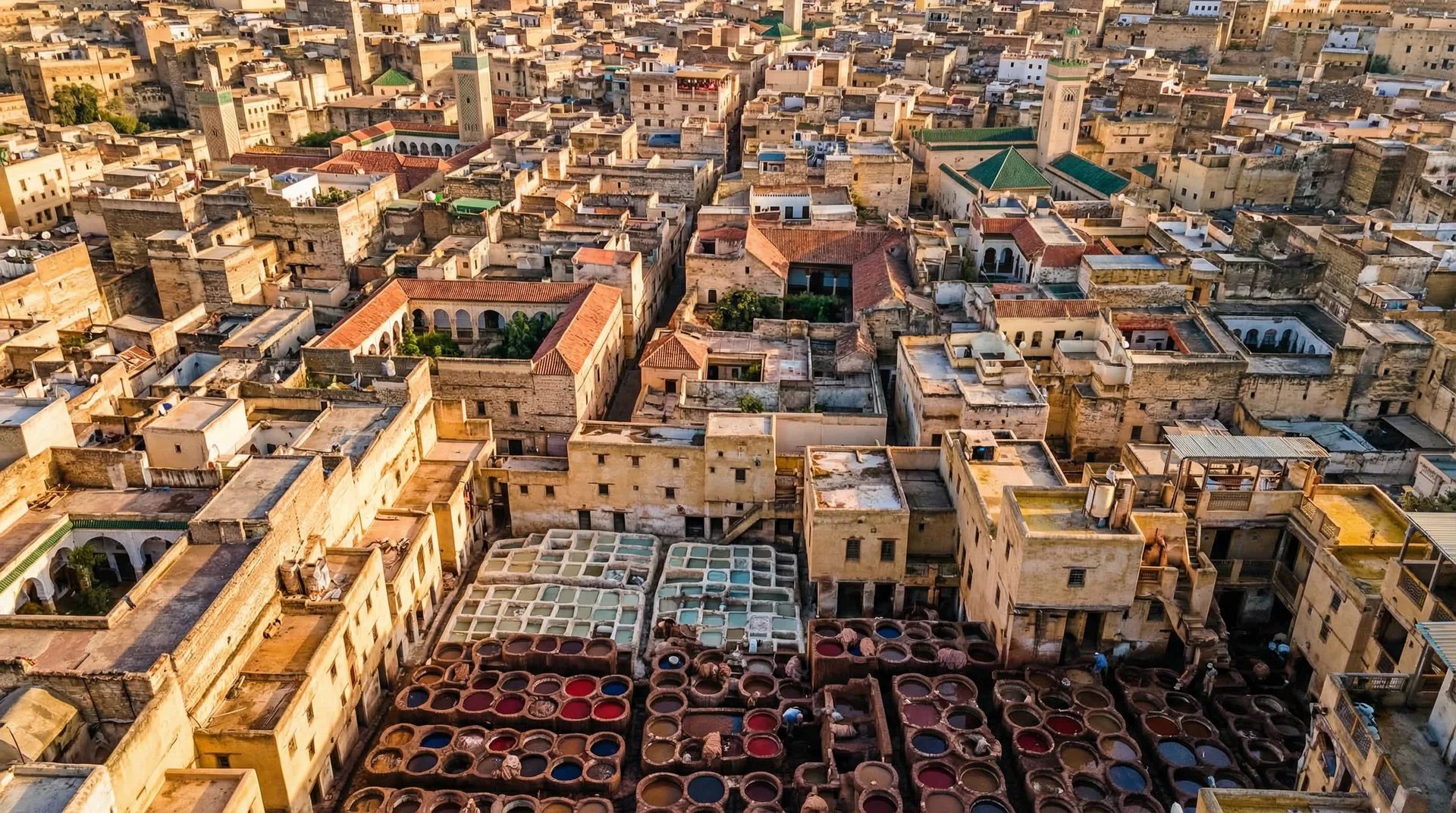
Getting around Fes is unlike getting around almost any other city, because the heart of it cannot be driven at all. Fes el-Bali — the old walled medina — is one of the largest car-free urban areas in the world. There are no taxis inside, no scooters threading the crowds, no delivery vans. What there is, instead, is your own two feet, a steady traffic of handcarts and the occasional laden mule. Understanding the split between this car-free core and the modern, drivable city around it is the whole secret to moving through Fes with ease.
Walking the car-free medina
Inside the medina walls, you walk everywhere — there is no alternative, and that is exactly the point. The lanes are too narrow and too stepped for any vehicle, so the medieval city has kept its medieval pace. Goods still move the way they always have: by handcart where the lane is wide enough, by porter where it isn't, and by donkey or mule for the heaviest loads. You will quickly learn the one word every visitor needs — balak!, shouted by a porter or muleteer to mean "make way" — and you will learn to flatten yourself against a wall as a cart of hides or gas canisters rumbles past.
Wear comfortable, closed shoes with a bit of grip: the lanes are cobbled, often damp near the tanneries and dyers, and they rise and fall constantly. Distances on a map look short, but the twists, the steps and the crowds mean a crossing of the medina takes longer than you expect. Build in time, and treat the walking itself as part of the experience rather than dead transit.
Porters, mules and your luggage
Because no car can reach your riad door, your luggage finishes its journey on foot too. Most riads will arrange a porter — often with a handcart — to meet your taxi at the nearest gate and wheel your bags to the door. It is worth accepting: dragging a wheeled case over uneven cobbles and steps for fifteen minutes is no fun, and the porter knows the shortest line through the maze. Agree a small fee or a tip in advance, and travel as light as you reasonably can.
A licensed guide for your first orientation
The Fes medina is a genuine labyrinth — thousands of lanes, many of them dead ends, with limited signage by design. Offline maps help, and we recommend downloading one before you arrive, but even a good map loses the thread in the tightest sections. For your first day, a licensed guide is the surest way to get your bearings: they walk you through the logical circuit, link the highlights into one coherent route, and hand you a mental map you can use on your own afterwards. A licensed guide carries an official badge — be politely firm with the unofficial "faux-guides" who offer to lead you somewhere, as their income comes from shop commissions rather than your time. We build a licensed guide into every Fes itinerary.
Petits taxis and the medina gates
For everything beyond the walls, the workhorse is the petit taxi — the small red cars that shuttle around Fes. They cannot enter the old medina, so they run between the gates (such as Bab Boujloud, Bab Rcif and Bab Guissa), the Ville Nouvelle and the train station. Tell the driver which gate you want; from there you walk in. Petits taxis are metered, but it is worth confirming the driver will use the meter, or agreeing a fare, before you set off — especially at the station and the gates, where set prices for visitors creep upward. Fares within the city are modest, and short hops between gate and Ville Nouvelle cost very little.
The Ville Nouvelle — the drivable city
Beyond the medina lies the Ville Nouvelle, the modern French-built quarter, and it could hardly be more different: wide boulevards, traffic, cafés, banks, larger hotels and shops you can drive right up to. This is where most practical errands happen and where the train station sits. Many visitors sleep in a riad inside the medina for the atmosphere and use the Ville Nouvelle — a short taxi ride away — for the station, the airport road and anything modern they need. If you would rather have step-free access and parking, the Ville Nouvelle is also where the conventional, drivable hotels are; our Fes destination guide weighs up both.
The train station and the airport
Fes is well connected by rail. The ONCF train station sits in the Ville Nouvelle, roughly a 10–15 minute petit taxi ride from the medina gates, with regular services to Meknes, Rabat, Casablanca and on to the high-speed line. From the platform, take a red petit taxi and name your gate — Bab Boujloud or Bab Rcif for most medina riads.
Fès–Saïss airport (FEZ) lies about 15 km south of the city, around 20–30 minutes by road. A petit taxi or a pre-booked transfer brings you to your gate or Ville Nouvelle hotel; many riads will arrange a fixed-price pickup and a porter to meet you. Confirm the fare before you set off, and you will glide from plane to courtyard with the medina maze handled for you.
Tips and a word on safety
Fes el-Bali is generally safe to walk, day and evening, and the main friction is simply the persistence of unofficial guides and the odd over-eager shopkeeper. Keep your bag in front of you through the most crowded stretches, agree taxi fares before you ride, and carry small change for porters and tips. Download an offline map, note the gate nearest your riad, and remember the medina broadly funnels downhill toward the river and the main gates — when in doubt, head down, or ask any shopkeeper to point you to the nearest bab. Getting a little lost is part of the gift of Fes; getting truly stuck is close to impossible.
Frequently asked
Can taxis drive inside the Fes medina?
No. Fes el-Bali, the old medina, is one of the largest car-free urban areas in the world — the lanes are far too narrow for vehicles. Petits taxis (the small red cars) drop you at the medina gates such as Bab Boujloud, Bab Rcif or Bab Guissa, and from there you continue on foot. Inside the walls, everything moves by handcart, by porter or by mule.
Do you really need a guide to find your way around Fes?
For a first orientation, a licensed guide genuinely earns their fee. The medina is a famous labyrinth with limited signage, and even good offline maps lose the thread in the tightest lanes. A licensed guide walks you through the logical circuit so you arrive at the highlights in order, then you are free to wander on your own afterwards. Be wary of unofficial 'faux-guides' who attach themselves to you in the street — a licensed guide carries an official badge.
How do I get from the train station to the Fes medina?
The ONCF train station sits in the Ville Nouvelle, the modern part of Fes, roughly a 10–15 minute petit taxi ride from the medina gates. Take a red petit taxi and ask for Bab Boujloud or Bab Rcif depending on where you are staying. Agree on the meter or settle a fare before you set off, as station-area drivers do not always switch the meter on.
How far is Fès–Saïss airport from the medina?
Fès–Saïss airport (FEZ) is roughly 15 km south of the city. A petit taxi or a pre-arranged transfer takes about 20–30 minutes to reach the medina gates or a Ville Nouvelle hotel. Confirm the price before you get in; many riads will arrange a fixed-price pickup that drops you as close to your door as the lanes allow, where a porter can meet you.
What is the difference between the medina and the Ville Nouvelle?
Fes el-Bali is the ancient walled medina — car-free, dense and best explored on foot. The Ville Nouvelle is the modern, French-built quarter: wide drivable boulevards, the train station, banks, larger hotels and chain shops. Petits taxis link the two in minutes, so many visitors sleep in a riad inside the medina and use the Ville Nouvelle for the station, the airport road and practical errands.
How do I avoid getting lost in the Fes medina?
Download an offline map before you arrive, note the nearest gate to your riad, and don't panic — the medina is broadly funnel-shaped, so heading downhill tends to bring you toward the river and the main gates. Signage is limited, so for your first day a licensed guide is the surest fix. After that, getting a little lost is part of the pleasure, and any shopkeeper will point you to the nearest bab.
Arriving in Fes?
We'll handle the gate, the porter and the guide.
Every Fes & Imperial Cities programme includes a fixed-price airport or station transfer to your riad door, a porter to meet you at the gate, and a licensed guide for your first medina orientation — so you spend your time wandering, not worrying about the route.
Request a Fes itinerary