Here's the honest answer. Yes, the Fes medina can feel overwhelming on your first walk in — it's the world's largest car-free medieval city, a dense maze of thousands of unsigned lanes with no grid — but it's far more manageable than it looks, and getting briefly lost is part of the experience rather than something to fear. The trick is to stop fighting it: anchor yourself to a few big landmarks — the gates, the main spine of lanes, the downhill pull toward the river — keep an offline map and your riad's location saved, and consider taking a licensed guide for your first day to learn the shape of the place. Do that and the overwhelm turns into the best kind of wonder.
The medina
Car-free
The world's largest such city
The maze
~9,000
Lanes, many dead ends
Truly stuck?
Almost never
Gates ring the whole city
Is the Fes medina actually overwhelming?
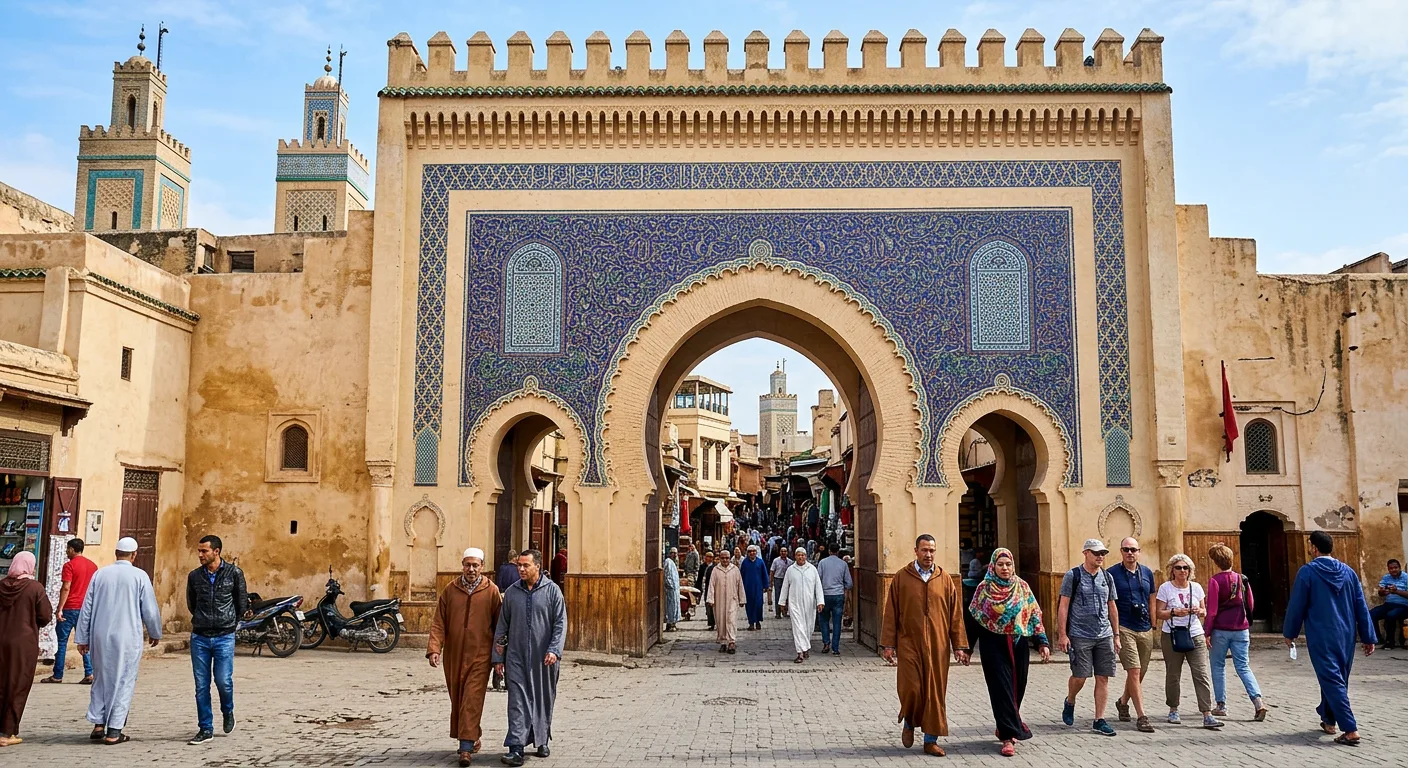
For most first-timers, honestly, a little — and that's normal. Fes el-Bali isn't a tidy old quarter you stroll through in an afternoon; it's a complete, working medieval city that has never paused to become a museum. Step through the blue gate at Bab Boujloud and the senses get a lot at once: the calls of traders and the clatter of metalworkers, the smell of mint, cedar, fresh bread and — somewhere near — the tanneries, lanes that narrow to shoulder width then open onto a tiled courtyard, and the occasional laden donkey or handcart that everyone presses against the wall to let pass.
Layered on top is the human attention: a steady stream of people offering to show you the way, or telling you the route ahead is closed. None of it is dangerous, but together it can feel like a wall of input. The shift most travellers make within a day is to stop trying to mentally map every turn and simply move with the flow. Once you accept that you'll wander, that you'll double back, and that the city will still spit you out near a gate when you want it to, the overwhelm settles into something closer to delight.
Why you'll probably get lost (and why that's fine)
You will likely get lost, and so does almost everyone — including return visitors. There's no grid, almost no street signage, and the lanes twist, fork and dead-end constantly; the city was built for people who already knew it by heart, not for the casual visitor with a map. Your phone won't fully rescue you either: the tall walls and covered passages block and bounce the GPS signal, so the blue dot jumps, drifts or freezes just when you need it.
The reassuring truth is that getting genuinely stuck is close to impossible. The whole medina is ringed by gates, the main lanes funnel crowds toward them, and a quick question to any shopkeeper gets you pointed to a landmark within a minute. Treat the wandering as the gift it is — the doorway-and-shadow corners, the bakery where neighbours queue with unbaked loaves, the workshops you'd never have routed yourself toward. For the deeper layout, the monuments and how the circuit fits together, our walking the Fes medina guide is the companion piece to this one.
How not to get lost: the anchors that work
Don't try to memorise turns — you can't, and it only fuels the panic. Instead, anchor yourself to a few big, fixed things. These are the same reference points locals use, and together they let you wander freely and still find your way home.
The gates (babs) are your edges. The medina is ringed by named gates. Learn three — Bab Boujloud (the blue gate at the western edge), Bab Rcif (down by the river) and Bab Guissa (to the north) — and treat them as your exits. Ask anyone for the nearest bab and you'll be pointed there within a minute.
Follow the main spine. Two main lanes thread through the heart of Fes el-Bali: Talaa Kebira (the larger, busier one) and Talaa Seghira (its quieter twin). They carry most of the foot traffic and the souks. When you feel lost, work your way back to one of them and the city starts to make sense again.
Downhill leads to the river. The old city slopes, and that's a free compass. Heading consistently downhill generally brings you toward Bab Rcif and the Oued Fes; climbing takes you back up toward Bab Boujloud and the western heights. When disoriented, pick a direction by gradient rather than guesswork.
Use minarets and monuments as fixed points. The green-tiled minaret of the Qarawiyyin, the Bou Inania medersa, the Nejjarine fountain — the big monuments don't move, and locals navigate by them too. A few minutes on a museum or riad rooftop gives you an aerial read of the medina that no street-level photo can.
An offline map and a saved riad pin. Download an offline map before you arrive, because live GPS is patchy among the high walls. Drop a pin on your riad's exact location, photograph its door, note the closest gate, and save the riad's phone or WhatsApp number — that combination gets you home even when the blue dot is sulking.
When in doubt, ask. Shopkeepers and stallholders give directions all day and are generally happy to help. If a child or a passer-by walks you the last stretch, a small tip is the polite norm. Be wary, though, of strangers who insist a route is 'closed' or steer you elsewhere — that's usually the start of a sales detour.
A calmer way to walk the medina
Beyond navigation, a few habits take the edge off the intensity itself:
- Go early. The first couple of hours after the medina wakes are calmer and cooler, the light is lovely, and the selling is gentler before the day's crowds build. It's the easiest time to find your feet.
- Pace yourself and pause. Sit for a mint tea on a terrace, watch the lanes from above, then dive back in. The medina is far more enjoyable in unhurried bursts than as a forced march from sight to sight.
- Handle the touts kindly but firmly. A warm "no thank you" — or "no thank you, I have a guide meeting me" — usually ends the approach. Don't follow anyone who insists a route is closed and offers an alternative; that's the classic start of an unwanted detour.
- Keep your essentials close. Bag in front of you in the busiest stretches, valuables low-key, and your riad's details saved. With the worry of logistics handled, you can actually look up and enjoy the place.
Should you just take a guide?
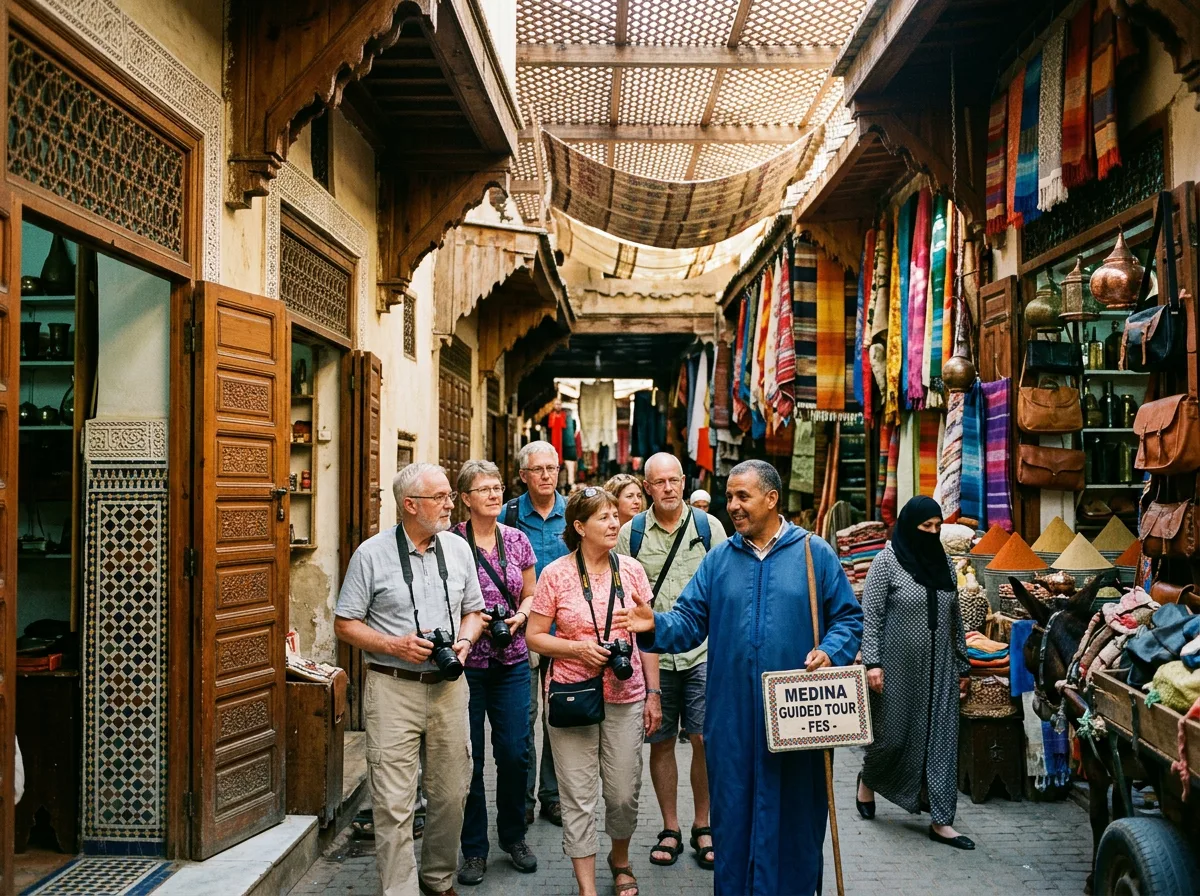
If the overwhelm is the worry, the simplest answer is yes — at least for your first day. A licensed local guide is the fastest way to understand the layout, see inside the medersas and reach the tannery terraces, and it lifts the pressure of constant directions and sales attention off you entirely. A popular approach is to take a guide on day one to build a mental map, then explore solo on day two with your offline map and newfound bearings. Insist on a guide licensed by the tourism authority — they carry an official badge — and agree the plan before you set off. Our honest take on whether you need a guide for the Fes medina weighs both sides.
We arrange exactly this. Our guided Fes el-Bali medina & tanneries day puts a licensed Fassi guide alongside you for the gates, the medersas, the Qarawiyyin quarter and the Chouara tannery from a private terrace — you can read the full plan on the medina & tanneries tour page or browse all our Fes tours. If you'd rather plan the tannery visit yourself, see the best way to see the Chouara tannery.
How long do you need, and where to base yourself
Give the medina time and it stops feeling overwhelming. Two days in Fes is the comfortable amount most travellers want — one focused day for the essentials and a second to slow down and get pleasantly lost; our how many days in Fes guide lays out the options. Where you sleep shapes the whole experience too: a riad inside Fes el-Bali means stepping straight into the lanes (and a porter walking your bags from the nearest gate), while the Ville Nouvelle gives you a calmer, car-to-the-door base a short taxi from the old city. Weigh both in our where to stay in Fes neighbourhood guide and the medina vs Ville Nouvelle comparison. And for getting between the gates, the station and the new town, our getting around Fes guide covers the petit taxis and the car-free reality.
Frequently asked
Is the Fes medina overwhelming?
For most first-time visitors, yes, at least for the first hour or two — and that's completely normal. Fes el-Bali is the world's largest car-free medieval city, a dense maze of thousands of unsigned lanes, and the senses get a lot at once: the calls of traders, the smell of the tanneries and spice stalls, narrow lanes that suddenly open onto a courtyard, the occasional laden donkey squeezing past, and a steady stream of people offering to show you the way. The intensity is also the point — it's a living medieval city, not a museum. Once you stop trying to mentally map every turn and accept the flow, the overwhelm usually settles into wonder within a day.
Is it easy to get lost in the Fes medina?
Yes — and almost everyone does, including people who've visited before. There's no grid, almost no street signage, the lanes twist and fork constantly, and many simply dead-end. Phone GPS is unreliable too, because the tall walls and covered passages block and bounce the signal so your blue dot jumps or freezes. The reassuring part is that getting truly stuck is close to impossible: the medina is ringed by gates, the main lanes funnel crowds toward them, and any shopkeeper will point you to a landmark within a minute. Getting briefly lost in Fes is part of the experience, not a danger.
How do you avoid getting lost in the Fes medina?
Don't try to memorise turns — anchor yourself to a few big, fixed things instead. Learn the names of the main gates (Bab Boujloud, the blue gate at the western edge, plus Bab Rcif and Bab Guissa) and treat them as your exits. Follow the main spine, Talaa Kebira and its quieter twin Talaa Seghira, which run down through the heart of the old city. Remember that the medina slopes, so heading downhill generally leads you toward Bab Rcif and the river. Download an offline map before you go, save your riad's exact location as a pin, photograph its door and note the nearest gate, and keep its phone or WhatsApp number handy. With those anchors you can wander freely and still find your way back.
Is the Fes medina safe to walk?
Generally yes — Fes is a deeply traditional city used to visitors, and violent crime against tourists is rare. The main friction isn't danger but the steady attention from unofficial 'guides' and the ease of getting lost. By day the busy main arteries around Talaa Kebira and the Blue Gate are fine for most walkers; the deep, quiet residential back lanes are where people get disoriented, and they're best avoided alone after dark. Keep your bag in front of you in the most crowded stretches, keep valuables low-key, and arrange transport to the nearest gate at night rather than threading dark alleys on foot.
Do you need a guide to walk the Fes medina?
It isn't required, but for a first visit a licensed local guide makes an enormous difference — it's the fastest way to understand the layout, see inside the medersas and reach the tannery terraces, and it lifts the pressure of constant directions and sales attention off your shoulders. A common approach is to take a licensed guide for the first day to get your bearings, then explore solo on a second day with an offline map and the mental picture the guide gave you. Insist on a guide licensed by the tourism authority (they carry an official badge) and agree the plan before you set off.
How many days do you need for the Fes medina?
Two days in Fes is the comfortable amount most travellers want: one focused day to cover the essentials of the medina — the Chouara tannery, the Bou Inania and Al-Attarine medersas, the surrounds of the Qarawiyyin and the Bab Boujloud gate — and a second to slow down, get pleasantly lost, and perhaps add a cookery class or a quieter quarter. If you only have one full day, take a guide so you don't lose half of it backtracking. Our how-many-days-in-Fes guide breaks the options down in detail.
Nervous about the medina?
We'll turn the maze into the best day of your trip.
Tell us your dates and how you like to travel, and we'll pair you with a licensed Fassi guide for your first day, arrange a riad with a porter to meet you at the gate, and shape the rest of the medina around your pace — no getting lost, no hard sell.