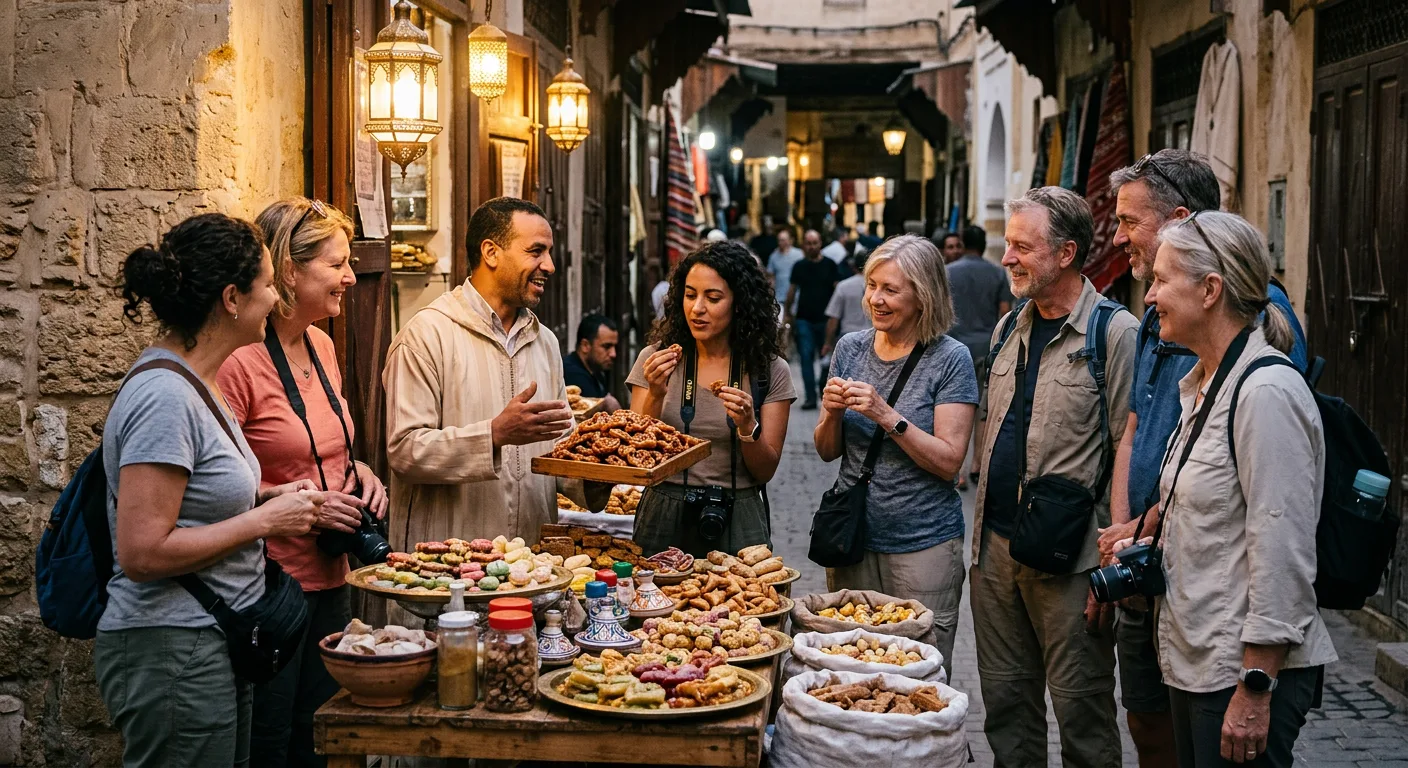
Here is the direct answer. You do not need a guide to enter the Fes medina — it is free to walk and open to all — but for a first visit we strongly recommend hiring a licensed guide for at least a half-day. Fes el-Bali is the world's largest car-free urban area, a living 9th-century city threaded through roughly 9,000 lanes with almost no signage and few landmarks beyond the minarets. A good guide converts that beautiful chaos into a coherent walk, opens doors you would never find, and absorbs the steady attention of unofficial touts. If you are a confident, unhurried traveller — or returning to Fes — you can absolutely explore alone, and many people relish it.
Hire a guide if
- It is your first time in Fes el-Bali
- You want the history and context, not just the photos
- You hope to see working ateliers and private courtyards
- You have limited time and want the essentials in order
- Persistent street sales attention would spoil your day
You can skip one if
- You have visited the medina before
- Getting pleasantly lost is exactly what you want
- You are comfortable with offline maps and asking directions
- You are on a tight budget and travelling slowly
- You are happy to field the sales pitches yourself
What a guide actually does in Fes
The value of a Fes guide is not that you would otherwise be unsafe — Fes el-Bali is generally safe to walk. It is that the medina was built for people who already knew it by heart, and a guide supplies that missing knowledge. In practice a good licensed guide does four things at once:
Routes the day logically. The highlights — the Chouara tanneries, the Bou Inania and Al-Attarine medersas, the surrounds of the Qarawiyyin, the Nejjarine fountain — are scattered across the maze. A guide links them into one walk so you are not doubling back for hours.
Opens doors. Coppersmiths, weavers, tanners, the family-run fondouks — much of the real Fes happens behind unmarked doorways. A guide who is known in the trades gets you a welcome rather than a closed door, and explains what you are watching.
Deflects the touts. The faux-guides who offer to walk you somewhere melt away once they see you already have a guide. That alone changes the texture of the day.
Takes the pressure off shopping. A licensed guide is paid by you, not by commission, so there is no obligation to buy. You can look at the leather, the zellige and the carpets, decline the tea politely, and move on.
Licensed guide vs faux-guide — how to tell the difference
This is the part that matters most. A licensed guide carries an official badge issued by Morocco's Ministry of Tourism, has trained in the city's history, and is paid for their time. A faux-guide — the friendly 'student' who tells you the way you are heading is closed, or that the tanneries are this way — earns nothing from you and everything from the shops he steers you into. The reliable way to avoid the problem entirely is to book your guide in advance through your riad or a tour operator, and to politely decline anyone who offers their services in the street. If in doubt, ask to see the badge.
One classic set-up worth knowing: a stranger insists your route is blocked or the medersa is shut for prayers and offers to lead you around it. Treat unsolicited 'help' with friendly scepticism — a warm, firm "no thank you, I have a guide meeting me" usually ends it.
What a guide costs in Fes
As a rough, current-ish guide, expect to pay around US$60–100 for a full day and US$40–60 for a half-day with a licensed private guide, depending on how much ground you cover and whether they open private ateliers for you. Prices move with the season and the exchange rate, so always confirm the rate and exactly what it includes before you set off. Museum and medersa entry fees are usually separate, and a tip for a genuinely good day is appreciated though never obligatory. Booking through your riad or an operator typically costs a little more than haggling one on the street, but you get a vetted, licensed guide and a fixed price — which is the whole point.
Navigating Fes el-Bali without a guide
If you decide to go it alone, you will be fine — getting truly stuck in Fes is close to impossible. A few things make it easier. Download an offline map before you go; GPS is imperfect in the deepest lanes but good enough to keep your bearings. Learn the main gates as anchors — Bab Boujloud (the blue gate) to the west, Bab Rcif in the middle near the river, Bab Guissa to the north — and you can always ask a shopkeeper to point you toward one. Walk the spine, Talaa Kebira, downhill and you will pass many of the headline sights. And listen for the call of "balak!" — it means a loaded mule or handcart is coming through, so step aside.
The honest trade-off of going alone is more backtracking, more sales attention, and the artisan doors that tend to stay shut. The honest reward is the version of Fes that no itinerary routes you toward — the quieter Andalusian quarter across the river, the neighbourhood bakeries, the doorway-and-shadow views. Many travellers split the difference: a structured guided morning, then a free afternoon to wander. For the full on-foot orientation, see our practical Fes medina guide and how to get around Fes.
Our recommendation
For a first visit, take a licensed guide for one structured half-day or day, then explore on your own for the rest of your stay. You get the orientation, the context and the open doors when you most need them, without feeling chaperoned for your whole trip. Every Fes itinerary we arrange builds in a licensed guide for exactly this reason — and we are happy to set one up even if you are otherwise travelling independently. You can also browse things to do in the medina to decide what you most want a guide to unlock.
Frequently asked
Do you need a guide for the Fes medina?
You do not legally need one, but for a first visit to Fes el-Bali a licensed guide is strongly recommended. The medina is the world's largest car-free urban area, threaded through roughly 9,000 unsigned lanes, many of them dead ends. A guide turns a disorienting maze into a logical circuit, opens doors to working ateliers and family courtyards, and deflects the persistent unofficial 'guides' so you can actually look around. Returning visitors and confident, slow travellers can absolutely explore alone.
How much does a licensed guide in Fes cost?
As a rough guide, budget around US$60–100 for a full day and US$40–60 for a half-day with a licensed private guide, depending on how much ground you cover and whether they open private ateliers. Prices move, so always confirm the rate and exactly what it covers before you start. Tips are appreciated but not obligatory. Entry fees to museums and medersas are usually separate.
What is the difference between a licensed guide and a faux-guide?
A licensed guide carries an official badge issued by Morocco's Ministry of Tourism, has trained in the city's history and is paid by you for their time. A faux-guide (the unofficial 'student' or 'helper' who attaches himself in the lanes) earns nothing from you directly and everything from shop commissions, which is why he steers you toward stores rather than sights. Ask to see the badge, and book your guide in advance through your riad or tour operator rather than accepting one on the street.
Can you explore Fes el-Bali without a guide?
Yes. Getting lost in Fes is part of the experience and getting truly stuck is almost impossible — ask anyone for Bab Boujloud, Bab Rcif or the Qarawiyyin and you will be pointed out within minutes, and offline map apps work surprisingly well between the highest minarets. The trade-off is that you will spend more time backtracking, you will field more sales attention, and the closed doors of the artisan workshops tend to stay closed.
How long should you hire a guide for in Fes?
Most visitors take a guide for a single structured half-day or full day covering the essentials — the Chouara tanneries, the Bou Inania and Al-Attarine medersas, the surrounds of the Qarawiyyin and the artisan lanes — then explore on their own afterwards. That gives you the orientation and the context without feeling chaperoned for your whole stay.
Is it safe to walk the Fes medina alone?
Fes el-Bali is generally safe to walk by day, including for solo and women travellers. The main friction is sales pressure and faux-guides rather than crime. Keep your bag in front of you on the busiest stretches near Talaa Kebira and the Attarine, stay aware after dark when the lanes empty, and a warm but firm 'no thank you' is your most useful phrase.
Do you need a guide for the tanneries?
No, but it helps. The Chouara tanneries are viewed from the terraces of the leather shops ringing the pits; you can walk up to one yourself and you will usually be handed a sprig of mint for the smell. A guide simply smooths the visit, times it for the morning light when the vats are fullest, and takes the pressure off the expectation to buy.
Want the medina, the right way
We'll line up a licensed Fes guide for you.
Tell us your dates and we will arrange a licensed guide, a logical medina circuit and a riad chosen for the quality of its restoration — whether you are on a full programme or travelling independently.
Request a Fes guide