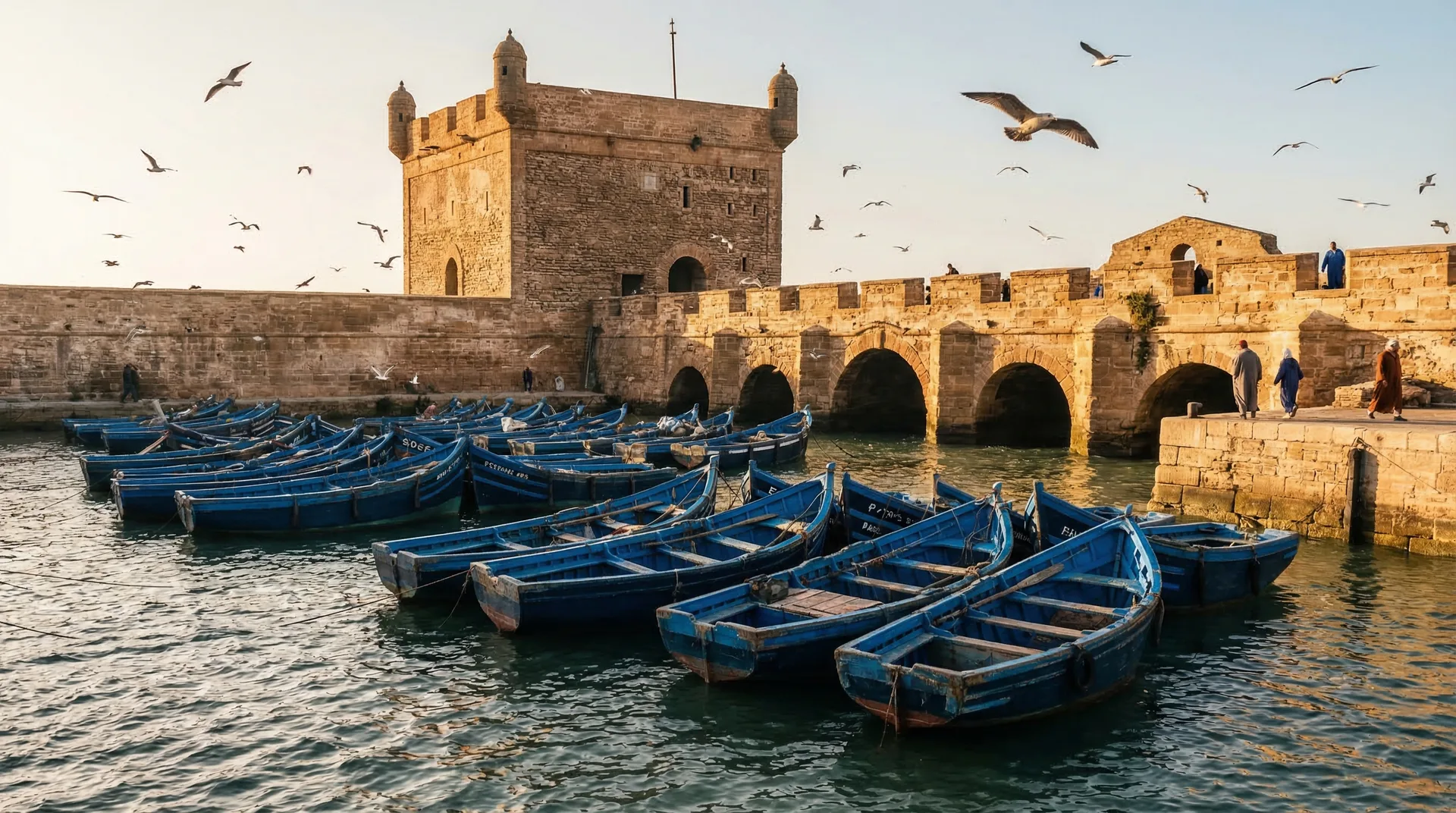
Essaouira was built to face the Atlantic. Its 18th-century ramparts drop sheer into the ocean; the wind — the Alizé — blows almost without pause from the north, keeping the city cool and the kite-surfers aloft. Where Fes is all enclosed lanes, brass and woodsmoke, Essaouira is open horizon and salt air — the perfect coastal release after the density of an imperial-city medina. The old town here is smaller, quieter and painted in a more bleached register: whitewash, blue woodwork, the grey of the Skala bastions.
The ramparts and the Skala de la Ville
The sea ramparts — the Skala de la Ville — are the defining structure of Essaouira and the right place to head once your bags are down. The platform runs along the northern wall, cannon still trained seaward, with views south down the long beach and north to the rocky coast. At sunset the light on the water is extraordinary, and Gnaoua musicians sometimes set up here in the early evening with guembri and qraqeb. Walk the full length to the harbour platform and loop back through the medina — about forty minutes for the two-kilometre circuit, and it hands you the shape of the whole town.
The port and the fish market
The working fishing harbour sits just south of the ramparts. Mornings, blue-hulled wooden boats land the night's catch: sea bass, bream, sole, cuttlefish, the occasional lobster. The harbour-side stalls will grill whatever you point to — one of the best meals in Essaouira, and under 80 MAD. The gulls are many and bold, so eat briskly.
Beside the harbour, a small boatyard builds and mends the traditional wooden craft in a workshop open to the street. The craftsmen are worth twenty minutes of watching — for a traveller fresh from the brass-beaters and tanners of Fes, it reads as the coastal cousin of the same hand-trade instinct, and one of the few working boat-building traditions left on Morocco's Atlantic.
The beach: wind, kites and long walks
The south beach runs for 20 km. The northern stretch beside the medina is the liveliest: horse and camel rides, kitesurfers launching in the shallows, football on the packed sand at low tide. Walk thirty minutes south and it empties out almost entirely. Several IKO-certified kitesurfing schools work the main beach; a two-hour introduction runs US$60–80 with equipment, and windsurfing hire is available too. The activity extensions we build into Essaouira programmes are always tailored to the wind forecast for your dates.
Gnaoua: the music of Essaouira
Gnaoua music grows out of the sub-Saharan African communities who arrived in Morocco from the 16th century onward. Its instruments — the three-stringed guembri bass lute, the metal castanets called qraqeb, and layered call-and-response voices — make something hypnotic and rhythmically dense. Essaouira is the spiritual home of the tradition, and every June the city hosts the Gnaoua World Music Festival, drawing over 400,000 people to free outdoor stages strung across the medina.
Outside the festival, Gnaoua groups play most evenings in the Djemaa Moulay Hassan, the main square. Sit, order a tea and listen — no ticket needed.
The medina: slower souks
Essaouira's medina is smaller and far less pressured than Marrakech's — and where Fes trades in brass, leather and zellige, the artisan quarter here works thuya: a dense, fragrant burl found along the Moroccan Atlantic, cut into boxes, frames and marquetry with extraordinary precision. These are no cheap imports; they are made in the workshops behind the stalls and are worth buying. The silversmith lanes on Rue Laalouj are excellent too — Essaouira's Jewish community long dominated the silver trade here, and the craft endures.
Near the Bab Doukkala gate, a women's cooperative sells cold-pressed argan oil — culinary and cosmetic — with certified provenance from the surrounding biosphere reserve. This is the place to buy it.
Where to stay
Stay inside the medina in a riad turned either to the ocean or to an interior courtyard. The best-restored houses here keep thick walls and tiled floors, without the fuss that can creep into Marrakech riads chasing the luxury market. We keep a shortlist with honest notes on what each one suits — a couple after romance, a family with children, guests who want the view above all. Ask us as you plan the trip through our Essaouira destination page.
A quick word on the wind: the Alizé is real and relentless. Ocean-facing rooms catch the sound and, now and then, a salt chill. Light sleeper, or run cold? Ask for a courtyard room. The wind is not a fault — it is the city's character — but it pays to be ready for it.
Getting there and when to go
By private vehicle from Marrakech it is two and a half hours on the A7 motorway and then the coast road. We always use a licensed driver who knows the route and can pull in at the argan cooperative on the way. March to May and September to November are ideal: mild temperatures, thinner crowds, and the wind at a workable rather than ferocious pitch. The Gnaoua Festival in June packs the town — book accommodation months ahead if you mean to attend. Summer (July–August) is busy and very windy; December to February is quieter and, on the Atlantic, surprisingly mild against the interior — a gentler season than the same months in Fes.
Frequently asked
How do you reach Essaouira, and where does it sit relative to Fes?
Essaouira is 188 km west of Marrakech — about two and a half hours by private vehicle on the A7 motorway and then the coastal road. Supratours buses run a regular timetable from Marrakech's Bab Doukkala station in around three hours. From Fes it is a longer haul, so most travellers reach the coast by pairing Essaouira with their Marrakech leg rather than driving straight across the country. Flights are not worthwhile over such a short distance.
Is Essaouira good for kite surfing and windsurfing?
Yes — Essaouira's steady Atlantic trade winds (known locally as the Alizé) make it one of the most dependable kitesurfing and windsurfing spots in Africa. The long south beach offers prime conditions from March to October. Several IKO- and RYA-certified schools work the beach, with both equipment hire and lessons available.
What is Gnaoua music?
Gnaoua (also written Gnawa) is a Moroccan musical and spiritual tradition rooted in the sub-Saharan African communities brought to Morocco as enslaved people from the 16th century onward. It runs on the guembri (a three-stringed bass lute), metal castanets (qraqeb) and call-and-response chant. The Gnaoua World Music Festival in Essaouira, held each June, is one of the great outdoor music events in Africa.
What are the best riads in Essaouira?
Essaouira has a strong riad culture, though more intimate in scale than Marrakech and gentler than the towering houses of Fes el-Bali. The medina is compact and entirely walkable. We work with a shortlist of restored riads where the original Arabo-Andalusian architecture has been kept rather than papered over. Ask us when you enquire — the right house shifts with the season and your group size.
Is Essaouira safe for solo travellers?
Essaouira is notably relaxed — calmer than Marrakech and easier to read than the dense lanes of Fes. The medina is small and well-lit at night, locals are used to international visitors, and the tout pressure is minimal. Solo travellers, women included, consistently report feeling comfortable. The beach after dark calls for the usual urban caution.
What is argan oil and can you buy it in Essaouira?
Argan oil is pressed from the fruit of the argan tree (Argania spinosa), which grows almost exclusively in the Souss-Massa region of southwest Morocco. It is used both culinarily (a rich, nutty flavour excellent on bread or couscous) and cosmetically. The area around Essaouira is within the UNESCO-listed argan biosphere. Buy from a women's cooperative for guaranteed provenance and fair pricing — several operate near the medina.
Essaouira calls
Add a weekend on the Atlantic to your imperial-cities itinerary.
We thread Essaouira cleanly into longer programmes built around Fes and the imperial cities — private transport from Marrakech, a handpicked riad, a harbour lunch and a Gnaoua evening. Two nights is our minimum; three lets you breathe.
Plan your Essaouira stay