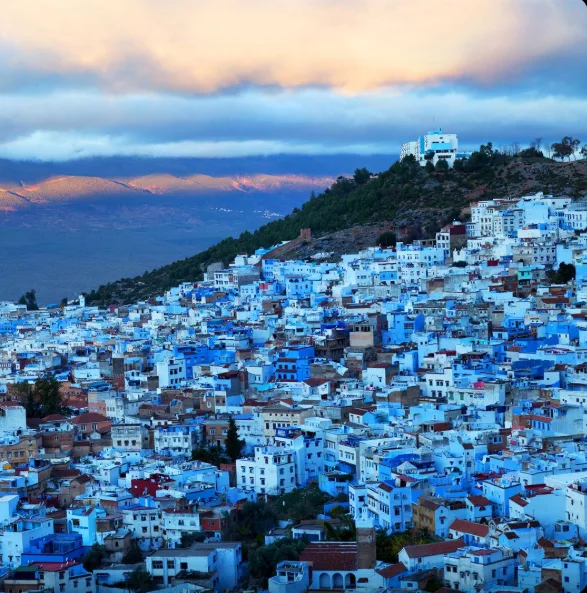
Chefchaouen sits at 600 metres in the Rif Mountains of northern Morocco, roughly four hours up from Fès and an hour from Tetouan — which makes it the most natural overnight escape from the imperial city. It is the most photographed town in the country, and one of the most misread. Travellers who arrive expecting a stage set find something better: a working mountain town with its own culture, a cooler climate, exceptional goat cheese, and streets every bit as blue as the photographs promised.
Why is Chefchaouen painted blue?
The blue-and-white of the medina has at least three competing origin stories, and all are probably partly true. The best-documented is Sephardic: when Jewish refugees expelled from Spain in 1492 settled here, they brought the habit of painting thresholds and shared walls in tekhelet — a blue tied in Jewish tradition to heaven and divine protection. The colour also repels mosquitoes, which likely helped it spread.
The Muslim population took up the practice over later generations, and it is now guarded as a piece of civic identity — the municipality holds the palette steady, and householders who repaint in unsanctioned colours are asked to put it right. Walk the lanes and you notice the blue is never uniform: cobalt here, periwinkle there, almost violet elsewhere, shifting with the pigment and the seasons of mountain weather each wall has soaked up. That variation is half the beauty.
What is there to do in Chefchaouen beyond photography?
The medina is compact — walkable in forty minutes — but it pays to go slowly. Start at Plaza Uta el-Hammam, the central square, anchored at its northern end by the fifteenth-century Kasbah and its hexagonal minaret. The Kasbah museum inside traces the town's Andalusian heritage through ceramics, weapons and textiles, and is worth half an hour.
From the square, head east toward Ras el-Maa, the mountain spring where women still wash wool in the cold rushing water. This is a working corner of town, not an attraction, and the ten-minute walk leads you through steadily more local lanes as the tour groups thin. The fall itself is modest, but the setting — blue-washed walls against the forested hillside — is superb.
The Spanish mosque on the hill above the medina (a twenty-minute climb from Plaza Uta el-Hammam) holds the finest panorama of the blue rooftops set against the Rif. Non-Muslims cannot enter, but the terrace outside is open, and sunrise from here — the town still hushed, the light raking the rooftops — is among the most memorable mornings Morocco hands you.
The morning market near the grand mosque sells Rif produce: fresh goat cheese (jben) in rush baskets, dried figs, wild thyme and oregano, hand-spun wool, and cannabis resin (openly traded in the northern Rif, legally grey for foreigners — use your judgement).
Day trip or overnight: which is better?
A day trip from Fès is workable — four hours each way, three or four hours in town — but it lands you in Chefchaouen at its busiest, between 11am and 4pm. The blue lanes are lovely at that hour; you will just be photographing them shoulder to shoulder with everyone else doing the same.
One night flips it. By 6pm the day coaches have gone and the medina drops back into its own rhythm: locals dragging chairs into the square, the call to prayer ringing off the blue walls, the mountain air notably cooler than the Fes you left that morning. Dawn — especially in spring and autumn — gives soft, warm light before the tour groups arrive. For anyone who wants to photograph seriously, or simply exhale after the intensity of Fes, two nights is our standing recommendation.
How do you get to Chefchaouen?
From Fès: four hours by private car via the N13; five to six by CTM bus, with two to three departures a day from the Fès bus station. This is the natural pairing — Fès and Chefchaouen balance each other beautifully, the artisan medina answered by the mountain calm.
From Tangier: two to three hours by private car; Tangier Med port is an efficient way in for travellers crossing from Spain. The Tangier–Chefchaouen–Fès run is a classic northern loop.
From Marrakech: six to eight hours by private car, which makes Chefchaouen a stop on a wider circuit (Marrakech — Fès — Chefchaouen — Tangier) rather than a day trip from the south. No direct train reaches the town; the nearest railheads are Meknès (three hours) and Tangier (two and a half).
See our destinations guide and private tours for itineraries that include Chefchaouen as part of a northern Morocco circuit.
What are the best photography spots in Chefchaouen?
- Rue Targhi — the signature lane of the blue quarter, its staircase best shot from below. Aim for 8–9am or 5–6pm.
- Plaza Uta el-Hammam at dusk — café lights warming the blue walls; bring a wide-angle lens.
- The Spanish mosque terrace at sunrise — the one window when the panorama is largely yours alone.
- Ras el-Maa — women washing wool against blue walls and fast water; shoot respectfully and ask before framing anyone close-up.
- The lanes north of the Kasbah — quieter than the central quarter, with older, more faded blue that feels genuinely lived-in.
Frequently asked
Why is Chefchaouen painted blue?
Several explanations sit side by side. The most historically grounded is that the blue-and-white palette was brought and reinforced by Sephardic Jewish refugees who settled here after the 1492 expulsion from Spain — blue carried spiritual weight in Jewish tradition. A second, more practical account credits the colour with repelling mosquitoes. The habit spread to the wider Muslim population over generations and is now a point of civic pride held in place by local ordinance.
Is Chefchaouen worth visiting, or is it just a photo opportunity?
It is a real mountain town with a living community, a working wool and leather market, old mosques, and an Andalusian-Moroccan character quite unlike Fès or Marrakech. The photo draw is genuine, but so is the substance — and the contrast with the brass-and-leather density of Fes makes the Rif's blue calm land all the harder. A night or two lets you have the medina after the day-trippers leave: quieter, cooler, more itself.
How do you get to Chefchaouen from Fès?
From Fès, Chefchaouen is about four hours by private car or five to six by CTM bus — close enough to be an easy overnight add-on to a Fès itinerary, which is exactly how most of our travellers fold it in. From Marrakech it is six to eight hours by private car, better treated as one leg of a northern circuit through Fès and Tangier. No train reaches the town directly; the nearest stations are Meknès and Tangier.
Is a day trip to Chefchaouen from Fès enough?
A day trip works but rushes you — out of Fes early, into the medina around midday at its busiest, back on the road by late afternoon. An overnight changes the texture entirely: the blue streets at dusk and dawn, free of the tour groups, are a different town. For a relaxed visit out of Fes we suggest two nights.
What is the best time of year to visit Chefchaouen?
Spring (March–May) and autumn (September–November) bring the kindest temperatures — 18–24°C by day — and the clearest light for photographs. Summer fills with Moroccan visitors escaping the coastal heat, and the town gets crowded in July and August. Winter can be cold and sometimes snowy, beautiful but worth packing warm layers for.
What should you not miss in Chefchaouen?
The blue quarter around Plaza Uta el-Hammam is the obvious heart of it. Beyond that: the Spanish mosque on the hill above town holds the most photographed panorama of the blue rooftops, best at sunrise. The Ras el-Maa spring at the eastern edge of the medina is a local gathering point and worth the ten-minute walk. The morning wool and goat-cheese market near the grand mosque is genuinely local, not staged.
Northern Morocco circuits from Fes
We build Chefchaouen into a Fes itinerary that makes sense.
Fès, Chefchaouen, Tangier — or a full northern loop out of the imperial city. Private car, curated guesthouses, early starts. Tell us what you are after.
Request an itinerary