Few cities reward a camera like Fes. Within the walls of Fes el-Bali you have craft, architecture, portraiture and raking medina light stacked into a few square kilometres of unbroken medieval fabric — and the imperial-cities circuit out from Fes adds Roman Volubilis, the holy town of Moulay Idriss, the Sahara and the blue Rif within a single trip. What it asks of you is timing, a little knowledge and real cultural sensitivity. This is our guide, written from years of walking these lanes with guests and photographers.
Fes el-Bali — the tanneries, the medersas and the rooftops
Fes el-Bali is arguably the most intact medieval city on earth. Its thousands of lanes are narrow and dark through the middle of the day, then brilliant in the low morning and late-afternoon light that rakes between the walls — the hours to be out with a camera. The Bou Inania and Al-Attarine medersas, the finest of the Marinid colleges, hold courtyards of carved cedar, sculpted stucco and zellige tile that photograph magnificently when the interior light is right (mid-morning in winter, earlier in summer). Entry is straightforward and a small fee applies.
The Chouara tanneries — the ancient dyeing pits seen from the leather terraces above — are the single most reproduced image of Fes, and they earn it. The stone vats sit like a painter's palette, filled with natural dye: saffron yellow, poppy red, indigo blue, mint green. Shoot mid-morning, when the men are working and the colours are freshest, and bring a 70–200mm to frame the grid of vats without distortion. The shopkeepers will hand you a sprig of fresh mint to soften the smell of the tanning agents.
For the wide view, climb to a medina rooftop terrace at first light, when the minarets and green-tiled roofs catch the sun before the lanes below do. Then walk down to Bab Bou Jeloud, the blue-and-green keyhole gate, and use its arch to frame the minarets of the Bou Inania beyond — the classic establishing shot of the old city.
Volubilis, Meknes and Moulay Idriss — the day trip from Fes
An hour west of Fes, the Roman ruins of Volubilis give you standing columns, mosaic floors and the Tingis arch against open farmland — best in late afternoon, when the stone warms and the hills behind soften. Pair it with the white hillside town of Moulay Idriss, draped over two outcrops, and the monumental Bab Mansour gate at Meknes. A wide-angle captures the scale of Volubilis; a short telephoto isolates the town's tumbling rooftops.
The Sahara — Erg Chebbi and Erg Chigaga
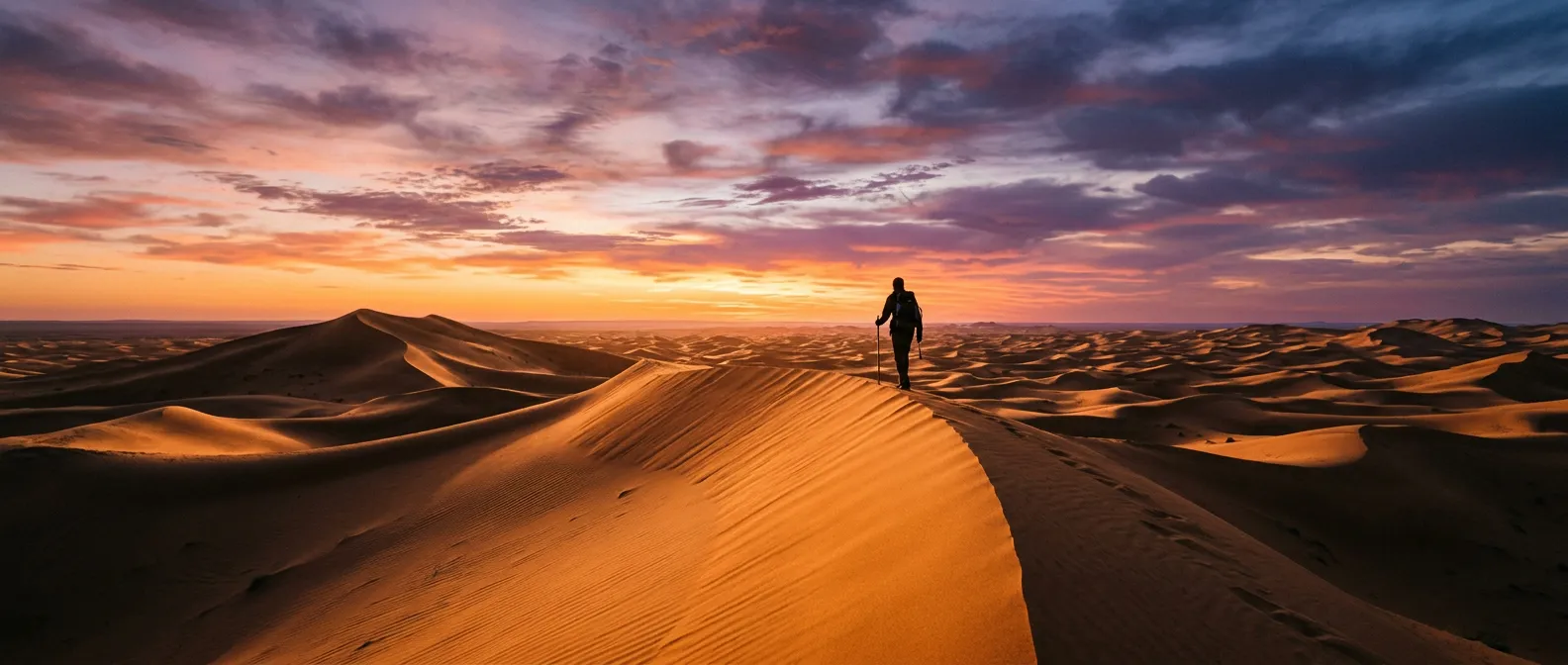
Many Fes-based itineraries run south to the dunes, and they are the country's most dramatic landscape. Erg Chebbi near Merzouga — around five to six hours from Fes via Midelt and Errachidia — rises to 150 metres and shifts from gold to deep amber to near violet across a single sunset. The logic is simple: arrive the afternoon before, ride into the dunes in the late light, and be on a high ridge by 5:30am the next morning.
Sunrise light in the Sahara is exceptional — low, warm and raking across the rippled sand to produce the shadow-and-highlight texture that makes dune photography work. A 24–70mm holds the broad landscape; a 70–200mm isolates a single ridge with compressed perspective. In the hour after dawn the sky is often entirely clear, an extraordinary blue against the orange sand.
Erg Chigaga, further south near M'hamid, is more remote and far less visited. It takes a 4×4 or an overnight camel trek to reach, but rewards with genuine solitude — hours of dunes with no other camp in sight.
Chefchaouen — the blue medina
Roughly three to four hours north of Fes, the blue city of the Rif is Morocco's most-searched photography destination — and its most crowded, busiest between 10am and 4pm. The fix is to stay overnight and work at dawn and dusk. The Rue Targhi staircase, the town's most iconic lane, is essentially empty at 7am and glorious in the warm, flat light before the sun clears the valley walls. The Spanish mosque terrace above the medina, a twenty-minute uphill walk, gives the wide panorama over the blue rooftops — best at sunrise, before the groups arrive.
For a more considered approach to Chefchaouen, see our dedicated Chefchaouen guide.
The Draa Valley, kasbahs and the road south
If your trip continues beyond the dunes, the Draa Valley and the road toward Ouarzazate form a landscape photographer's corridor of pink-red earth, palmeries and earthen kasbahs. The Aït Benhaddou ksar — a Unesco World Heritage site thirty minutes west of Ouarzazate — is a cluster of fortified earthen towers (a ksar is a fortified village) that looks most dramatic in the late afternoon, when the mud walls glow against the declining sun.
Continuing south, the Draa Valley palmeries stretch for nearly 200 kilometres — date palms, irrigated gardens (the seguia irrigation canals are Berber engineering from the eleventh century), and earth-built villages in amber and ochre. Stop at the Kasbah Tamnougalt and the Agdz palmery. A 24mm wide-angle captures the scale; a telephoto brings in the palm frond texture against the sky.
The High Atlas — Imlil, Ouirgane and the Toubkal region
Trips that extend toward the south reach the most classical mountain landscape in Morocco. The Imlil valley has green-terraced fields and flat-roofed Amazigh villages against a 4,000-metre rock backdrop that defines the Moroccan mountain aesthetic. Spring brings cherry blossom to the lower villages (March–April); summer is green and crisp; winter brings snow above 2,000 metres. The approach road from Asni to Imlil offers numerous stopping points.
The Todra Gorge, east of the Atlas near Tinerhir, is a slot canyon where sheer 300-metre walls narrow to fifteen metres across. The light falls directly to the canyon floor for two to three hours around midday — the only time of day worth photographing here. The vertical orange rock and the small stream at the base are extraordinary with a wide-angle.
Photographing people: how to do it well and respectfully
The most compelling images in Fes involve people — coppersmiths at Place Seffarine, tanners at the pits, weavers and tile cutters at their benches, market traders in the souk. The rules are straightforward but worth stating explicitly:
- Always ask before photographing someone at close range. A gesture and eye contact communicates the question. Respect a refusal without negotiation or payment pressure.
- Engaging with a craftsman's work — asking about the process, buying something — almost always produces a natural willingness to be photographed. The transaction is social, not transactional.
- Street photography at medium distance (70–135mm) is standard and generally accepted. Pointing a wide-angle into someone's face is not.
- Show people their image on the camera screen. The reaction is almost always positive and often opens a longer conversation.
- In a few settings — performers and henna artists in busy squares, for instance — a small payment for a photograph is expected. This is understood and fair; agree a figure (10–20 MAD) in advance.
Our private guides can arrange workshop visits with artisans who have agreed to photography in advance — the difference in image quality from a relaxed, consenting subject is enormous. See our private guide services and photography-focused tours.
Frequently asked
What is the most photogenic place in Fes?
For most photographers the answer is the Chouara tanneries, shot from the leather-shop terraces that ring the dyeing pits — a natural grid of saffron, poppy and indigo vats unlike anything else in Morocco. Close behind sit the carved courtyards of the Bou Inania and Al-Attarine medersas, the rooftops of Fes el-Bali at first light, and the great keyhole arch of Bab Bou Jeloud framing the minarets beyond it. Further afield, the Erg Chebbi dunes and the blue lanes of Chefchaouen are the country's other headline subjects.
What is the best time of year to photograph Fes and Morocco?
October to November and March to April give the most consistent, directional light, free of summer haze. In Fes the deep medina lanes hold shadow through the middle of the day all year, so plan tannery and rooftop work for mid-morning or late afternoon. Spring brings wildflowers to the hills around Volubilis and the Atlas; winter mornings are cold but exceptionally clear. Summer light is harsh between 10am and 4pm — shoot the medina early and rest the afternoon.
Is it acceptable to photograph people in Fes?
Always ask first, particularly for close portraits. Many Fassi residents — especially older artisans and women — prefer not to be photographed without consent. A gesture and a questioning look usually conveys the request, and a refusal should be respected without negotiation. In the artisan quarters, photographing a coppersmith, weaver or zellige cutter at work is generally welcomed, especially once you have shown genuine interest in the craft.
What camera gear should I bring to Fes and the imperial cities?
A versatile 24–70mm or 24–105mm covers nearly everything, from medersa courtyards to portraits in the souk. A wide-angle (16–24mm) handles tight interior architecture and the high dunes if your trip continues to the desert. A telephoto (70–200mm) frames the tannery vats cleanly from the terraces and keeps a respectful distance for candid street shots. A polarising filter helps in the Atlas. If the itinerary includes a desert leg, pack a small torch for the pre-dawn dune walk.
Can you photograph inside the Kairaouine mosque or other Fes mosques?
Non-Muslims may not enter the prayer halls of active mosques in Morocco, including the Kairaouine; the Hassan II Mosque in Casablanca is the one exception, with guided tours and photography in designated areas. In Fes the rewards are at the thresholds — you can glimpse the Kairaouine courtyard from its doorways, and the carved doors, minarets and zellige walls visible from the lanes are among the most compelling subjects in the city.
Where are the best places to photograph artisans in Fes?
The Chouara tanneries, seen from the leather terraces above, are the most famous. For brass and copper, the metalworkers around Place Seffarine hammer in the open; for tile, ask to visit a zellige workshop in the potters' quarter where craftsmen chisel each piece by hand; weavers and embroiderers work throughout Fes el-Bali. A guide can arrange a workshop visit in advance — an artisan who has agreed beforehand is far more relaxed and gives better photographs.
Photography itineraries
We build trips around the light, not the tourist schedule.
First light on the Fes rooftops, workshop access with the artisans, mid-morning at the tanneries, then the dunes at dawn — tell us your priorities and we design around them.
Request an itinerary