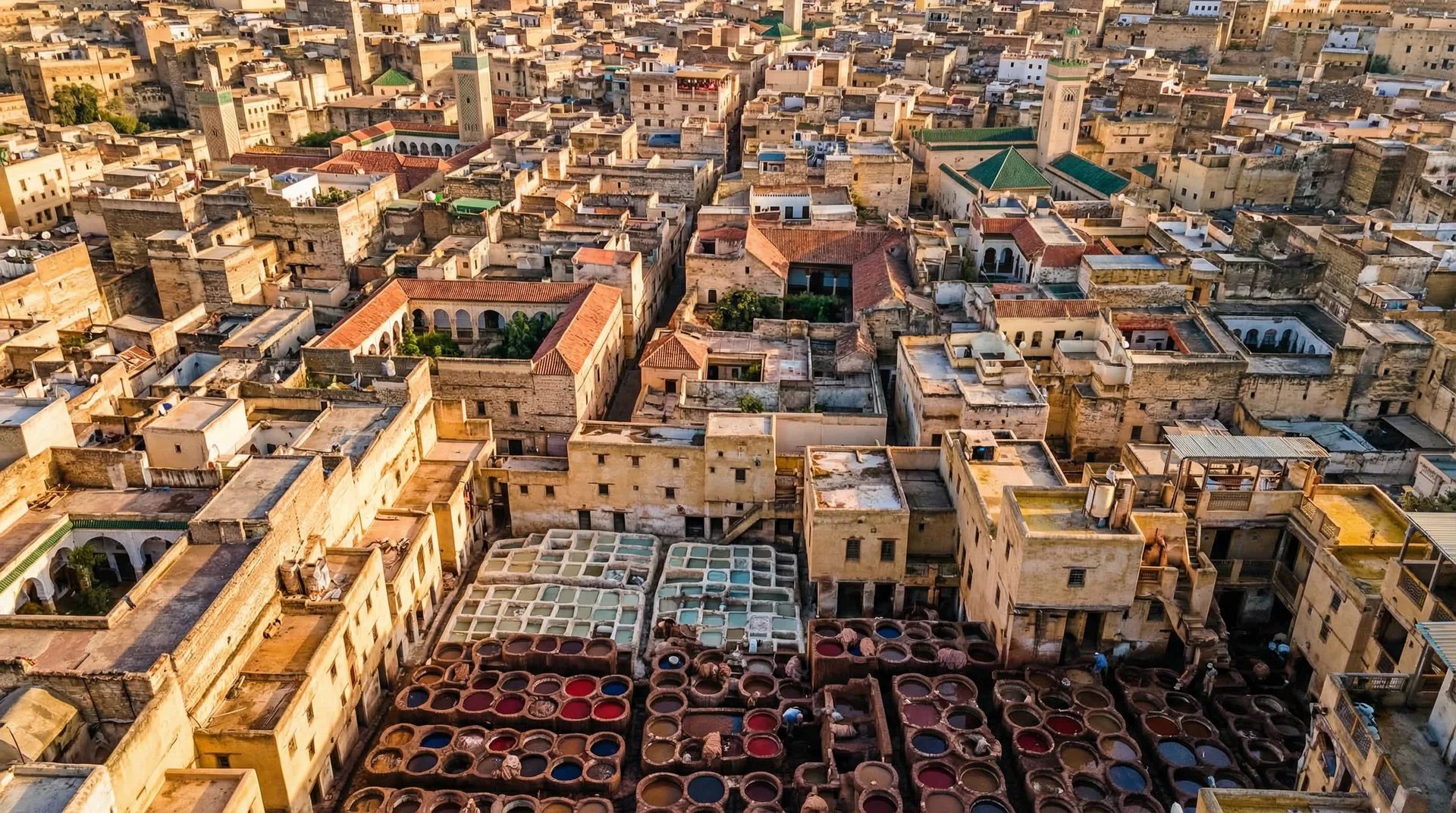
Fes is one of the most rewarding cities in Morocco — and one of the few that genuinely catches first-time visitors off guard. It is older and more traditional than Marrakech, far less polished for tourism, and built around a medina that is famously hard to read. None of that is a reason to be nervous; it is simply a reason to arrive informed. The visitors who love Fes most are usually the ones who knew what to expect before they walked through the gate. Here is the honest version.
The medina is a true labyrinth — even more than Marrakech
Fes el-Bali, the old walled medina, is one of the largest car-free urban areas in the world — thousands of lanes, many of them dead ends, with deliberately limited signage. Plenty of seasoned travellers find it even more disorienting on a first visit than the Marrakech medina. The honest, low-stress solution is to take a licensed guide for a first-day orientation: they link the highlights into one logical circuit and hand you a mental map you can use on your own afterwards. After that, getting a little lost is part of the pleasure — the medina broadly funnels downhill toward the river and the main gates, and any shopkeeper will point you to the nearest bab. Our guide to getting around Fes walks through the practicalities.
Decline the faux-guides — politely but firmly
You will almost certainly be approached in the street by people offering to lead you somewhere — to a viewpoint, a tannery, a workshop or simply "the way out". These unofficial "faux-guides" earn their living from shop commissions rather than your time, and a casual stroll can quietly become a hard sell. A licensed guide, by contrast, carries an official badge. There is no need to be rude: a warm, confident "no thank you" — repeated calmly if needed — is completely normal and well understood. If you want a guide, arrange one in advance rather than accepting one in the lane.
The tanneries come with a view, a smell and a pitch
The Chouara tannery is the postcard image of Fes, but it helps to know how a visit actually works. The famous overhead view is taken from the terraces of the leather shops that ring the dye pits — so you reach it by walking up through a shop, and you will usually be handed a sprig of mint to hold against the strong smell of the tanning process. On the way back down you can expect an enthusiastic sales pitch, and often a small tip is expected for the terrace view itself. None of this should put you off: the sight is genuinely extraordinary. Just go in knowing you are under no obligation to buy, carry a little change for a tip, and a friendly "no thank you" is all it takes to leave empty-handed.
Fes is more traditional — dress and speak accordingly
Fes is one of Morocco's great spiritual and scholarly cities, and it feels noticeably more traditional and conservative than Marrakech, with far less of the tourist gloss. Dressing modestly — shoulders and knees covered, for everyone — is appreciated, helps you blend in, and simply feels right in a city built around its mosques and madrasas. You will also notice that fewer people speak English here than in the more touristy cities; French and Arabic dominate. You don't need to be fluent, but a few words go a long way: a warm salam (hello), shukran (thank you) or la shukran (no thank you) are met with real warmth.
Carry cash — cards don't reach far into the medina
Much of the old medina runs on cash: small shops, food stalls, porters, tips and the souks often can't or won't take cards, and acceptance deep inside Fes el-Bali is patchy. ATMs are concentrated in the Ville Nouvelle — the modern, French-built quarter — and near some of the main gates, so it is worth withdrawing before you disappear into the lanes. Carry small notes and coins for taxis, porters and tips, and keep your money somewhere secure and easy to reach.
The rhythm of the medina: mules, "balak" and the call to prayer
Because no vehicle can enter the medina, goods still move the medieval way — by handcart, by porter and by laden mule or donkey. When you hear someone shout balak! ("make way"), step aside and flatten yourself against the wall: porters, handcarts and animals have the right of way in the narrow lanes. You will also hear the call to prayer ring out several times a day from countless minarets — it is a beautiful, defining part of the soundscape, and a reminder that you are a guest in a living, working religious city. Friday, the main day of prayer, tends to be quieter, with some shops shut or opening late.
It's safe — just stay aware in the crowds
None of this is cause for anxiety. Fes is generally safe to explore on foot, day and evening, and the real friction is persistence rather than danger — the faux-guides and the occasional over-eager shopkeeper. Sensible habits cover the rest: keep your bag in front of you through the most crowded stretches, stay aware in tight crowds, agree taxi fares before you ride, and carry small change for porters and tips. Go in respectful, relaxed and curious, and Fes gives you one of the most atmospheric experiences in the whole of Morocco. If you'd rather have the gate, the porter and a licensed guide arranged for you, that is exactly what we do on every Fes itinerary.
Frequently asked
Is Fes harder to navigate than Marrakech?
For most visitors, yes. Fes el-Bali is the largest car-free urban labyrinth in the world, with thousands of lanes and very limited signage by design — many people find it even more disorienting on a first visit than Marrakech's medina. The honest fix is to take a licensed guide for a first-day orientation, then wander on your own once you have a mental map. Getting a little lost afterwards is part of the pleasure, not a danger.
Do I have to buy anything at the Fes tanneries?
No. The famous Chouara tannery view is taken from the terraces of the leather shops that surround the pits, so you reach it by walking up through a shop — and you will usually be handed a sprig of mint to soften the strong smell. Expect an enthusiastic sales pitch on the way down and, often, a small tip expected for the terrace view. You are under no obligation to buy. A polite, friendly 'no thank you' is completely acceptable, and carrying a little change for a tip keeps things easy.
Is Fes more conservative than Marrakech?
Fes is generally more traditional and less touristy than Marrakech. It is one of Morocco's great spiritual and scholarly cities, so dressing modestly — shoulders and knees covered for everyone — is appreciated and helps you blend in. Fewer people speak English here than in Marrakech; French and Arabic dominate, so a few words of either go a long way and are warmly received.
Should I carry cash in Fes?
Yes. Many small shops, food stalls, porters, guides and the medina's tiny businesses work in cash, and card acceptance inside the old medina is patchy. There are ATMs in the Ville Nouvelle (the modern quarter) and near some of the main gates. Carry small notes and coins for taxis, porters, tips and the souks, and top up before you head deep into Fes el-Bali.
Is Fes safe for tourists?
Fes is generally safe to explore on foot, day and evening. The main friction is not crime but persistence — unofficial 'faux-guides' offering to lead you, and the occasional hard sell. Keep your bag in front of you in the most crowded lanes, stay aware in tight crowds, agree taxi fares before you ride, and decline unofficial guides politely but firmly. A licensed guide carries an official badge.
What is 'balak' and why do people shout it?
'Balak!' means roughly 'make way' or 'watch out'. Because the medina is car-free, goods still move by handcart, by porter and by laden mule or donkey. When you hear 'balak', flatten yourself against the wall and let the cart or animal pass — they have the right of way in the narrow lanes. It is one of the few words every visitor learns within their first hour in Fes.
Heading to Fes?
Arrive ready, not rattled.
Every Fes & Imperial Cities programme includes a fixed-price transfer to your riad door, a porter at the gate and a licensed guide for your first medina orientation — so the labyrinth, the tanneries and the etiquette are handled, and you are free to simply fall for the city.
Request a Fes itinerary