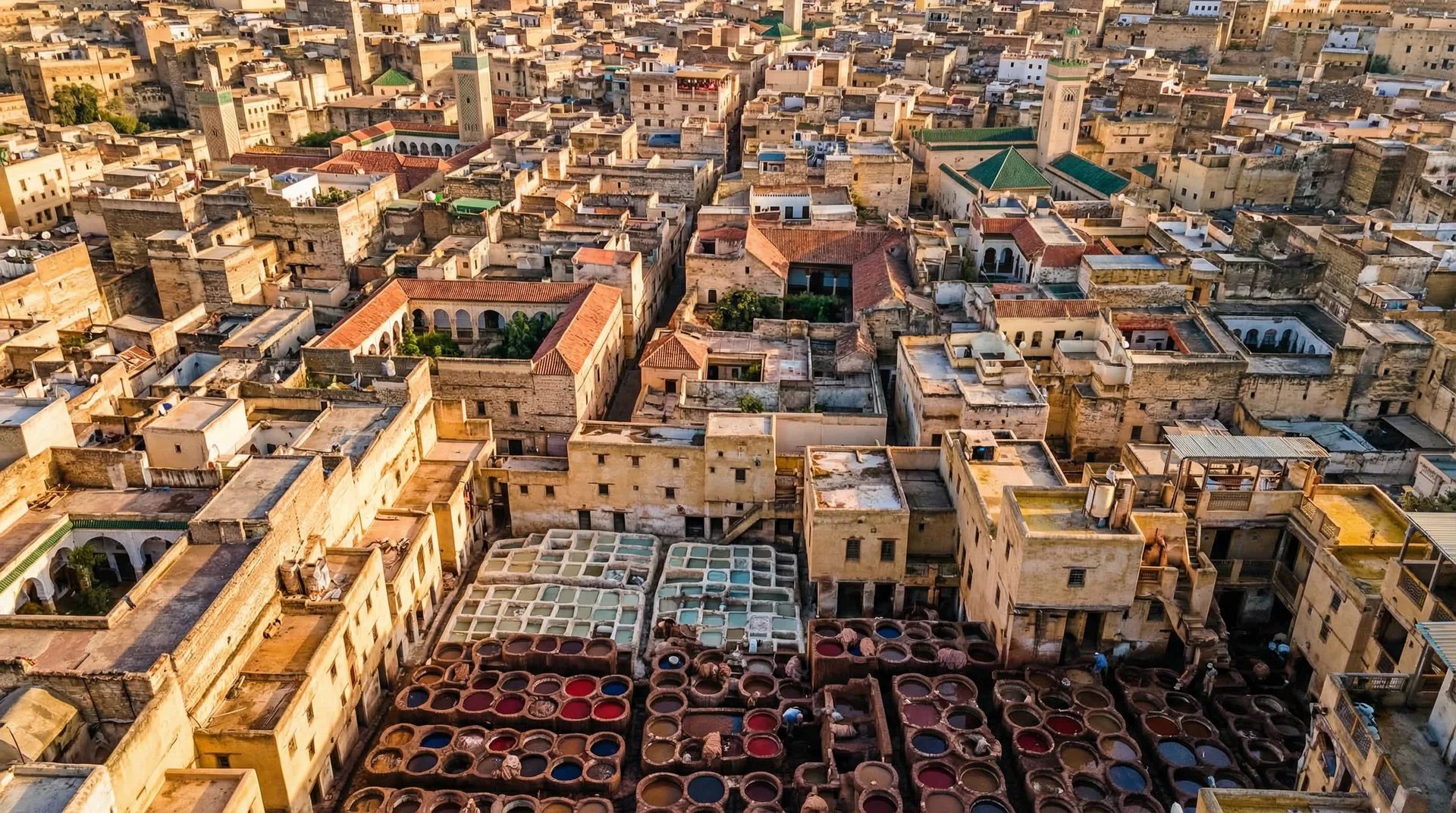
Fes has an inland, continental-Mediterranean climate — hotter summers and colder, wetter winters than you find on the Atlantic coast a few hours west. That matters more here than in most Moroccan cities, because the way you experience Fes is on foot, for hours, through a labyrinthine medina of cool stone lanes. The weather decides whether that walk is a pleasure or an endurance test. The short answer: aim for April to June or September to October. Everything below is the long answer — and a note that these are typical, approximate seasonal norms, not promises. Weather varies year to year, so treat this as a planning guide rather than a forecast.
The year at a glance
Approximate typical ranges and the general mood of each season. Figures are rough norms, not exact predictions for any given week.
| Season | Typical feel | Verdict for the medina |
|---|---|---|
| Spring (Apr–Jun) | Mild, clear, comfortable | Ideal — the best walking weather of the year |
| Summer (Jul–Aug) | Hot & dry, often ~35 °C+ | Airless midday; start early, rest, resume at dusk |
| Autumn (Sep–Oct) | Mild, clear, settling cooler | Ideal — spring's twin, with thinner crowds |
| Winter (Dec–Feb) | Cold & wet, roughly 5–16 °C | Atmospheric but damp and chilly; pack layers |
Month by month
January & February — cold, quiet, atmospheric
The depth of winter. Days are cold and often wet, broadly in the 5–16 °C band, and a damp chill settles into the medina's stone lanes that no amount of mint tea quite shifts. Occasional cold snaps push things lower. In return you get the quietest, most cinematic Fes of the year — woodsmoke from the hammam furnaces, soft grey light over the rooftops, almost no coach groups. Riads run heating and offer it for a reason; ask for a room away from the courtyard if you feel the cold. Pack as you would for a wet European winter day.
March — the turn
A transitional month that can swing either way: still-cool, showery early spring one week, the first genuinely warm, clear afternoons the next. Crowds remain light, and the medina begins to feel comfortable again for long walks. A good-value time to come if you don't mind a little uncertainty and pack for both ends of the range.
April, May & June — peak conditions
This is when we most often send guests to Fes. Days are mild and clear, the light is generous across the medina rooftops, and you can walk the lanes for hours without wilting. The Chouara tanneries are far more pleasant now than in high summer — the cooler air keeps the dye vats from overwhelming the senses. June begins to warm noticeably toward summer at its end, but the mornings and evenings stay lovely. If your dates are flexible, this window is the one to chase.
July & August — hot and dry
High summer is hot and dry in Fes, frequently pushing 35 °C or more by mid-afternoon. The deep, enclosed lanes of the medina can feel airless around midday, and the tanneries are at their most pungent. It is still entirely visitable — and the thick stone walls and shaded alleys help more than the headline temperature suggests — but the rhythm has to change. Start at first light, take the middle of the day slowly indoors or over a long lunch, and come back out as the city cools toward evening. Carry water and don't over-schedule.
September & October — autumn's reward
Spring's equal, and our other favourite window. The summer heat eases into mild, clear, comfortable days, the crowds thin from their European-holiday peak, and the medina returns to its best walking form. The tanneries are comfortable again, the rooftop terraces are a pleasure, and the light through October takes on a warm, low-angled quality that flatters the whole city. If you want the best balance of weather and calm, this is it.
November & December — cooling into winter
November cools steadily and brings the first reliable rain, while December slides into proper winter — cold, often wet, and quiet. Both months reward travellers who don't mind grey skies in exchange for an almost private medina and the year's lowest visitor numbers. Dress warmly, keep something waterproof to hand, and lean into the introspective, lamplit mood of the old city in the cold.
A note on Ramadan
Ramadan doesn't sit in a fixed month — it shifts roughly eleven days earlier each year on the Gregorian calendar — so it can land in any season depending on your travel year. During it, the daytime rhythm of Fes changes: some restaurants close until sunset, opening hours move around, and the real energy comes after the evening iftar, when the medina fills and celebrates late. It can be a wonderful, atmospheric time to visit with the right expectations. Because the dates move, we'd simply advise checking when Ramadan falls for your year before you commit to dates.
What to pack, by season
Whatever the month, you'll be walking a lot on uneven stone, so broken-in, closed shoes with grip come first. Beyond that, pack to the season:
- Spring (Apr–Jun): light layers, a long-sleeve option for cooler mornings and evenings, sun protection, and a light scarf. The easiest season to dress for.
- Summer (Jul–Aug): loose, breathable, modest-cut clothing that covers the shoulders, a brimmed hat, strong sun protection and a refillable water bottle. Lightweight long sleeves shade your skin better than bare arms.
- Autumn (Sep–Oct): much like spring — layers you can shed at midday and add back at dusk, with a light jacket for the cooler end of October.
- Winter (Dec–Feb): warm layers, a proper jacket, a waterproof shell or compact umbrella, and warm socks. The damp cold of the medina goes through thin clothing, so over-pack warmth rather than under-pack.
For a fuller checklist across the whole country, our seasonal packing guide goes deeper.
So when should you go?
If you can choose freely, choose April to June or September to October — mild, clear, comfortable for the long medina walks that make Fes what it is, with the tanneries at their most bearable. Come in summer and you can still have a wonderful time, provided you respect the heat and reshape your day around it. Come in winter for the quietest, most atmospheric Fes of all, and pack as if you mean it. Whichever you choose, build in unhurried hours — Fes is a city to walk slowly through, in any season.
Frequently asked
What is the best time of year to visit Fes?
For most travellers, April to June and September to October are the sweet spots. Days are typically mild and clear, the labyrinthine medina is comfortable to walk for hours, and the tanneries are far easier on the nose than in high summer. These are approximate seasonal norms rather than guarantees — weather varies year to year, so treat them as a planning guide.
Is Fes too hot to visit in summer?
July and August are hot and dry in Fes, often pushing 35 °C or more by mid-afternoon, and the deep stone lanes of the medina can feel airless around midday. It is still very visitable — start early, rest through the worst of the heat, and pick up again in the cooler evening. The thick walls and shaded alleys help more than you would expect, but plan a slower pace than in spring or autumn.
What is winter like in Fes?
Winter (roughly December to February) is cold and often wet, with temperatures broadly in the 5–16 °C range, rain, and a damp chill that settles into the medina's stone lanes. Occasional cold snaps happen. It is the quietest, most atmospheric season — woodsmoke, fewer visitors, soft light — but pack warm layers and something waterproof, and don't expect to lounge on riad terraces.
Does Ramadan affect a visit to Fes?
It can. During Ramadan, daytime rhythms shift — some restaurants close until sunset, opening hours change, and the city comes alive after the evening iftar. It is a fascinating time to visit if you go in with the right expectations. Because the dates move earlier each year on the Gregorian calendar, check when Ramadan falls for your travel year before booking.
When are the tanneries most pleasant to see?
The Chouara tanneries are most comfortable in the cooler months — spring, autumn and winter. In high summer the heat intensifies the ammonia from the dye vats, so the famous view is far more pleasant (and the offered sprig of mint less essential) in April–June or September–October.
Which months have the fewest crowds in Fes?
The winter months and the edges of the shoulder seasons tend to be quietest. Late autumn and the depths of winter see the thinnest crowds, while spring and early autumn balance good weather against moderate visitor numbers. Midsummer brings heat rather than peak crowds in Fes specifically, since many travellers head for the coast or the mountains.
Found your window?
We'll build a Fes itinerary around the season you choose.
From a cool-month medina walk to a slow-paced summer schedule that beats the midday heat, every Fes & Imperial Cities programme is shaped to the time of year you travel — licensed guide, the right riad, and tanneries timed for comfort.
Request a Fes itinerary