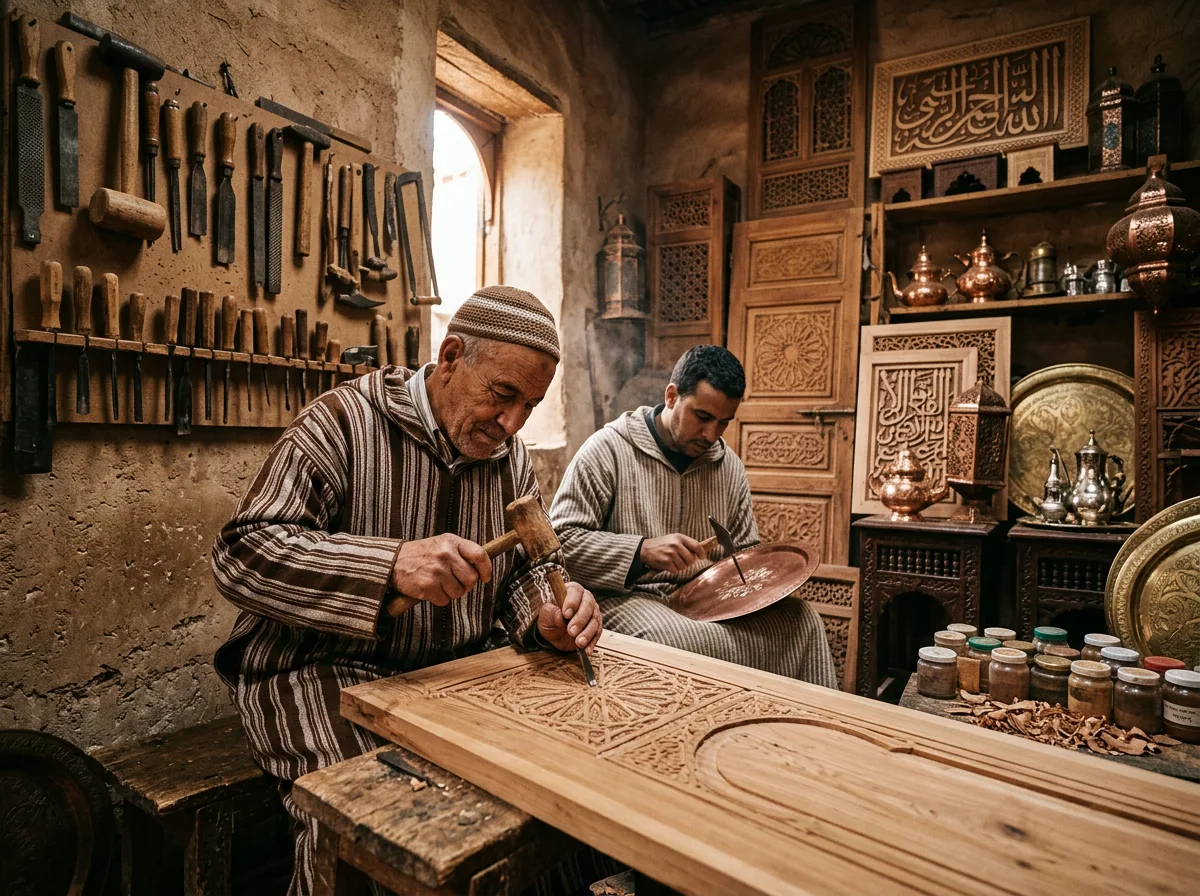
Fes is one of the world's great photographic cities: extraordinary light falling into the tannery vats, intricate Marinid zellige and carved cedar, the labyrinth of Fes el-Bali, and craftsmen at work in the artisan quarters. Knowing where to go, when, and how to engage respectfully makes all the difference.
In this guide
Best locations and light
The Chouara tanneries are the iconic Fes shot — best from the terrace of a leather shop overlooking the honeycomb of dye vats, in the morning when the light falls directly into the basins. The Bou Inania and Al-Attarine medersas reward a slow eye for their zellige tilework, stucco and cedar; shoot when soft daylight reaches the courtyards. Bab Bou Jeloud, the Blue Gate, frames beautifully from outside in the morning and glows in late afternoon, and the rooftops of the medina seen from a riad terrace at dusk, with the green minaret of the Kairaouine rising among them, are unforgettable.
For a Sahara extension to Merzouga, the hour after sunrise and the hour before sunset are the canonical times — the dune shadows are long and the light is golden. The golden-orange of Erg Chebbi in that light is as vivid as it appears in photographs. Closer to home, the Roman ruins at Volubilis photograph extraordinarily in late-afternoon light, with the columns and triumphal arch against the Zerhoun hills.
Medina etiquette and photographing people
The single most important rule: ask permission before photographing people, every time. A tannery worker turning hides, a weaver at a loom in the Nejjarine quarter, a coppersmith hammering a tray, children playing in a lane — each deserves the choice. The Arabic to use is 'mumkin sura?' (may I take a photo?). Many will say yes with pleasure; some will ask for a small fee — 5–20 MAD is fair and generous; some will decline, and that decision must be respected without argument. The tanners in particular are working, not performing, so be courteous.
Street photography in the candid western tradition sits uneasily in the Fes medina. Long lenses that allow unnoticed shooting of people who would decline if asked are widely considered disrespectful — and in this devout, traditional city have caused real friction. The most rewarding portraits come from connection, not distance: take the time to talk, buy a small item from the artisan, share a tea if invited, and the resulting images reflect that.
Gear and practical notes
The Fes el-Bali lanes and souks are extremely tight spaces: a versatile zoom (24–70mm equivalent) or a mid-range prime is far more useful than a long telephoto, and a wide angle helps in the cramped medersa courtyards and over the tannery vats. If you head to the desert, dust is pervasive — bring a sealed camera bag and lens cloths, and change lenses sparingly outdoors. The Moroccan sun is intense: shade your lens to avoid flare, and protect your camera from direct sun when not shooting.
- Bring extra batteries — cold desert nights, if you extend to Merzouga, drain them faster than expected.
- A small tripod or gorilla pod pays off for dim medersa interiors and blue-hour rooftop scenes over the Fes medina.
- Phone cameras, particularly with computational photography, perform remarkably in the Fes light and slip easily through tight souk lanes — don't feel obliged to carry heavy gear.
- Keep your camera discreet around the tanneries and busy souks, and remember the leather-shop terraces overlooking Chouara usually expect you to browse in return for the view.
Drone rules in Morocco
Drone operation in Morocco requires authorisation from the Moroccan Civil Aviation Authority (DGAC). Flying without a permit is illegal, and drones have been confiscated at customs and in the field. The process for obtaining authorisation is bureaucratic and time-consuming. For most travellers, the advice is to leave the drone at home — Morocco's landscape is extraordinary enough at ground level, and the legal risk is not worth it.
Frequently asked
Can you take photographs in Moroccan souks?
Of goods, architecture and general scenes in the Fes souks — yes. Of people — always ask first. The workshops (the Chouara tanneries, weavers, brass and zellige ateliers) are often best accessed through a guided medina tour that has established relationships; the guide will advise on what is permitted and smooth the introductions.
When is the best time of day to photograph Morocco?
Golden hour — the hour after sunrise and before sunset — is transformative in Fes. Mid-morning light falls best into the Chouara tannery vats, and the blue hour over the medina rooftops from a riad terrace is remarkable. Midday, especially in summer, is harsh and flat.
Is it safe to use a camera in the Fes medina?
Yes, in general. Keep it close in the most crowded souk lanes and be aware of your surroundings. A strap worn across the body rather than over one shoulder is sensible in tight, jostling spaces.
Are drones allowed in Morocco?
Not without prior authorisation from the Moroccan DGAC. Drones have been confiscated at customs. Unless you have the time and connections to navigate the permit process, leave the drone at home.
What is 'mumkin sura' and when should I use it?
'Mumkin sura?' means 'may I take a photo?' in Darija (Moroccan Arabic). Use it every time before pointing your camera at a person — it takes three seconds, shows genuine respect, and usually results in a much more natural and willing subject.
Planning a trip?
Let a Marrakech atelier handle the details.
Tell us your dates and style and we'll send a written itinerary and a transparent quote within 24 hours.
Request an itineraryKeep reading
Culture
Morocco Etiquette & Customs
A little cultural awareness goes a long way in Fes, one of Morocco's most traditional and spiritual cities. Dress modestly, greet warmly, ask before photographing people, use your right hand, and embrace the unhurried pace of mint tea and conversation in the medina.
Planning
The Best Time to Visit Morocco
Spring (March–May) and autumn (September–November) are the best all-round times to visit Morocco and to base yourself in Fes — warm days, cool evenings and comfortable conditions for long hours on foot in the Fes el-Bali medina, plus easy day trips to Volubilis, Meknes and the Middle Atlas.
Itineraries
Fes & Morocco Itinerary: 10 Days
Ten days is the sweet spot — long enough to root yourself in Fes and the imperial north, drop south to the Sahara, and finish in Marrakech in one unhurried loop, with Chefchaouen or the coast as an optional add-on.