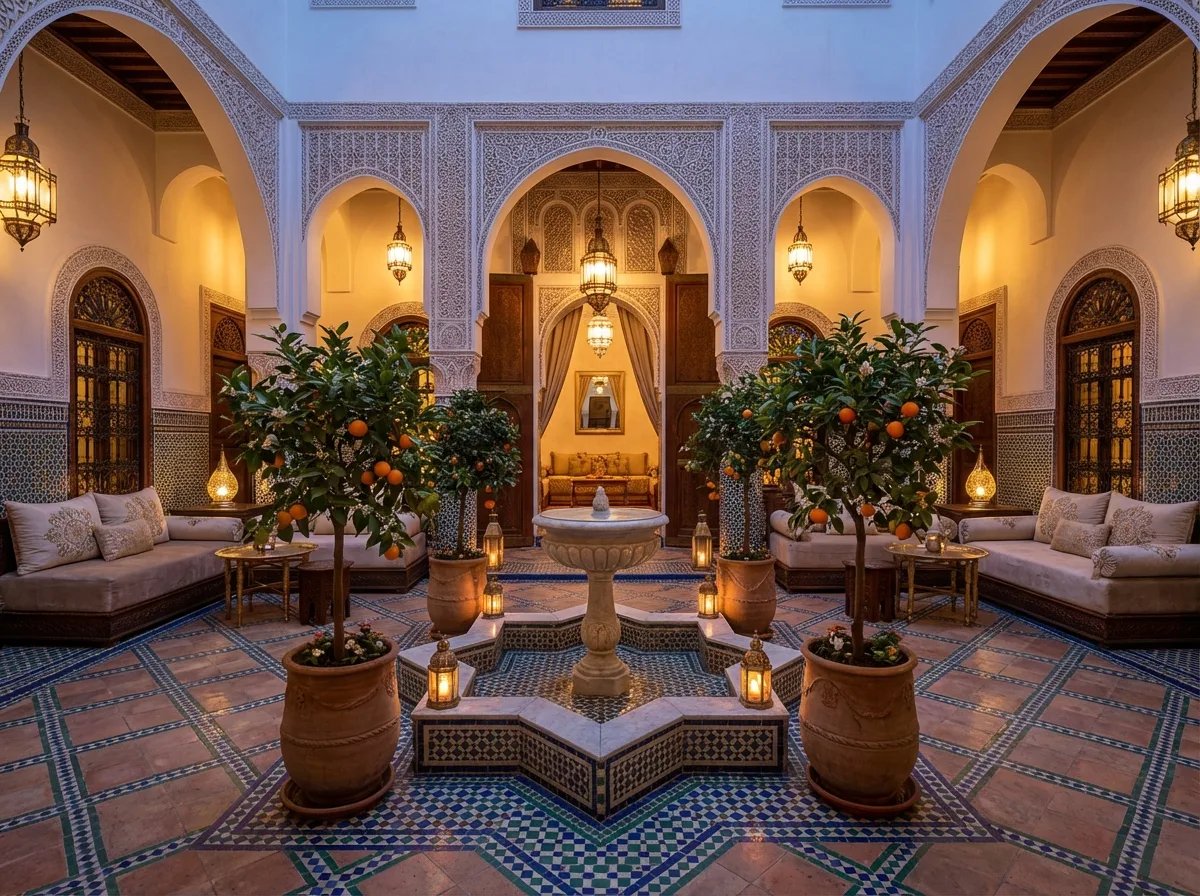
Fes offers one of the world's great accommodation experiences — restored Fassi palace-riads with zellige courtyards, plunge pools and private chefs deep in Fes el-Bali — and a Fes-based trip pairs naturally with a luxury Sahara camp at Merzouga and the imperial-city loop. Knowing which type suits your trip, and what to look for, makes a significant difference.
In this guide
What is a riad and why is it the best way to stay in Fes?
A riad is a traditional Moroccan townhouse built around an interior courtyard — typically with a fountain, orange trees or a plunge pool at its centre, and rooms arranged on two or three gallery floors above. Fes el-Bali holds some of the finest surviving examples in the country: from the outside, a Fassi riad is completely anonymous, a plain medina wall and a studded cedar door that gives no hint of what lies within. From the inside, it is often extraordinarily beautiful — hand-cut Fassi zellige, carved stucco, painted cedarwood ceilings and a silence that the narrow lane outside cannot penetrate.
Fes riads range from family guesthouses with four rooms and a shared breakfast table (US$60–120 per night) to fully restored merchant palaces with in-house hammams, private chefs, roof terraces over the medina rooftops and plunge-pool suites (US$300–800+ per night). The experience of waking inside a centuries-old Fes courtyard, hearing the dawn call to prayer from the Kairaouine echo off the walls, and taking breakfast on a terrace looking across the medina is something no city hotel can replicate — and it is the reason a Fes riad is the defining way to stay in the city.
What to look for when booking a Fes riad
Location within Fes el-Bali matters enormously. Riads near a main gate such as Bab Bou Jeloud (the Blue Gate) or Bab Rcif are easiest for arrivals and departures, since no car can enter the medina and you will walk in with a porter; those buried deep towards the Kairaouine and Place Seffarine are wonderfully atmospheric but require a longer guided walk in, often with a riad staff member meeting you at a fixed point. Ask the riad for its nearest gate and a WhatsApp pin before you arrive.
For families, check pool depth and staircase configuration — traditional Fes riads often have steep, open spiral stairs unsuitable for young children. For couples, look for properties with no more than eight rooms and a private suite with its own terrace over the medina. Solo travellers should ask specifically about single-room rates rather than accepting a half-price double.
- Pool: a genuine selling point in spring and autumn; near-essential for summer stays.
- Breakfast: most riads include breakfast — confirm it is served on the terrace or roof.
- In-house hammam: offered by many mid-to-upper riads; one of the best Morocco experiences.
- Private chef: available on request at better riads; a private dinner in the courtyard is memorable.
- Noise: ask about proximity to mosques (the pre-dawn call to prayer carries far in quiet medinas).
What other accommodation types exist around a Fes trip?
Outside the medina, Fes has a Ville Nouvelle with modern hotels useful for an early flight from Fès–Saïss or a business stay, though they lack the riad magic. If your Fes trip extends to Marrakech, the Hivernage and Palmeraie districts there hold international luxury hotels (Four Seasons, Mandarin Oriental, Selman) with resort facilities — pools, spas, multiple restaurants — that suit travellers who want five-star scale alongside their medina days.
On the day-trip and extension circuit from Fes, the accommodation changes character. In the Middle Atlas around Ifrane, alpine-style chalets and lodges sit among the cedar forests; in the High Atlas a riad's equivalent is the gîte, a simple Berber mountain lodge with a communal tagine dinner. North towards the Rif, Chefchaouen's equivalent of the riad is the dar — smaller, family-run guesthouses in the blue medina lanes. And on a Sahara extension south from Fes, the night is spent in a desert camp rather than under a roof at all.
What are luxury desert camps and how do they work?
The luxury Sahara camp is a category of accommodation unlike anything else in Morocco, and the natural overnight on a desert extension from Fes. At Erg Chebbi (Merzouga) — reached on the scenic drive south from Fes through Ifrane and the Ziz Valley — and at Erg Chigaga (near M'Hamid), a handful of genuinely high-quality camps offer permanent ensuite tents or geodesic domes with proper beds, hot showers, electricity and a private fire pit, positioned in the dunes far enough from the road to feel genuinely remote. Dinner is served under a canopy of stars; the breakfast is cooked fresh in the camp kitchen.
The gap between budget and luxury in the desert camp market is wide. Budget camps offer shared open-air 'bedouin tents' with thin mattresses and communal toilets; they fill with tour groups and lose any sense of solitude. Luxury camps — at US$150–350 per person per night, all meals included — typically host fewer than 30 guests and are positioned away from any neighbours. If the desert is a centrepiece of your trip, the upgrade from budget to luxury camp is the single best investment you can make.
- Luxury camp indicators: ensuite private bathrooms; permanent fixed tents or domes; no more than 20–30 tents; generator-off quiet hours.
- Merzouga camps: most accessible Sahara; best luxury camp infrastructure; some camps visible from the road.
- Chigaga camps: wilder and more remote; fewer neighbours; 4WD transfer from M'Hamid required.
- Book early: the best camps at Erg Chebbi sell out months ahead in autumn and winter.
How much should you budget for accommodation in Morocco?
Budget travellers can find clean, simple riad guesthouses in Fes el-Bali from US$40–70 per night including breakfast. A comfortable mid-range Fes riad with a pool and attentive service runs US$100–200 per night. Restored Fassi palace-riads with hammams, private chefs and pool suites start at US$250–400 per night and climb significantly in the top properties. Desert camps on a Sahara extension: US$80–150 (budget) to US$200–350 (luxury), per person per night, all meals included. Atlas gîtes: US$30–60 per person including dinner and breakfast.
Frequently asked
Should I stay in a riad or a hotel in Fes?
For a Fes trip, a riad inside Fes el-Bali is strongly recommended — the Fassi architecture, the intimacy, the courtyard breakfast and the medina immersion are experiences a Ville Nouvelle or Palmeraie resort hotel cannot offer. A modern hotel makes sense only for an early Fès–Saïss flight or as a Marrakech extension. For very young children, a resort hotel with a large pool and reliable food service may be more practical.
What is the difference between a riad and a dar in Morocco?
Both are traditional Moroccan courtyard houses common throughout Fes el-Bali. A riad technically has an interior garden with plants and a fountain; a dar is a plain courtyard without planting. In practice, the terms are used interchangeably in the Fes accommodation market — both describe the same type of intimate medina guesthouse.
How early should I book a riad in Fes?
For travel in April and October (peak seasons), book your Fes riad at least 2–3 months ahead for the best properties — and earlier still if your dates overlap the Fes Festival of World Sacred Music in June, when the finest riads fill fast. Luxury desert camps at Merzouga and Chigaga need 3–6 months' advance notice in the peak Sahara season (October to March). January and February allow more flexibility, though the best properties still fill.
Are riads suitable for families with young children?
Many riads are excellent for families — the enclosed courtyard is a safe play space and staff are genuinely welcoming. Check pool depth and staircase configuration before booking: traditional riads often have steep open stairs without childproof barriers. Ask specifically about family rooms or interconnecting suites. Ring ahead; a good riad will be honest about its suitability.
Is it worth upgrading to a luxury desert camp?
Emphatically yes. The difference between a basic Sahara camp and a luxury one — proper beds, ensuite bathrooms, private fire pits, a real dinner under the stars and genuine quiet — is enormous and transforms the experience. At US$150–300 per person for one night, it is the best value premium upgrade in Morocco.
Planning a trip?
Let a Marrakech atelier handle the details.
Tell us your dates and style and we'll send a written itinerary and a transparent quote within 24 hours.
Request an itineraryKeep reading
Planning
Morocco Travel Costs & Budget
Fes can be done on almost any budget. Mid-range travellers spend roughly US$80–150 per person per day; private, riad-based trips with a local guide and driver typically run US$200–400+ per day depending on season and style.
Planning
Morocco Honeymoon Guide
Fes is one of the world's most atmospheric honeymoon bases: restored palace-riads hidden in the medina, candlelit rooftop dinners above the old city, traditional hammams, and the romance of getting happily lost in a thousand-year-old labyrinth. Here is how to plan an unforgettable romantic trip with Fes at its heart.
Planning
Sahara Desert Tour Guide: Merzouga, Chigaga & Zagora
From Fes, the Sahara is a deeply rewarding extension, and Erg Chebbi at Merzouga is the natural choice — the drive south through Ifrane and the Ziz Valley leads to the grandest dunes in Morocco. Here is how Merzouga compares to Chigaga and Zagora, what the camps are like, and when to go.