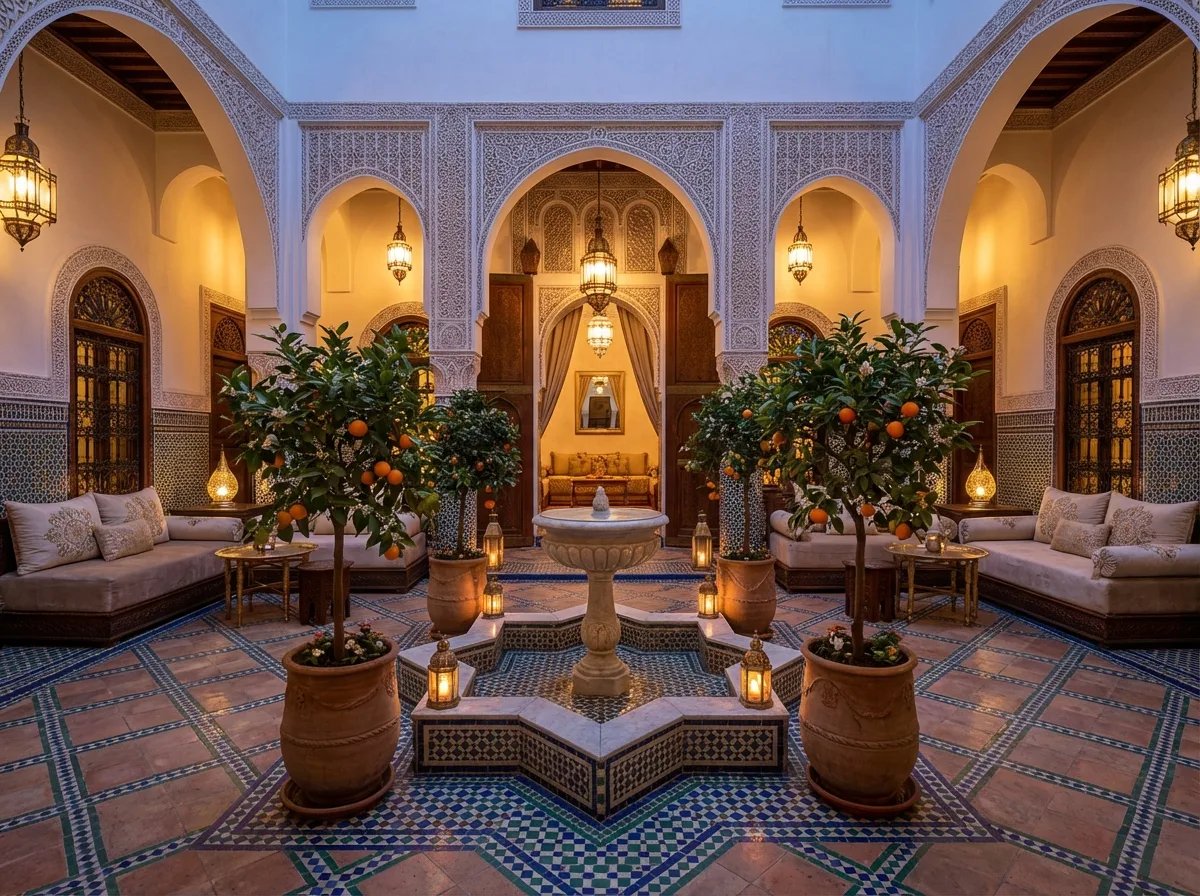
Fes can be done on almost any budget. Mid-range travellers spend roughly US$80–150 per person per day; private, riad-based trips with a local guide and driver typically run US$200–400+ per day depending on season and style.
In this guide
Currency and payments
The currency is the Moroccan dirham (MAD), a closed currency you can't easily get before you arrive — withdraw from ATMs at Fès–Saïss or in the Ville Nouvelle, or exchange on arrival. Cards are accepted in riads and larger restaurants, but the medina souks, leather and zellige workshops, petits taxis and tips all run on cash. Carry small notes, since artisan stalls rarely have change for large ones.
What things cost
Rough, real-world ranges to set expectations (they vary by city and season):
- Mint tea on a medina rooftop: 15–30 MAD; a casual tagine or bowl of harira lunch: 60–120 MAD.
- A good Fes riad room: US$60–200+ per night; restored palace-riads far higher.
- A licensed half-day private Fes el-Bali medina guide: roughly US$60–120.
- Private intercity transfer (e.g. Fes–Chefchaouen or Fes–Merzouga): from around US$200+ per car.
- A luxury Sahara camp night on a desert extension: US$150–400+ per person, all-in.
Where the money goes — and how to save
The biggest line items on a private trip are accommodation and guiding; both scale with season and standard. In Fes, a smart approach is one well-guided medina day to learn the lanes and meet the artisans, then self-guided wandering afterwards. Travelling in the shoulder months and keeping group sizes efficient (a private car to Volubilis and Meknes costs the same for two as for four) stretches the budget without cutting the experience.
Frequently asked
How much does a week in Morocco cost?
A comfortable mid-range week based in Fes runs roughly US$600–1,100 per person excluding international flights. A fully private, riad-and-guide trip pairing Fes with the imperial cities and a Sahara night typically lands between US$1,400 and US$3,000+ per person for the week, depending on season and standard.
Should I bring cash or use cards in Morocco?
Both. Use cards for riads and bigger restaurants, but carry dirham cash for the medina souks, artisan workshops, petits taxis, tips and any desert extension, where cards aren't accepted.
Is Morocco expensive?
Fes can be as cheap or as luxurious as you like. Medina street food and small guesthouses make it very affordable; private guiding, restored palace-riads and desert camps push it firmly into premium territory.
Planning a trip?
Let a Marrakech atelier handle the details.
Tell us your dates and style and we'll send a written itinerary and a transparent quote within 24 hours.
Request an itineraryKeep reading
Planning
Morocco Visa & Entry Requirements
Most travellers — including US, Canadian, UK, EU/Schengen, Australian, New Zealand and Japanese passport holders — enter Morocco visa-free for up to 90 days, whether they land at Fès–Saïss or arrive overland. You need a passport valid for at least six months beyond arrival.
Practical
Getting Around Morocco
Fes sits squarely on Morocco's best rail line, so trains link it easily to Meknes, Rabat, Casablanca, Marrakech and Tangier. For Chefchaouen, Volubilis, the Middle Atlas and the desert, you'll want a private driver. The right mix depends on your route and pace.
Planning
The Best Time to Visit Morocco
Spring (March–May) and autumn (September–November) are the best all-round times to visit Morocco and to base yourself in Fes — warm days, cool evenings and comfortable conditions for long hours on foot in the Fes el-Bali medina, plus easy day trips to Volubilis, Meknes and the Middle Atlas.