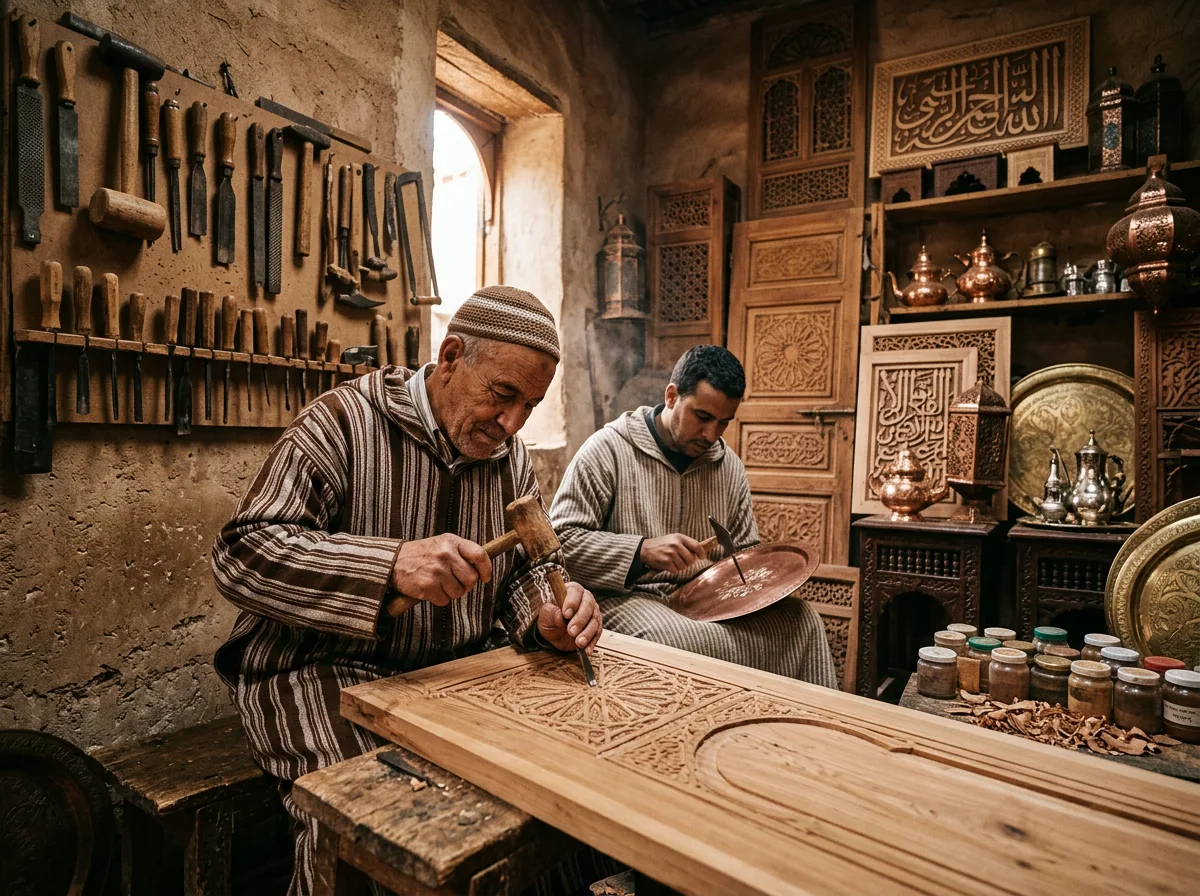
Tucked into the heart of Fes el-Bali, the Nejjarine quarter takes its name from the carpenters and woodworkers ("nejjarine" means carpenters) whose souk has clustered here for centuries. The square's centrepiece is the beautiful Nejjarine Fountain, a richly tiled public fountain framed in carved cedar and zellige that is one of the most photographed in the medina. Beside it stands the Nejjarine Museum of Wooden Arts and Crafts, housed in a superbly restored early-18th-century fondouk, a galleried courtyard caravanserai that once lodged travelling merchants and their goods. Inside, the museum displays antique Moroccan woodwork, doors, musical instruments and craftsmen's tools, and a rooftop terrace café offers sweeping views over the rooftops of Fes. This guide covers the fountain, the fondouk architecture, the woodwork collection, the rooftop view, the surrounding carpenters' souk and the scent of cedar, how long to allow, dress and etiquette, and how to fold the visit into a wider medina walk.
On one side of Nejjarine Square stands the Nejjarine Fountain, a richly decorated public fountain sheathed in zellige mosaic and framed by carved and painted cedar above a deep recessed niche. Historically these fountains supplied water to the surrounding quarter, and this one, set against the fondouk wall, is among the most beautiful and most photographed in Fes.
02Landmark
The Nejjarine Museum of Wooden Arts and Crafts
Beside the fountain, the Nejjarine Museum of Wooden Arts and Crafts (Musée Nejjarine des Arts et Métiers du Bois) gathers a collection devoted to the woodworking traditions of Fes and Morocco. It celebrates the crafts of the surrounding carpenters' souk, displaying antique pieces across the galleries of the restored building.
03Architecture
A restored early-18th-century fondouk
The museum occupies a fondouk, a caravanserai or merchants' inn dating from the early 18th century, where travelling traders once stabled animals and stored goods on the ground floor and lodged in rooms above. Carefully restored, it is a fine surviving example of this building type and a destination in its own right for its architecture alone.
04What to see
The galleried courtyard
At the centre is a tall, light-filled courtyard ringed by tiers of wooden galleries that rise around all four sides, reached by stairs and overlooking the open space below. The carved cedar railings, doorways and balconies show off exactly the kind of woodwork the museum celebrates, so the building and its collection echo one another.
05What to see
The woodwork collection
The galleries display antique Moroccan woodwork: carved and painted doors, chests, religious and domestic furniture, prayer beads, and pieces showing the joinery and marquetry of Fassi craftsmen. The collection traces how cedar and other woods have been worked in the medina, from architectural elements to everyday objects.
06What to see
Musical instruments and craftsmen's tools
Alongside furniture and doors, the displays include traditional wooden musical instruments and the tools of the carpenter's trade, the saws, planes, lathes and gauges used to shape and carve. Together they show woodworking not just as decoration but as a living craft passed down through generations in the surrounding souk.
07What to see
The rooftop terrace and medina views
A stair leads up to a rooftop terrace café crowning the fondouk, one of the museum's highlights. From here you look out over the tiled roofs, minarets and green-tiled landmarks of Fes el-Bali, a rare open vantage point above the dense, mostly hidden medina below. It is a good place to pause before heading back into the lanes.
08Setting
The carpenters' souk and the scent of cedar
The square sits within the woodworkers' souk that gives the quarter its name, where carpenters still saw, plane and assemble cedar by hand in tiny workshops. The smell of freshly worked cedar hangs in the air, and the sound of tools is part of the atmosphere, making the area feel like a working craft district rather than a museum set piece.
09Etiquette
Dress and etiquette
Modest dress with shoulders and knees covered is appropriate, as throughout the medina. The museum is a calm space, so keep noise down and be considerate when photographing. In the surrounding souk, ask before photographing craftsmen at work, and step aside for the porters and laden mules that thread through the narrow lanes.
10Tips
How long to allow
Most visitors spend around 45 minutes to an hour taking in the fountain, walking the galleries and going up for the rooftop view, perhaps longer over a drink on the terrace. There is an admission charge for the museum; check current admission prices and opening hours locally, as these can change and access may vary around midday and on certain days.
11Itinerary
Combining with the medina
Nejjarine Square lies in the dense core of Fes el-Bali, within easy reach of the Qarawiyyin, the Al-Attarine and Bou Inania madrasas, the Attarine spice souk and the Chouara tannery. A natural route threads down from Talaa Kebira through the souks to the fountain and museum, then on toward the Qarawiyyin, letting you weave the woodworkers' quarter into a wider medina walk.
12Tips
Going with a local guide
A local guide can navigate the maze of lanes to Nejjarine Square, explain the fondouk's role in the medina's trading past and point out details in the woodwork you might otherwise pass over. It also makes it easy to link the museum with the nearby madrasas, souks and tanneries in a single coherent walk without getting lost.
Frequently asked
What is the Nejjarine Museum in Fes?
It is the Nejjarine Museum of Wooden Arts and Crafts, devoted to the woodworking traditions of Fes and Morocco. It is housed in a superbly restored early-18th-century fondouk, a former merchants' inn, with galleries displaying antique doors, furniture, musical instruments and craftsmen's tools, and a rooftop terrace café with views over the medina.
What is a fondouk?
A fondouk (also caravanserai) is a traditional merchants' inn built around a central courtyard, where travelling traders once stored goods and stabled animals on the ground floor and lodged in galleried rooms above. The Nejjarine fondouk, dating from the early 18th century, is a finely restored example now used as the wood museum.
What is the Nejjarine Fountain?
It is a beautiful public fountain on Nejjarine Square, set against the fondouk wall and decorated with zellige mosaic and carved, painted cedar. Such fountains historically supplied water to the surrounding quarter, and this one is among the most admired and photographed in Fes el-Bali, sitting at the heart of the carpenters' souk.
How long should I spend at the Nejjarine Museum?
Allow roughly 45 minutes to an hour to see the fountain, walk the galleries of woodwork and go up to the rooftop terrace for the medina views, longer if you stop for a drink. There is an admission charge, and opening hours can vary, so check current admission prices and times locally.
See it with a local
Turn this into a private Fes trip.
We'll build a private, guided plan around the experiences you care about — with a driver, hand-picked riads and a written quote in 24 hours.