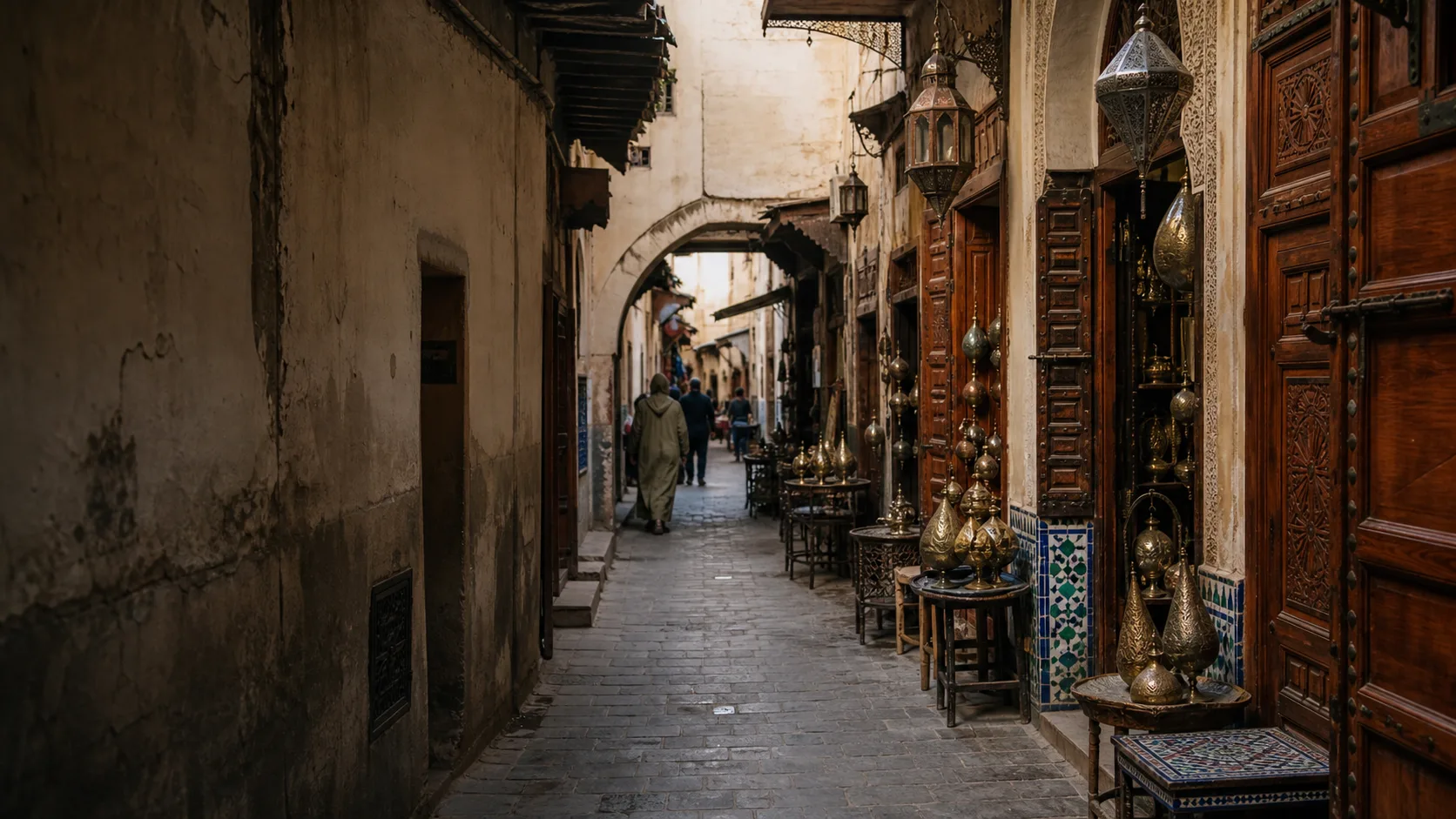
The medina of Fes el-Bali is one of the world's great market cities, and for centuries its trades have been organised into specialised quarters — each lane and square given over to a single craft or commodity. This guide is about the souks themselves and the experience of shopping in them: which souk sells what, the sounds and smells that fill the air, how haggling works and why there's no need to feel pressured to buy. It covers wandering and getting pleasantly lost, what's genuinely worth carrying home, the fixed-price alternative for a calmer browse, and the practicalities of shipping larger pieces.
Near the Qarawiyyin mosque and university, the Attarine souk is the traditional spice and perfume market, lined with herbalists (attars) whose stalls are stacked with pyramids of spices, dried herbs, perfumes and natural remedies. The name comes from the Arabic for the scent and perfume sellers who have traded here for centuries.
02Souk
The Henna Souk
The Henna Souk is a quiet little square shaded by old plane trees, traditionally selling henna, ceramics and natural cosmetics such as kohl and argan products. It sits in one of the older parts of the medina, near the site of a historic hospital, and offers a calmer pause between the busier lanes.
03Souk
Place Seffarine — the brass & copper smiths
On Seffarine square you hear the souk before you see it: the rhythmic hammering of metalworkers beating sheets of brass and copper into pots, trays, lanterns and water vessels by hand. Watching the smiths at work around the square is as much a part of the experience as buying the finished pieces.
04Souk
The Dyers' Souk (Souk Sabbighin)
In the dyers' quarter, skeins of freshly dyed wool and silk are hung out to dry above the narrow lanes and along the river, turning the alleys into ribbons of colour. The dyers work the threads in vats by hand, and the souk supplies the bright yarns later woven into the city's textiles.
05Souk
The Kissaria — covered textile market
The Kissaria is the medina's covered market, a tight grid of small shops concentrating on textiles, clothing, scarves, kaftans and finer goods. Historically the most secure part of the souk, it is where cloth, embroidery and ready-made garments are traditionally sold.
06Souk
The Nejjarine carpenters' quarter
Around Place Nejjarine, carpenters and woodworkers shape fragrant cedar into furniture, doors, boxes and carved panels, and the air carries the smell of freshly worked wood. The restored Nejjarine funduq and its woodwork museum anchor the quarter and explain the trade.
07Souk
Leather from the tanneries
The shops fanning out from the medieval tanneries sell the leather goods the quarter is known for — babouche slippers, bags, poufs, belts and jackets. Many shops have terraces overlooking the dye pits, so you can see where the leather comes from before browsing the finished work.
08Experience
Getting pleasantly lost
Fes el-Bali is a vast maze of thousands of lanes, and part of its pleasure is wandering without a fixed plan — letting the trades, sounds and smells guide you from spice stalls to metalworkers to dyers. If you lose your bearings, the main arteries and gates lead you back out, and locals will often point the way; a guide can also be hired to navigate and reach working workshops.
09Tips
What's worth buying
The medina's strongest buys reflect its trades: leather (slippers, bags, poufs), hand-hammered brass and copper, Fes-blue ceramics and pottery, woven textiles and scarves, plus argan oil, spices and natural cosmetics. Take time to compare a few stalls, check the quality and weight of metal or the finish of leather, and buy what genuinely appeals rather than on the spot.
10Tips
How haggling works
Bargaining is the normal way to agree a price in the souks and is expected for most goods, though staples and food are usually fixed. Stay friendly and unhurried, ask the price, make a counter-offer and meet somewhere in between; it is completely fine to thank the seller and walk away if the price or the piece isn't right. There's no obligation to buy just because you've looked or been shown into a shop.
11Tips
The fixed-price alternative
If you'd rather browse without negotiating, government-run Ensemble Artisanal craft complexes and some cooperatives sell quality work at marked, fixed prices. They're a useful way to gauge a fair benchmark before haggling elsewhere, and a low-pressure place to see ceramics, leather, metalwork and textiles side by side.
12Tips
Shipping larger pieces home
For carpets, large ceramics, lamps or furniture that won't fit in a suitcase, many established shops can arrange international shipping. Agree the full price including packing and freight in writing, keep your receipts, and where possible photograph the item; reputable sellers are used to organising this for visitors.
Frequently asked
How are the souks of Fes organised?
The medina of Fes el-Bali is traditionally divided into specialised trade quarters, each given over to a craft or commodity: the Attarine souk for spices and perfumes near the Qarawiyyin, the Henna Souk for henna and ceramics, Place Seffarine for brass and copper, the dyers' souk (Souk Sabbighin) for dyed wool and silk, the Kissaria for textiles and clothing, the Nejjarine area for woodwork, and the tanneries for leather.
Do you have to haggle in the Fes souks?
For most goods, yes — bargaining is the normal and expected way to agree a price, while staples and food are usually fixed. Stay friendly, make a counter-offer, and meet in the middle. There is no pressure to buy: it is perfectly acceptable to thank the seller and walk away if the price or the item isn't right for you.
What is worth buying in the Fes medina?
The best buys reflect the medina's trades: leather goods such as slippers, bags and poufs; hand-hammered brass and copper; Fes-blue ceramics and pottery; woven textiles and scarves; and argan oil, spices and natural cosmetics. Compare a few stalls and check quality before deciding.
Is there a fixed-price alternative to bargaining in Fes?
Yes. Government-run Ensemble Artisanal craft complexes and some cooperatives sell quality crafts at marked, fixed prices, which makes for a low-pressure browse and a useful benchmark for fair value before haggling in the souks. Many shops can also arrange shipping for larger items like carpets and furniture.
See it with a local
Turn this into a private Fes trip.
We'll build a private, guided plan around the experiences you care about — with a driver, hand-picked riads and a written quote in 24 hours.