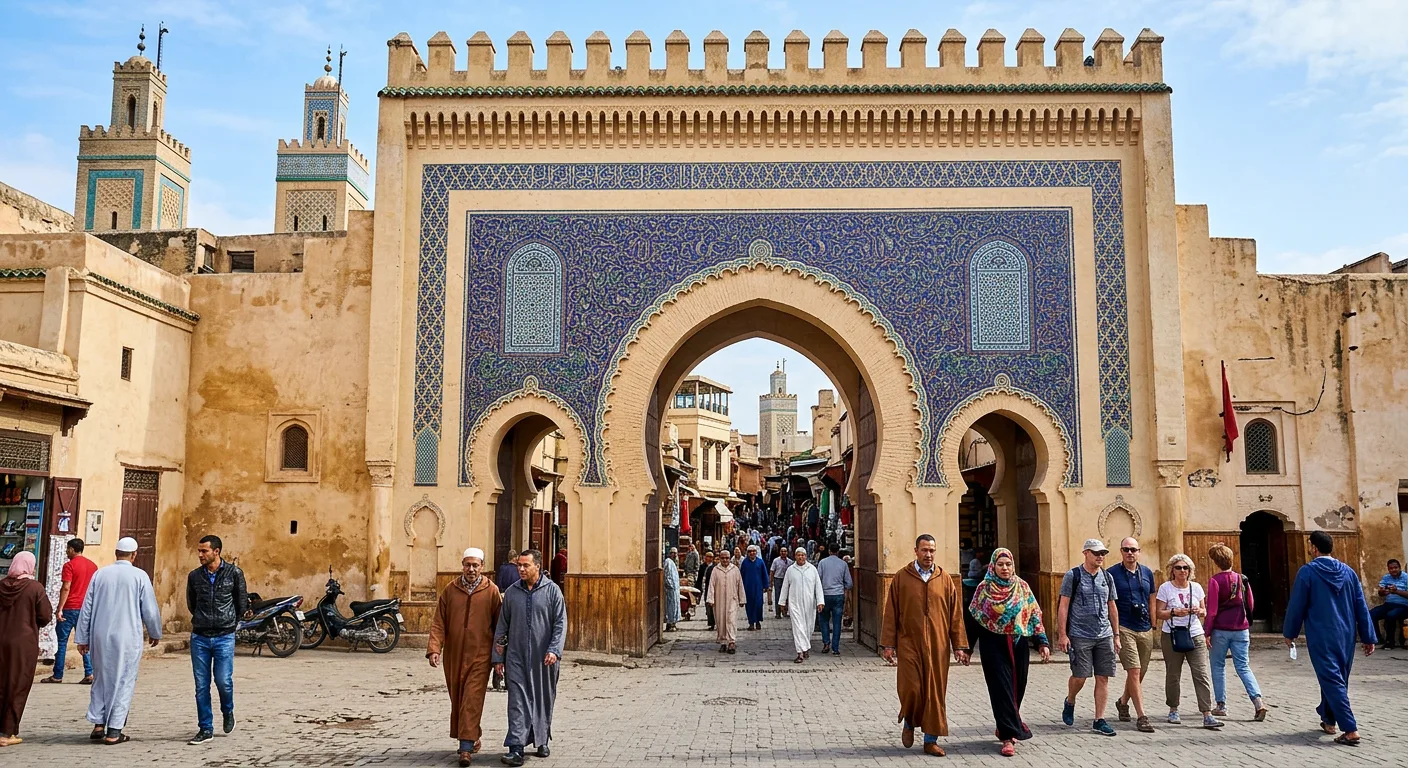
Beside the Royal Palace in Fes el-Jdid lies the Mellah, widely described as one of the oldest Jewish quarters in Morocco, with origins in the 14th century under the Marinid dynasty. For centuries it was home to a thriving Jewish community whose presence is woven into the long history of Fes; most of that community emigrated in the mid-20th century, but the quarter and its monuments remain. The Mellah looks unlike the rest of the medina: where Muslim medina houses turn inward around private courtyards, the houses here present carved wooden balconies and windows that face directly onto the street, giving the lanes a distinctive character. Within and around the quarter you can see the restored Ibn Danan Synagogue, the hillside Jewish cemetery with its white rounded tombs, the streets long associated with the goldsmith and jewellery trade, and, close by, the magnificent brass gates of the Royal Palace at the Place des Alaouites. This guide covers the history of the Mellah, its unusual architecture, the synagogue, the cemetery, the palace gates and how to visit respectfully, with notes on combining it with the wider Fes el-Jdid district.
The Mellah of Fes is often cited as one of the oldest Jewish quarters in Morocco, established in the 14th century during the Marinid era in the newer royal city of Fes el-Jdid, beside the Royal Palace. For hundreds of years it was the heart of a substantial Jewish community in Fes. Most families emigrated around the middle of the 20th century, yet the quarter, its synagogues and its cemetery preserve the memory of that long-rooted presence.
02Architecture
Distinctive balconied architecture
The most immediately striking feature of the Mellah is its architecture. Unlike the inward-facing houses of the Muslim medina, which hide their life behind blank walls and inner courtyards, the houses here have carved wooden balconies and windows that open directly onto the street. This outward-facing style gives the quarter a streetscape found nowhere else in Fes and is one of the clearest physical signs of its separate history.
03Landmark
The Ibn Danan Synagogue
The restored Ibn Danan Synagogue is the best-known historic synagogue of the Mellah and a highlight of any visit. A notable example of Moroccan Jewish religious architecture, it has been the subject of careful restoration and is generally open to visitors. Inside you can see the prayer hall, the ark and the traditional fittings that recall the religious life of the community that once filled the surrounding lanes.
04Landmark
The Jewish cemetery and its white tombs
On the slope at the edge of the quarter lies the Jewish cemetery, instantly recognisable by its rows of white, rounded tombs covering the hillside. It is a quiet, moving place and an important site of remembrance. Among the graves visitors are often shown the tomb of Solica (Lalla Solica), a young Jewish woman of Fes whose story is venerated locally. Visit calmly and respectfully, as you would any active place of memory.
05Crafts
The goldsmiths' and jewellery trade
The Mellah has long been associated with goldsmithing and the jewellery trade, a craft for which the quarter's artisans were historically known across Fes. As you walk the main street you can still see workshops and small shops connected to this tradition. It is a tangible link to the economic role the community played in the life of the city for centuries.
06Landmark
The Royal Palace brass gates
A short walk from the Mellah, at the Place des Alaouites, stand the magnificent gates of the Royal Palace of Fes (Dar al-Makhzen). Their enormous brass doors, set amid carved cedar, zellij tilework and decorated surrounds, are among the most photographed sights in the city. The palace itself is not open to the public, but the gates and the broad square in front of them are freely accessible and a natural pairing with a Mellah visit.
07Neighbourhood
Fes el-Jdid, the royal city
The Mellah sits within Fes el-Jdid, the "new Fes" founded by the Marinids in the 13th century as a royal and administrative city, distinct from the older Fes el-Bali. Alongside the Mellah and the palace gates, the district has its own gates, mosques and a covered market street, making it an easy and rewarding area to explore on foot as a contrast to the great medina nearby.
08Walking
Walking the main street
The Mellah is compact and best seen slowly on foot. Its main thoroughfare runs through the quarter past the balconied houses, workshops and shops, with the synagogue and cemetery reached on short detours. Walking lets you take in the architectural details overhead and the everyday rhythm of a neighbourhood that, while much changed, still forms part of living Fes.
09Visiting
How to visit the sites
The streets and the palace square are open to all. The synagogue and the cemetery are looked after by caretakers, and at such sites it is customary to offer a small donation or tip to the caretaker who opens up and shows you around; carry some small change for this. Opening times can vary, so it is worth checking locally or going with a guide who knows the current arrangements.
10Etiquette
Visiting respectfully
These are sites of living heritage and remembrance, so a respectful approach matters. Dress modestly, keep your voice low in the synagogue and cemetery, and ask before photographing people or, where signs request it, religious interiors. Men may be asked to cover their heads in the synagogue. Treating the cemetery and synagogue as you would any active place of worship is both courteous and expected.
11Itinerary
Combining with the rest of Fes
Because the Mellah, the synagogue, the cemetery and the palace gates are clustered together in Fes el-Jdid, they make a compact half-day that pairs well with the wider medina. A common plan is to start at the Royal Palace gates, walk through the Mellah and visit the synagogue and cemetery, then continue into Fes el-Bali for the souks, madrasas and Qarawiyyin, seeing the two faces of historic Fes in a single day.
12Tips
Going with a local guide
A knowledgeable local guide adds a great deal here, explaining the history of the community, the meaning of the architecture and the stories attached to the cemetery, and smoothing access to the synagogue and other sites where a caretaker is involved. It also helps you navigate Fes el-Jdid and link the Mellah naturally to the rest of your time in the city.
Frequently asked
What is the Mellah of Fes?
The Mellah of Fes is the historic Jewish quarter of the city, widely described as one of the oldest in Morocco, with origins in the 14th century under the Marinid dynasty. It lies in Fes el-Jdid beside the Royal Palace and was home to a substantial Jewish community for centuries; most families emigrated in the mid-20th century, but the quarter, its synagogues and its cemetery remain.
Why does the Mellah look different from the rest of the medina?
Its houses face outward, with carved wooden balconies and windows that open directly onto the street, unlike the inward-facing houses of the Muslim medina that turn around private courtyards. This outward-looking style gives the Mellah a distinctive streetscape that sets it apart from the surrounding city.
Can you visit the Ibn Danan Synagogue and the Jewish cemetery?
Yes. The restored Ibn Danan Synagogue is generally open to visitors, and the hillside Jewish cemetery, with its white rounded tombs, can also be visited. Both are cared for by caretakers, so opening times can vary and it is customary to leave a small donation or tip; carrying some small change and dressing modestly is advisable.
What else is there to see near the Mellah?
Close by at the Place des Alaouites are the magnificent brass gates of the Royal Palace of Fes, among the most photographed sights in the city (the palace itself is closed to the public). The Mellah sits within the wider royal district of Fes el-Jdid, which has its own gates, mosques and market street and is easily combined with a visit to the main medina, Fes el-Bali.
See it with a local
Turn this into a private Fes trip.
We'll build a private, guided plan around the experiences you care about — with a driver, hand-picked riads and a written quote in 24 hours.