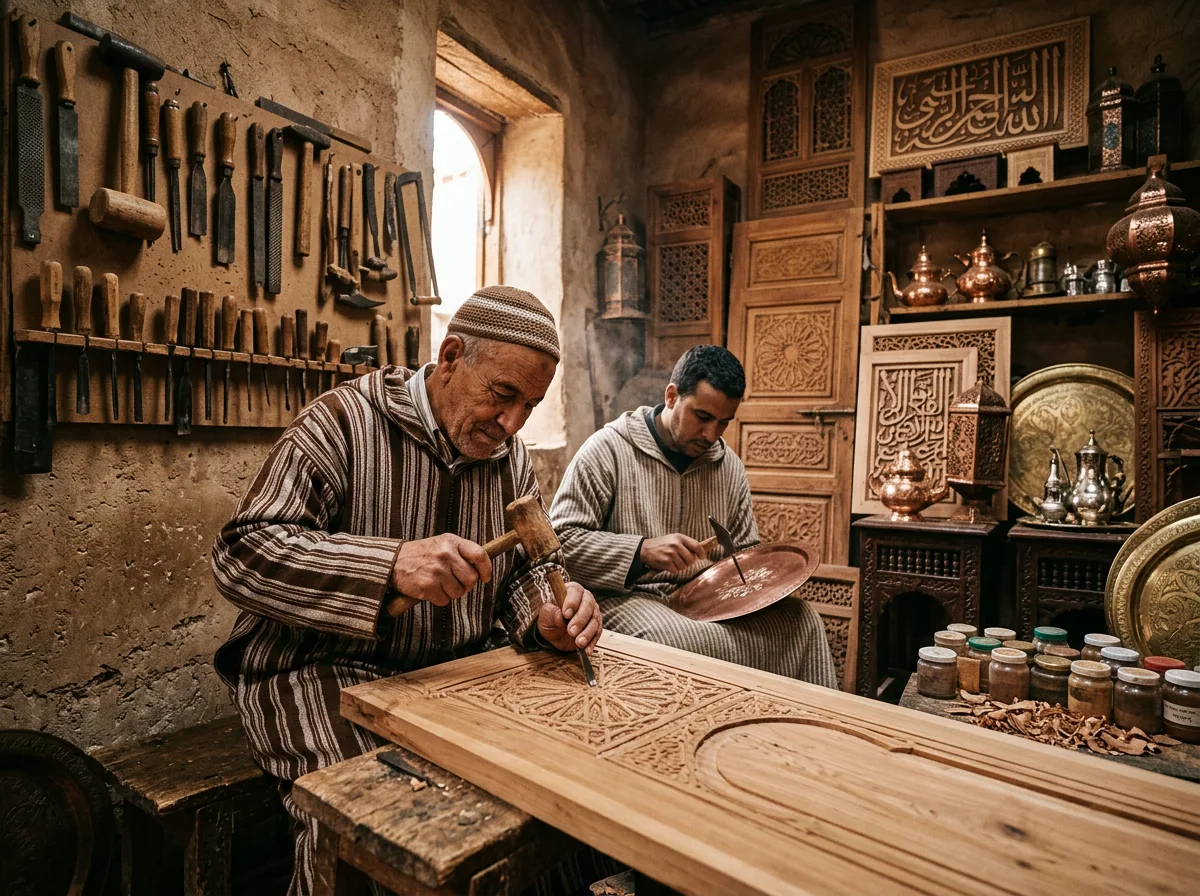
Fes is widely regarded as the craft capital of Morocco, and its medina is as much a vast working workshop as it is a place to live. Skills here are passed down through families and guilds, and many of the techniques have changed little in centuries. This guide covers the great Fassi crafts — zellige tilework, the famous Fes-blue pottery and ceramics, brass and metalwork, cedar woodwork, weaving and textiles — and where you can watch artisans at work and buy what they make responsibly.
Zellige — the geometric mosaic of hand-cut glazed tiles — is one of Fes's signature crafts, used on fountains, floors, walls and medersa courtyards across the city. Each tessera is shaped by hand with a hammer, then set face-down to build the pattern, a slow and highly skilled process.
02Craft
Fes-blue pottery & ceramics
Fes is famous for its cobalt 'Fes blue' pottery and ceramics — bowls, plates, tagines and tiles decorated with fine hand-painted patterns. The clay, the cobalt glaze and the painting style are closely associated with the city's centuries-old ceramic tradition.
03Workshop
Art Naji & the pottery quarter
On the edge of the city, the pottery quarter is home to large ceramic and zellige workshops, of which Art Naji is among the best known. Here you can watch the full process — throwing pots at the wheel, hand-painting the blue designs, and cutting and assembling zellige mosaics.
04Craft
Brass & metalwork at Place Seffarine
Place Seffarine is the brassworkers' and coppersmiths' square, where artisans hammer pots, trays, lanterns and pans by hand under a great plane tree. The constant ringing of metal makes it one of the most atmospheric working corners of the medina.
05Craft
Nejjarine woodwork
Around the Nejjarine quarter, carpenters work fragrant cedar into doors, furniture, screens and intricately carved panels. The Nejjarine Museum of Wooden Arts and Crafts, in a restored funduq, shows historic pieces and explains the woodworking tradition.
06Craft
Weaving & textiles
Fes has a long weaving tradition, from cactus-silk and cotton scarves to blankets and the woven cloth used in clothing. In weavers' workshops you can watch the loom in action and see how thread is dyed and woven into the fabrics sold throughout the souks.
07Craft
Leather and the tanneries
Leather is one of Fes's defining crafts, centred on the medieval tanneries where hides are still cured and dyed by hand. The leather feeds a whole quarter of workshops making babouche slippers, bags, jackets and poufs sold in the surrounding shops.
08Tips
Where to watch artisans at work
Many crafts can be seen in their own quarters of the medina — Seffarine for metal, Nejjarine for wood, the tanneries for leather — and in the larger ceramic and zellige workshops on the city's edge. A guide can take you into working ateliers rather than only shops, so you see the making, not just the selling.
09Tips
Buying crafts ethically
Buying directly from the artisans and cooperatives that make the work, rather than only middleman shops, keeps more of the value with the makers. Ask how and where a piece was made, take time to compare quality, and bargain politely — haggling is expected and part of the exchange.
10Tips
Craft cooperatives & associations
Fes has craft cooperatives and artisan associations that train makers and sell their output, sometimes with fixed prices. These can be a good way to support traditional skills, see careful work, and buy ceramics, textiles or metalwork with a clearer sense of who made them.
Frequently asked
What crafts is Fes famous for?
Fes is regarded as Morocco's craft capital and is best known for zellige tilework, its cobalt 'Fes blue' pottery and ceramics, brass and copper metalwork, carved cedar woodwork, weaving and textiles, and leather from its medieval tanneries.
What is Fes blue pottery?
Fes blue is the distinctive deep cobalt-blue used on the city's traditional pottery and ceramics — bowls, plates, tagines and tiles hand-painted with fine patterns. The colour and style are closely associated with Fes's centuries-old ceramic tradition.
Where can you watch artisans working in Fes?
Many crafts are made in their own quarters of the medina: Place Seffarine for brass and copper, the Nejjarine area for woodwork, and the tanneries for leather. Larger ceramic and zellige workshops on the edge of the city, such as Art Naji, let you watch potting, painting and tile-cutting from start to finish.
How do you buy Fes crafts ethically?
Buy directly from artisans, workshops and cooperatives wherever possible so more of the value reaches the makers, ask how and where a piece was made, compare quality across a few sellers, and bargain politely — haggling is expected. Craft cooperatives and associations are a good way to support traditional skills.
See it with a local
Turn this into a private Fes trip.
We'll build a private, guided plan around the experiences you care about — with a driver, hand-picked riads and a written quote in 24 hours.