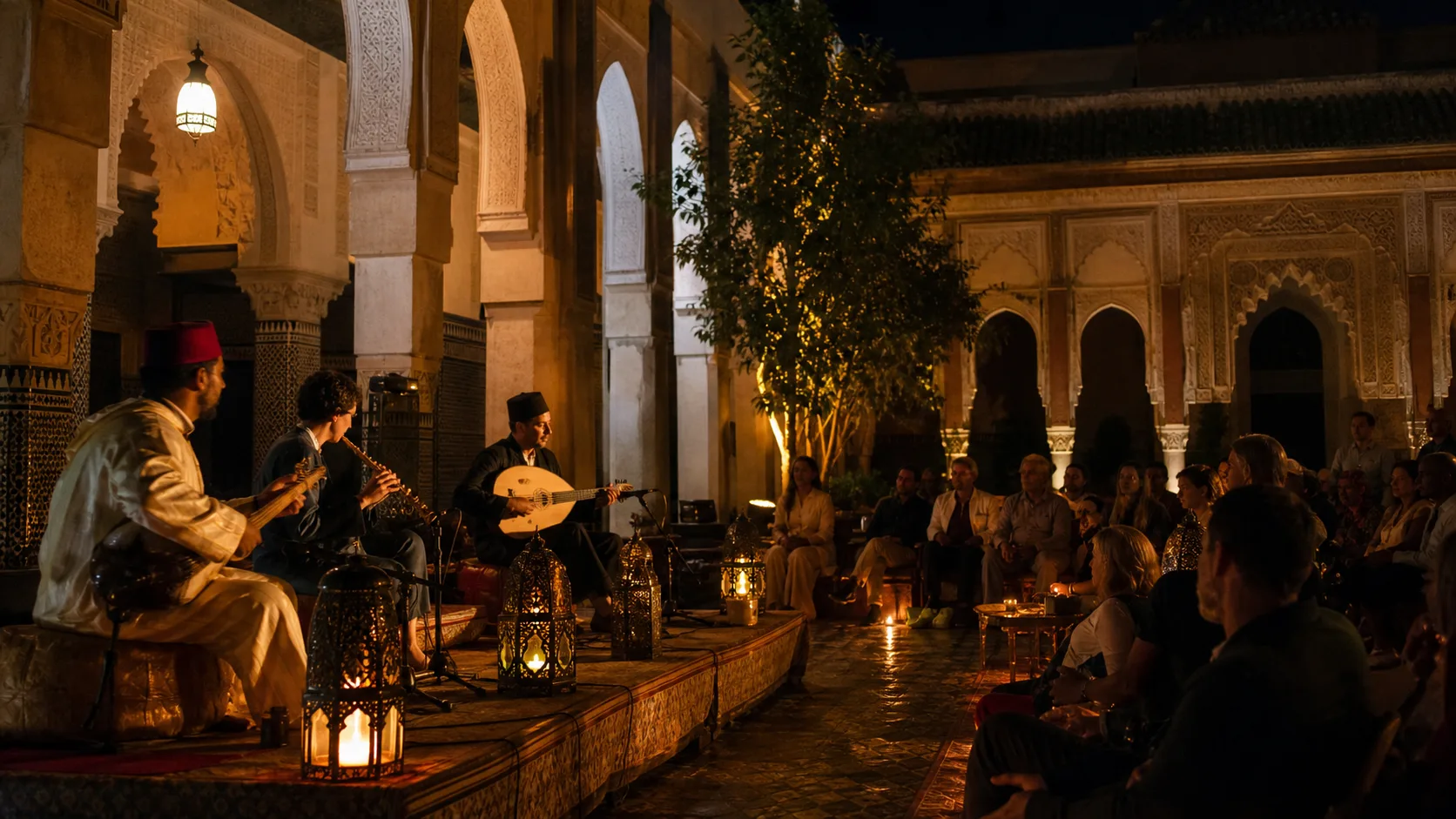
The Andalusian Quarter (Adwat al-Andalus) is the eastern half of Fes el-Bali, set across the Oued Fes river from the famous Qarawiyyin side. According to long tradition it was settled in the 9th century by Andalusian refugees from Córdoba, just as the opposite bank received refugees from Kairouan in Tunisia, which is why the old city has two historic quarters facing each other across the river. Today the Andalusian side is quieter, more residential and far less touristed than the Qarawiyyin core, with steep lanes winding up the hillside toward the Bab Ftouh gate and its cemetery. At its heart stands the Andalusian Mosque (Jamaa al-Andalus, the Mosque of the Andalusians) with its grand monumental gateway, and nearby is the Sahrij (As-Sahrij) Madrasa, prized for its fine zellij. This guide covers the history of the two banks, the Andalusian Mosque and its gate, the Sahrij Madrasa, the quiet residential lanes and local life, the Bab Ftouh gate and cemetery, how to cross from the Qarawiyyin side, photography, and visiting respectfully.
The Andalusian Quarter, known in Arabic as Adwat al-Andalus, occupies the eastern half of the old walled medina, on the far side of the Oued Fes from the Qarawiyyin district. It is one of the two historic halves of Fes el-Bali, and although it sits within the same UNESCO-listed medina it sees a fraction of the visitors of the opposite bank.
02History
The two banks: Andalusian and Kairouan
By tradition the medina grew from two communities of refugees who settled on opposite sides of the river in the 9th century: Andalusians from Córdoba on the eastern bank and people from Kairouan in Tunisia on the western, Qarawiyyin, side. Each founded a great mosque, and the rivalry and exchange between the two banks shaped the city. It is this story that gives the Qarawiyyin its name and the Andalusian Quarter its identity.
03Landmark
The Andalusian Mosque (Jamaa al-Andalus)
The spiritual centre of the quarter is the Mosque of the Andalusians, Jamaa al-Andalus, founded in the 9th century and the counterpart to the Qarawiyyin on the other bank. It is best known for its grand monumental gateway, a richly worked portal with carved decoration and a projecting canopy that is one of the landmarks of this side of the medina.
04How to visit
Admiring the mosque from outside
As with mosques across Morocco, non-Muslims generally cannot enter the Andalusian Mosque, so the experience here is to admire it from the street. The monumental gate, the doorways and the surrounding lanes reward a slow look, and you can take in the scale and the carved detail of the portal without crossing the threshold.
05What to see
The Sahrij (As-Sahrij) Madrasa
A short walk from the mosque is the Sahrij Madrasa, a Marinid-era college named for the reflecting pool (sahrij) in its courtyard. It is admired for its fine zellij mosaic, carved stucco and cedar woodwork, in the same tradition as the better-known madrasas on the Qarawiyyin side but seen here in a far quieter setting. Check locally whether it is open, as access to the smaller madrasas can vary.
06Atmosphere
Quiet residential lanes
Away from the souks and crowds of the opposite bank, the Andalusian Quarter is mostly residential. Its lanes are narrow and steep, climbing the hillside between high blank walls, ordinary doorways and small neighbourhood shops. The mood is everyday and unhurried, and this is much of the appeal: it is one of the calmest parts of Fes el-Bali.
07Atmosphere
Local life on the eastern bank
Because tourists are relatively few here, what you see tends to be daily neighbourhood life: children playing in the lanes, a corner bakery or grocery, a small local mosque or fountain, residents going about their day. It offers a different and quieter face of the medina from the trade-driven bustle around the Qarawiyyin and the main souks.
08Landmark
Bab Ftouh and the hillside cemetery
At the edge of the quarter is Bab Ftouh, one of the great gates of Fes el-Bali, beyond which a large cemetery spreads across the hillside. The gate has long been an entry point to this side of the city, and the open ground around it gives a sense of the medina's edge after the enclosed lanes. As a working cemetery and place of remembrance, it calls for quiet and respect.
09Getting there
Crossing from the Qarawiyyin side
The quarter is reached on foot from the Qarawiyyin side by crossing the line of the Oued Fes that historically divided the two banks. From the dense core around the Qarawiyyin and the Attarine souk, the lanes lead east and uphill toward the Andalusian Mosque. The medina is a maze, so a guide or offline map helps, and the crossing makes a natural extension to a wider medina walk.
10Tips
Photography in the quarter
The Andalusian side rewards patient, unhurried photography: the monumental gate of the Andalusian Mosque, the steep stepped lanes, doorways and the views from near Bab Ftouh out over the city. As this is a residential neighbourhood, photograph people only with their consent, and be especially discreet near the mosque and the cemetery.
11Etiquette
Visiting respectfully
Because the quarter is residential and far less used to visitors, modest dress and a low-key, respectful manner go a long way. Keep noise down in the lanes, don't linger in doorways or block narrow passages, and treat the mosque surroundings and the cemetery with particular care. The reward is a genuine, lived-in corner of Fes el-Bali.
12Tips
Going with a local guide
A local guide makes this side of the medina far easier to read, navigating the unmarked lanes, placing the Andalusian Mosque and Sahrij Madrasa in the story of the two banks, and helping you cross over from the Qarawiyyin core without losing your way. It is also the simplest way to fold the quieter eastern bank into a longer walk through Fes el-Bali.
Frequently asked
What is the Andalusian Quarter of Fes?
The Andalusian Quarter, or Adwat al-Andalus, is the eastern half of Fes el-Bali, set across the Oued Fes river from the famous Qarawiyyin side. By tradition it was settled in the 9th century by Andalusian refugees from Córdoba, while the opposite bank took in refugees from Kairouan in Tunisia. Today it is the quieter, more residential and far less touristed half of the old medina.
Can you go inside the Andalusian Mosque in Fes?
As with mosques across Morocco, non-Muslims generally cannot enter the Andalusian Mosque (Jamaa al-Andalus). The experience is to admire it from outside, especially its grand monumental gateway with its carved decoration, and to explore the surrounding lanes of the quarter.
What is there to see in the Andalusian Quarter?
The main sights are the Andalusian Mosque and its monumental gate, the nearby Sahrij (As-Sahrij) Madrasa with its fine zellij and courtyard pool, the quiet residential lanes climbing the hillside, and the Bab Ftouh gate with the cemetery spreading across the slope beyond it. Much of the appeal is simply the calm, lived-in atmosphere compared with the busier Qarawiyyin side.
How do you get to the Andalusian Quarter from the Qarawiyyin side?
You cross on foot over the line of the Oued Fes that historically divided the two banks, heading east and uphill from the Qarawiyyin and Attarine area toward the Andalusian Mosque. The medina is a maze of unmarked lanes, so a local guide or an offline map is a great help, and the crossing works well as an extension to a wider Fes el-Bali walk.
See it with a local
Turn this into a private Fes trip.
We'll build a private, guided plan around the experiences you care about — with a driver, hand-picked riads and a written quote in 24 hours.