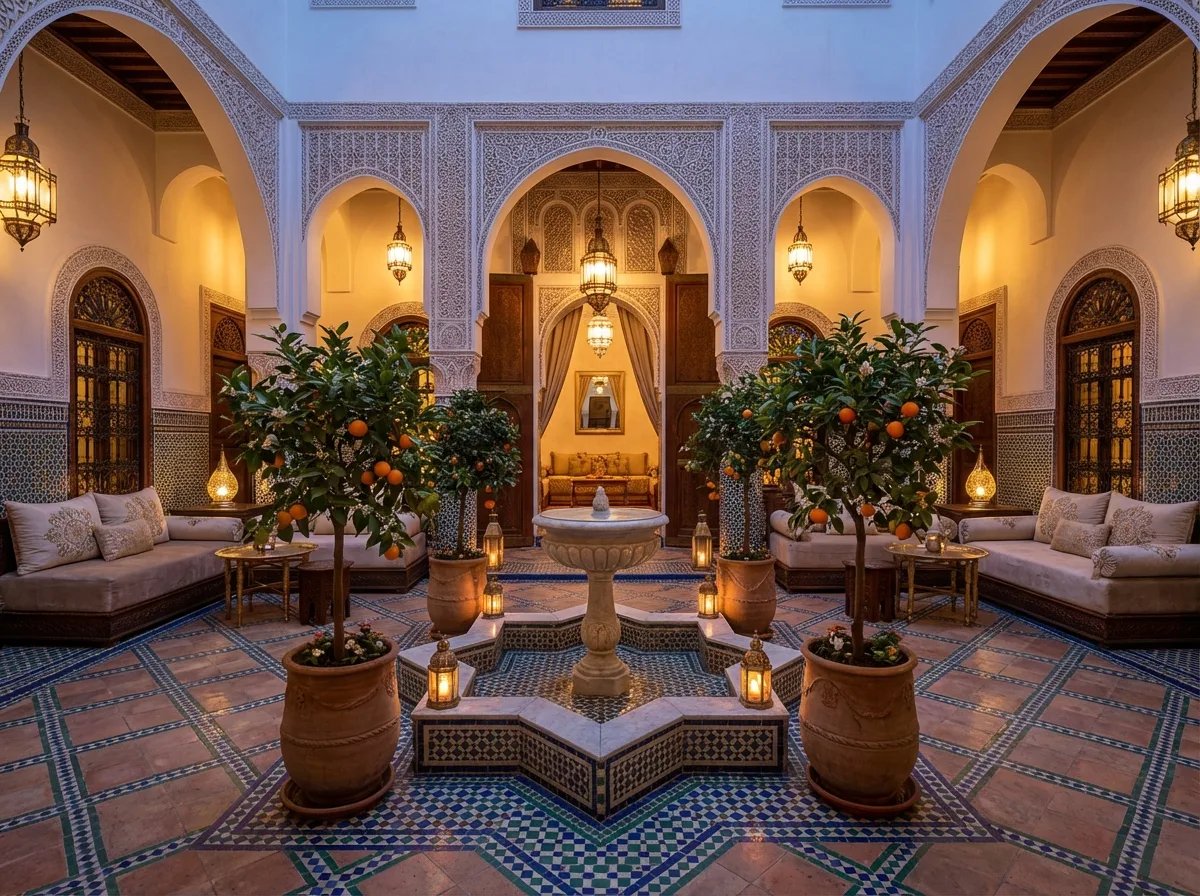
On the edge of Fes el-Bali, a short walk from the Blue Gate of Bab Boujloud, the Dar Batha Museum (Musée Dar Batha) occupies a late-19th-century summer palace built in a Hispano-Moorish style. Begun under Sultan Hassan I and completed under his successor Moulay Abdelaziz, the palace was later given over to the state and opened as a museum of Moroccan arts and crafts. Today it gathers some of the finest examples of traditional Fassi craftsmanship under one roof, and it is especially renowned for its collection of "Fes blue" faience ceramics and zellij tilework, alongside carved and painted woodwork, embroidery, carpets, astrolabes and manuscripts. For many visitors the highlight is not a single object but the large Andalusian garden at the heart of the palace, a tranquil walled courtyard shaded by a grand old tree. The museum is also associated with the Fes Festival of World Sacred Music, which has used the garden as a concert setting. This guide covers the palace architecture, the ceramics and zellij collection, the woodwork and other crafts, the Andalusian garden, how long to allow, dress and etiquette, photography, and how to combine the visit with Bab Boujloud and the medina.
The museum is housed in a former royal summer palace built in a Hispano-Moorish (Andalusian) style at the close of the 19th century. Work is generally said to have begun under Sultan Hassan I and to have been completed under Moulay Abdelaziz, before the building later passed to the state and was opened as a museum. The architecture itself, with its tiled courtyards and carved detail, is part of the attraction.
02What to see
The Andalusian garden
The heart of Dar Batha is its large walled Andalusian garden, a calm, green courtyard laid out around paths and water and shaded by mature trees, including a grand old tree that many visitors single out. After the bustle of the nearby medina, the garden is a place to slow down, and for many it is the highlight of the whole visit. It has also served as an open-air setting for concerts.
03What to see
The 'Fes blue' ceramics collection
Dar Batha is best known for its collection of Fassi faience ceramics, including the distinctive cobalt "Fes blue" pottery for which the city is famous. The displays gather plates, bowls, jars and decorative pieces that trace the long ceramic tradition of Fes. As with any museum, exactly which pieces are on show can change, so treat specific items as indicative rather than guaranteed.
04What to see
Zellij tilework
Alongside the pottery, the museum is celebrated for its zellij, the intricate geometric mosaic tilework that is one of the signature crafts of Fes. You can see zellij both as decoration within the palace itself and among the collection, giving a sense of how the cut-tile tradition developed and how its patterns are assembled by hand.
05What to see
Carved and painted woodwork
The collection includes examples of Moroccan woodwork, the carved and painted cedar of doors, ceilings, screens and furniture that is a hallmark of Fassi craftsmanship. Together with the zellij and plasterwork, it shows the decorative arts that adorn the medina's madrasas, mosques and grand houses, here brought together in a single setting.
06What to see
Embroidery, carpets and textiles
Among the arts and crafts on display are traditional textiles, including embroidery and carpets that reflect regional Moroccan styles. These pieces add to the picture of Fes as a centre of craft production, where the decorative traditions extend well beyond ceramics and tile to the fabrics and furnishings of daily and ceremonial life.
07What to see
Astrolabes and scientific instruments
The museum's holdings are sometimes noted for astrolabes and related instruments, a reminder of the scientific and scholarly traditions long associated with Fes and its university heritage. As displays rotate, it is worth confirming on the day what is currently exhibited rather than expecting any single object to be on view.
08What to see
Manuscripts and the written arts
Reflecting the scholarly history of Fes, the collection extends to manuscripts and the arts of the book. These complement the crafts on display by tying the city's decorative traditions to its long-standing role as a centre of learning, though, as with the other categories, the specific items shown may vary over time.
09Tips
How long to allow
Many visitors spend around an hour to ninety minutes at Dar Batha, taking in the palace rooms, the collection and an unhurried walk in the garden. It makes a calm pause within a medina day rather than a half-day in itself. There is an admission charge; check current admission prices and opening hours locally, as times can vary and the museum may close on certain days or for periods of restoration.
10Etiquette
Dress and etiquette
Modest dress with shoulders and knees covered is appropriate, in keeping with the medina around it. The museum and garden are quiet spaces, so keep voices low, do not touch the exhibits, and be considerate of other visitors when lingering for photographs in the garden or the tiled courtyards.
11Tips
Photography
The tiled courtyards and the garden, with its old tree and green calm, are the most photogenic parts of Dar Batha, especially in soft morning or late-afternoon light. Rules on photography inside the galleries can vary and flash is often discouraged near delicate objects, so check any posted signs or ask staff before photographing the collection.
12Itinerary
Combining with Bab Boujloud and the medina
Dar Batha sits just outside Fes el-Bali, a short walk from the Blue Gate of Bab Boujloud and the heads of the Talaa Kebira and Talaa Seghira streets. A natural plan is to start with the calm of the palace and garden, then pass through Bab Boujloud into the medina to continue on to the Bou Inania Madrasa, the souks and the wider old city, weaving the museum into a larger walk.
Frequently asked
What is the Dar Batha Museum in Fes?
Dar Batha (Musée Dar Batha) is a museum of Moroccan arts and crafts on the edge of Fes el-Bali, housed in a late-19th-century Hispano-Moorish summer palace begun under Sultan Hassan I and completed under Moulay Abdelaziz. It is best known for its collection of "Fes blue" ceramics and zellij tilework, along with woodwork, embroidery, carpets, astrolabes and manuscripts, and for its large Andalusian garden.
What is the highlight of Dar Batha?
For many visitors the highlight is the large Andalusian garden at the centre of the palace, a tranquil walled courtyard shaded by mature trees, including a grand old tree, that offers a calm pause from the busy medina. The renowned "Fes blue" ceramics and the zellij tilework are the standout parts of the collection itself.
How long should I spend at Dar Batha?
Allow roughly one to one and a half hours to see the palace rooms and collection and to enjoy an unhurried walk in the garden. There is an admission charge, and opening hours can vary, so check current admission prices and times locally, as the museum may close on certain days or during periods of restoration.
Where is Dar Batha and what is nearby?
Dar Batha lies just outside Fes el-Bali, a short walk from the Blue Gate of Bab Boujloud. From there you can pass into the medina to reach the Bou Inania Madrasa, the Talaa Kebira and Talaa Seghira streets and the souks, making it easy to combine the museum with a wider medina walk.
See it with a local
Turn this into a private Fes trip.
We'll build a private, guided plan around the experiences you care about — with a driver, hand-picked riads and a written quote in 24 hours.