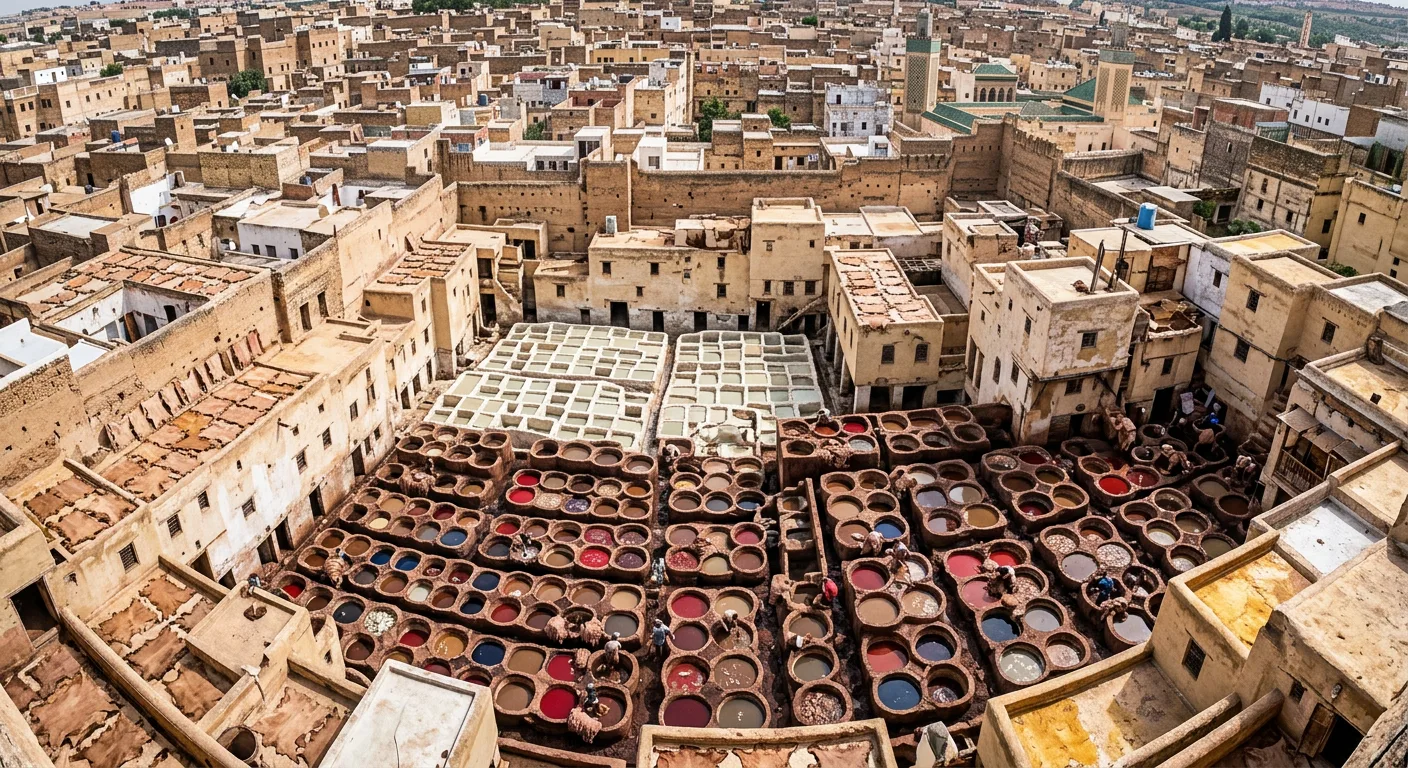
The Chouara is the largest and most famous of Fes's medieval tanneries, worked by hand for centuries in the heart of Fes el-Bali. Its honeycomb of round stone vats — white ones for curing, coloured ones for dyeing — is the single most iconic image of the city. You do not walk among the pits; you look down on them from the rooftop terraces of the leather shops that ring the site. This guide covers how to reach a terrace, why you are handed a sprig of mint, how the leather is softened and dyed, what to buy, how to photograph it respectfully, and how to fit the visit into a day in the medina.
The Chouara is the biggest and best-known of the tanneries that have operated in Fes el-Bali since medieval times. Its dense cluster of round stone vats, set among the surrounding houses and shops, is the picture most people have of Fes, and the centrepiece of any tannery visit.
02How to visit
Viewing from the leather-shop terraces
You do not enter the working area; instead you look down on the vats from the rooftop terraces of the leather shops built around the tannery. A shop will guide you up to its terrace, generally in the hope that you will browse its leather goods on the way back down.
03Tips
The sprig of mint
As you reach a terrace you are usually handed a sprig of fresh mint. Held to the nose, it helps counter the powerful smell of the tannery — the natural curing process, which traditionally involves lime and pigeon droppings, is famously pungent, especially in warm weather.
04Process
How the hides are softened
Raw hides are first soaked in the white vats, in a mixture that traditionally includes lime and pigeon droppings. This stage loosens hair and flesh and softens the skin so it can absorb dye. It is the source of much of the tannery's strong smell, and the reason the mint is so welcome.
05Process
The natural dyes
Once cured, the hides are moved to the coloured vats and dyed using natural sources — traditionally poppy for red, saffron for yellow, indigo for blue, henna for brown and mint for green. The dyed skins are then laid out across the rooftops and nearby surfaces to dry in the sun.
06Shopping
The leather goods
The shops beneath the terraces sell goods made from the tannery's hides — babouche slippers, bags, jackets, belts, poufs and cushion covers. Seeing the dye pits and then the finished pieces in one place is part of the appeal, and there is no obligation to buy.
07Tips
Best light and timing
Mornings are generally the most active time at the vats, and the light falls well across the pits for photographs. The smell is strongest in the heat of the day and in the hottest summer months, so an earlier visit tends to be the more comfortable as well as the more photogenic one.
08Etiquette
Respect for the workers
The tannery is a hard, physical workplace, not a display. The men labouring barelegged among the vats are doing demanding work in harsh conditions. Watch quietly, keep out of the way of anyone working, and ask before photographing individuals close up rather than singling them out unasked.
09Tips
Photography
The view over the coloured vats is one of the most photographed scenes in Morocco, and you can photograph the tannery itself freely from the terrace. A wider shot captures the full honeycomb of pits; for close pictures of the workers, ask first as a courtesy.
10Etiquette
No obligation to buy, but mind the etiquette
Access to a terrace is usually free or by a small tip, and you are not obliged to buy anything. It is courteous, though, to at least glance at the shop's leather, to decline politely rather than abruptly, and to leave a small tip if a member of staff has shown you up and explained the view.
11Itinerary
Combining the Chouara with the medina
The Chouara sits deep in Fes el-Bali, close to other landmarks such as the Al-Attarine and Bou Inania madrasas and the souks. It is easy to fold a tannery stop into a wider medina walk; a local guide can lead you straight to a terrace through the maze of lanes and explain what you are seeing.
Frequently asked
How do you visit the Chouara tannery in Fes?
You view the Chouara from the rooftop terraces of the leather shops that surround it, looking down on the stone dye pits rather than walking among them. A shop will guide you up to its terrace, usually in the hope that you will browse its leather goods, though there is no obligation to buy.
Why are you given mint at the Chouara tannery?
The traditional curing process, which involves soaking hides in a lime-and-natural mixture, gives the tannery a very strong smell. On arrival at a terrace you are typically handed a sprig of fresh mint to hold against your nose, which helps mask the odour while you take in the view over the vats.
How are the hides dyed at the Chouara?
The hides are first soaked and softened in the white vats, then moved to the coloured vats and dyed using natural sources — traditionally poppy for red, saffron for yellow, indigo for blue, henna for brown and mint for green — before being laid out in the sun to dry.
Is the best time to visit the Chouara in the morning?
Mornings are generally the most active at the vats and the light is good for photographs. The smell is also strongest in the heat of the day and in the hottest summer months, so an earlier visit tends to be both more comfortable and more rewarding.
See it with a local
Turn this into a private Fes trip.
We'll build a private, guided plan around the experiences you care about — with a driver, hand-picked riads and a written quote in 24 hours.