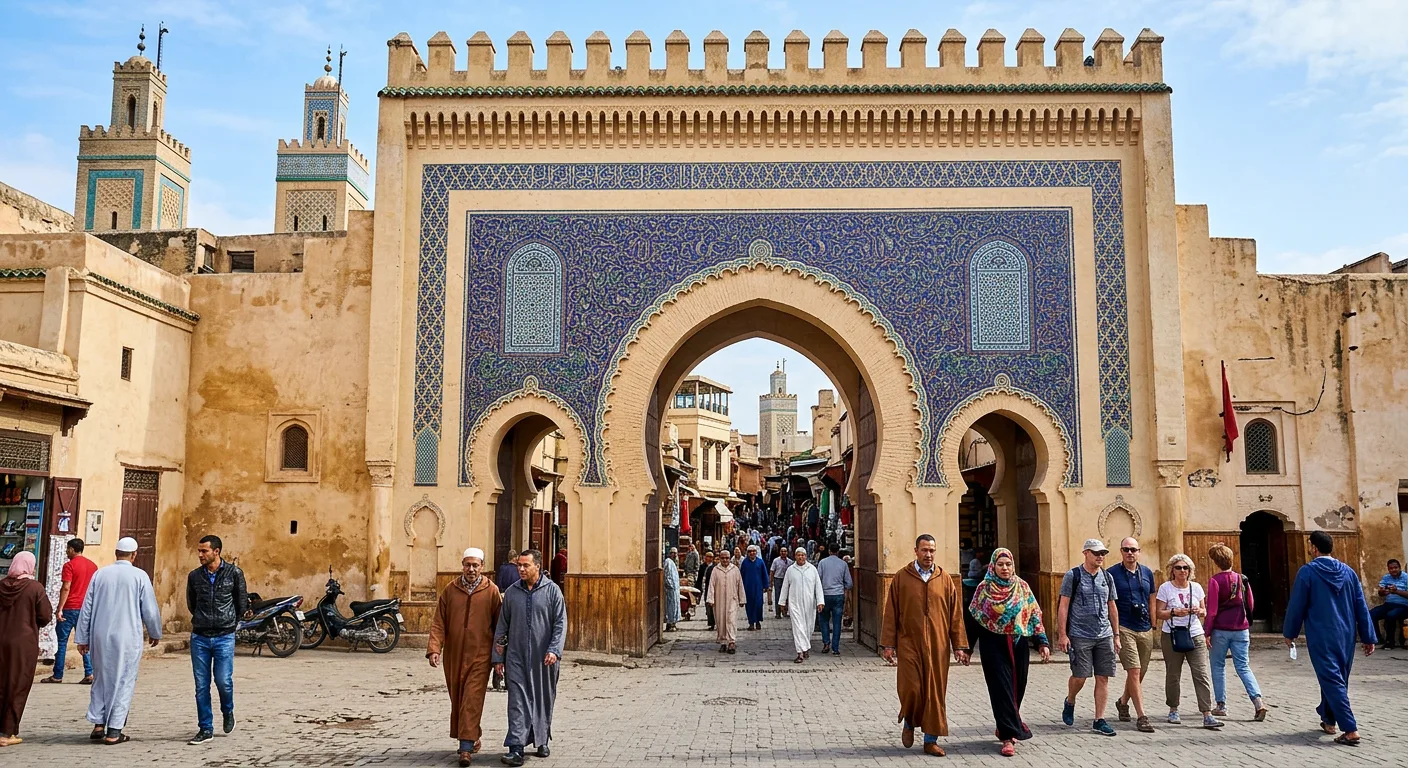
Place R'cif, the square around Bab R'cif, is one of the main gates and gathering places of Fes el-Bali, set in the lower part of the old medina near the course of the Oued Fes — the river that runs through the city and is largely built over or covered as it passes through the heart of the medina. It is a busy, working hub rather than a polished monument: the R'cif Mosque with its green-tiled minaret rises above the square, a daily market spreads out with produce, fish and everyday goods, and the square is one of the key petits-taxis pick-up and drop-off points for the old city. For many visitors R'cif is above all an orientation landmark, a relatively open space roughly between the Qarawiyyin and Andalusian quarters that makes it far easier to enter or leave the maze. Nearby, the river resurfaces in places, and old bridges and the memory of water mills recall the medina's long hydraulic past. This guide covers Place R'cif as a gate, square and taxi hub, the R'cif Mosque, the market and everyday life, the Oued Fes and the medina's water heritage, using R'cif to navigate, respectful photography of local life, and combining it with the Qarawiyyin and Andalusian quarters.
Place R'cif is one of the main gates and open squares of Fes el-Bali, set in the lower part of the old medina. Unlike the grand show-gates, it is first and foremost a working local square, a place where the dense lanes of the medina open out and where residents, traders and taxis come and go. It is a useful first reference point for understanding how the lower medina fits together.
02Getting there
A petits-taxis hub for the old city
Because vehicles cannot enter the heart of the medina, the edge of the maze matters, and Place R'cif is one of the key petits-taxis pick-up and drop-off points for Fes el-Bali. Many visitors arrive or leave here, then continue on foot into the lanes. As with taxis across Morocco, agree the fare or ask for the meter before setting off, and check current rates locally.
03Landmark
The R'cif Mosque and its green-tiled minaret
Rising above the square is the R'cif Mosque, whose minaret carries the green tilework that is traditional for mosques in Fes and across Morocco. As with mosques throughout the country, non-Muslims generally cannot enter, so the experience here is to take in the minaret and façade from the square. It is the main vertical landmark that helps you fix the location of R'cif in the lower medina.
04What to see
The daily market around the square
R'cif is a genuine neighbourhood market. Around the square and the lanes feeding into it you will typically find produce, fish and seafood, everyday household goods and street food, sold to and by people who live and work in the medina rather than to tourists. It is one of the better places to watch the ordinary commerce of Fes el-Bali going about its daily rhythm.
05Atmosphere
Everyday life in the lower medina
More than a sight to tick off, R'cif is a place to stand and watch the medina at work: porters and handcarts, taxis loading and unloading, shoppers crossing the square, traders calling their goods. Because it is so local and unpolished, it gives a vivid, unforced sense of how the old city actually functions day to day.
06History
The Oued Fes, the river through the medina
R'cif sits near the course of the Oued Fes, the river that runs through the old city. Through much of the medina the river is built over or covered, flowing beneath the streets and buildings, so for long stretches you sense rather than see it. The lower medina around R'cif is closely tied to this watercourse, which historically shaped where the city grew and how it was supplied.
07What to see
Where the river resurfaces
In places near and beyond R'cif the Oued Fes comes back into the open, glimpsed between buildings or beside the lanes, with old bridges crossing it. These resurfacing stretches are a reminder that the covered river is still there beneath the medina, and they are among the few spots where you can actually see the watercourse that gives the city its name and shape.
08History
The medina's water heritage
Water is central to the story of Fes el-Bali. The Oued Fes and its channels once drove water mills, supplied fountains and served trades such as the tanneries and dyers, and bridges, conduits and the memory of mills survive across the lower medina. R'cif is a good place to start thinking about this hydraulic past, which underpins the whole working life of the old city.
09Tips
Using R'cif to navigate the medina
The medina is a famously confusing maze, and R'cif is one of the most useful anchors within it. Sitting roughly between the Qarawiyyin and Andalusian quarters in the lower medina, it is an easy landmark to head for or set out from, with taxis on hand at its edge. If you lose your way in the lanes, asking for R'cif is often the simplest way to reorient.
10Tips
Photography of local life, respectfully
R'cif offers some of the most candid, everyday scenes in Fes: the market stalls, the green-tiled minaret above the square, porters and shoppers crossing in front of the mosque. Because this is a working local square rather than a tourist set-piece, photograph people only with their consent, be discreet around the market and the mosque, and keep out of the way of taxis and handcarts.
11What to see
Combining R'cif with the Qarawiyyin and Andalusian quarters
R'cif's position in the lower medina makes it a natural pivot for a wider walk. From here you can climb toward the Qarawiyyin and its great mosque, the Attarine souk and the main madrasas on one side, or cross toward the quieter Andalusian quarter on the other. Folding R'cif into the route lets you see the working, local face of the medina alongside its famous monuments.
12Tips
Going with a local guide
A local guide turns R'cif from a confusing transit point into a meaningful part of the medina. A guide can place the square in the story of the Oued Fes and the city's water heritage, help you read the market and everyday life, navigate from R'cif into the Qarawiyyin and Andalusian quarters, and arrange a taxi at the right rate when you are ready to leave.
Frequently asked
What is Bab R'cif (Place R'cif) in Fes?
Place R'cif, the square around Bab R'cif, is one of the main gates and gathering places of Fes el-Bali, in the lower part of the old medina near the course of the Oued Fes river. It is a busy, working local hub with the R'cif Mosque and its green-tiled minaret, a daily market, and one of the key petits-taxis pick-up and drop-off points for the old city, which also makes it a handy landmark for finding your way in the medina.
Where is the river in the Fes medina?
The Oued Fes, the river that runs through the old city, flows close to R'cif, but through much of the medina it is built over or covered and runs beneath the streets and buildings. In places near and beyond R'cif it resurfaces in the open, crossed by old bridges, and these are among the few spots where you can actually see the watercourse that shaped the medina and once powered its mills.
Can you get a taxi at Place R'cif in Fes?
Yes. Because cars cannot enter the heart of the medina, the edges matter, and Place R'cif is one of the main petits-taxis pick-up and drop-off points for Fes el-Bali. Many visitors arrive or leave here on foot. As with taxis across Morocco, agree the fare or ask for the meter before you set off, and check current rates locally rather than relying on a fixed price.
Is R'cif a good place to explore the Fes medina from?
It is one of the most useful anchors in the medina. R'cif sits roughly between the Qarawiyyin and Andalusian quarters in the lower medina, with taxis at its edge, so it works well as a point to set out from or head back to. From here you can climb toward the Qarawiyyin, the Attarine souk and the main madrasas, or cross toward the quieter Andalusian quarter, taking in the working market and local life on the way.
See it with a local
Turn this into a private Fes trip.
We'll build a private, guided plan around the experiences you care about — with a driver, hand-picked riads and a written quote in 24 hours.