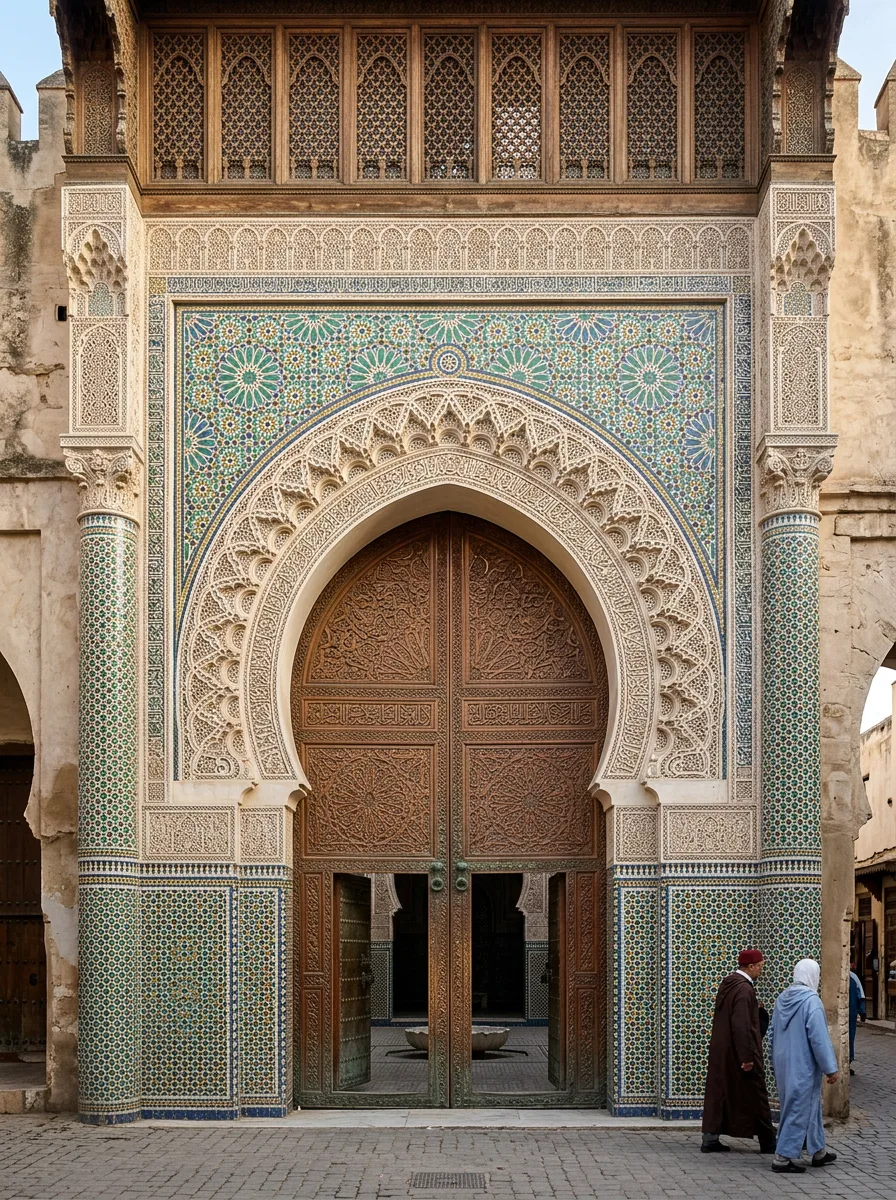
The Al-Attarine Madrasa is an early-14th-century Marinid college founded by Sultan Abu Said Uthman around the 1320s, set right beside the Qarawiyyin mosque-university in the heart of Fes el-Bali. It takes its name from the adjacent Attarine souk, the lane of spice and perfume sellers it sits within. Though small, it is widely regarded as one of the jewels of Marinid craftsmanship, with exquisite zellige mosaic, finely carved cedar, delicate stucco and a marble courtyard set around a central fountain. Unlike the neighbouring Qarawiyyin, the madrasa is open to non-Muslim visitors, making it a rare chance to study this decoration up close. This guide covers what to see, the courtyard and upper student cells, the craftsmanship to look for, its setting in the spice souk, dress and etiquette, how long to allow, and how to combine the visit with the Qarawiyyin exterior and the Nejjarine quarter.
Founded by the Marinid sultan Abu Said Uthman in the 1320s, the Al-Attarine is one of the older madrasas of Fes el-Bali and a teaching college that once housed students of the nearby Qarawiyyin. Though modest in size, it is often described as a jewel of Marinid art, packing an extraordinary density of decoration into a compact plan.
02How to visit
Open to non-Muslim visitors
Unlike the adjoining Qarawiyyin mosque-university, which non-Muslims may not enter, the Al-Attarine Madrasa is open to all visitors. This makes it one of the best places in Fes to step inside a Marinid building and look closely at the tilework, stucco and cedar that you can only glimpse from the doorways of the surrounding religious sites.
03What to see
The central courtyard and fountain
At the heart of the madrasa is a small marble-paved courtyard with a central fountain, framed on every side by richly decorated walls. The intimate scale brings the decoration close, and the courtyard is where most visitors pause to take in how zellige, stucco and carved wood meet across each surface.
04Craftsmanship
The zellige mosaic
The lower walls and courtyard are sheathed in zellige, the geometric mosaic of hand-cut glazed tile that Fes is famous for. The precision of the cut tile and the complexity of the star-and-polygon patterns are a highlight, and the Al-Attarine is often singled out for the quality of this work.
05Craftsmanship
Carved cedar and stucco
Above the tilework, the middle registers are covered in finely carved stucco bearing arabesques and Arabic inscriptions, while the upper walls and eaves are worked in intricately carved cedarwood. The layering of tile, plaster and timber, each by a different craft, is exactly the combination that makes Marinid decoration so admired.
06What to see
The upper-floor student cells
Like other Fes madrasas, the Al-Attarine had small student rooms on an upper floor arranged around the courtyard, where those studying at the Qarawiyyin once lodged. Where access is open, a stairway leads up to these simple cells and to views down over the courtyard and across the surrounding rooftops.
07Setting
Its setting in the Attarine spice souk
The madrasa is named for the Attarine souk that surrounds it, the lane of spice and perfume sellers ("attarine" refers to the dealers in aromatics). Approaching it you pass stalls of spices, dried herbs and traditional remedies, so the visit is as much about the bustling souk setting as the building itself.
08Nearby
Beside the Qarawiyyin mosque-university
The Al-Attarine stands directly next to the Qarawiyyin, one of the oldest continuously operating centres of learning in the world. Non-Muslims cannot enter the mosque, but you can glimpse its courtyard through the great doorways nearby, and the madrasa offers an interior taste of the same architectural tradition.
09Etiquette
Dress and etiquette
Although open to visitors, the madrasa is a former religious teaching site, so dress modestly with shoulders and knees covered and keep your voice low. Photography of the architecture is generally fine, but be discreet and respectful, especially given how close you are to the working Qarawiyyin mosque next door.
10Tips
How long to allow
Because it is compact, most visitors spend roughly 20 to 30 minutes inside, walking the courtyard, studying the zellige, stucco and cedar, and climbing to the upper cells where they are open. There is a small entry fee; check the current price and opening hours locally, as access can vary around prayer times.
11Itinerary
Combining with the Qarawiyyin and Nejjarine
The madrasa sits in the dense core of Fes el-Bali, a short walk from the Qarawiyyin doorways and the Nejjarine quarter with its fondouk and fountain. A natural plan is to thread through the Attarine souk to the madrasa, glimpse the Qarawiyyin exterior, then continue to the Nejjarine Museum of Wooden Arts and Crafts before working back toward Talaa Kebira.
12Tips
Going with a local guide
A local guide can place the Al-Attarine in its Marinid context, point out details in the zellige, stucco and cedar you might otherwise miss, and navigate the tight lanes of the souk that surround it. It also makes it easy to fold the madrasa into a wider medina walk taking in the Qarawiyyin and Nejjarine without losing your bearings.
Frequently asked
Can non-Muslims visit the Al-Attarine Madrasa in Fes?
Yes. Unlike the neighbouring Qarawiyyin mosque-university, which non-Muslims may not enter, the Al-Attarine Madrasa is open to all visitors. It remains a former religious teaching site, so dress modestly and behave respectfully, and note that access can vary around prayer times.
What is there to see at the Al-Attarine Madrasa?
The draw is its Marinid craftsmanship packed into a small space: a marble courtyard with a central fountain, framed by exquisite zellige mosaic, finely carved stucco with arabesques and inscriptions, and intricate cedar woodwork, with small student cells on an upper floor. It sits within the Attarine spice and perfume souk, right beside the Qarawiyyin.
Why is it called the Al-Attarine Madrasa?
It takes its name from the Attarine souk that surrounds it, the lane of spice and perfume sellers in the heart of Fes el-Bali. "Attarine" refers to the dealers in spices, perfumes and aromatic remedies, and you pass their stalls as you approach the madrasa.
How long should I spend at the Al-Attarine Madrasa?
Around 20 to 30 minutes is usually enough to walk the courtyard, study the zellige, stucco and cedar, and climb to the upper student cells where they are open. There is a small entry fee and opening can vary around prayer times, so check current prices and hours locally.
See it with a local
Turn this into a private Fes trip.
We'll build a private, guided plan around the experiences you care about — with a driver, hand-picked riads and a written quote in 24 hours.