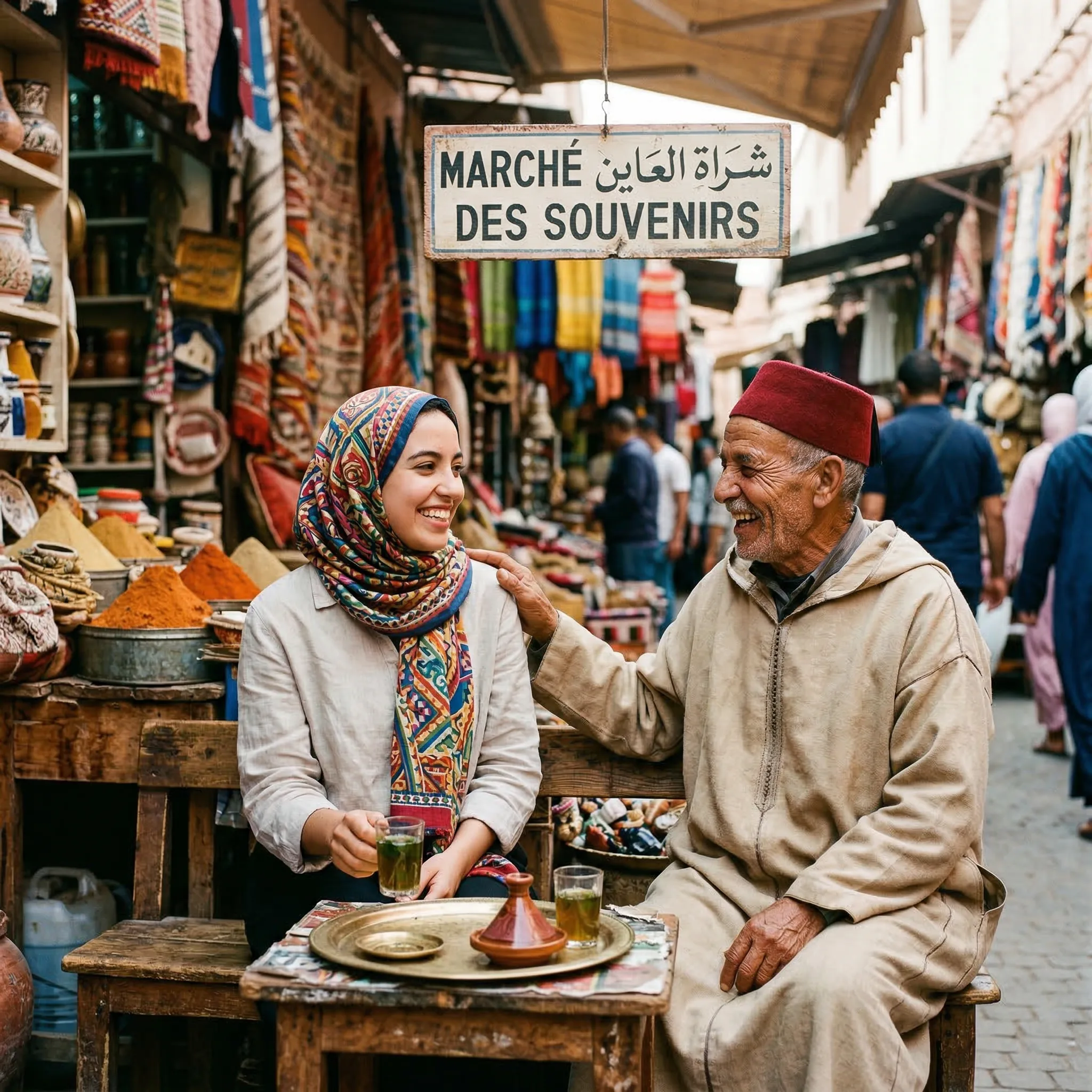
Cross the threshold of a Fes el-Bali riad, settle beside a tanner in the Chouara quarter, linger while a maâlem trims a star of zellige — and ahead of any talk, any bargaining, any food, the tray comes out. Atay, the locals call it: green gunpowder leaf, a fist of spearmint, more sugar than most visitors expect, sent down in a long ribbon from on high into a slim glass and given to you in both hands. This is no mere drink. It is a welcome made visible — and in a city as old and as mannered as Fes, it is poured with genuine care.
Where did the ritual come from?
Gunpowder green tea from China arrived on British trading ships around the middle of the 1700s, as London chased commerce along the North African shore. The Sultan warmed to it faster than to coffee and pressed it into court life, and inside a generation it had pushed aside the older herbal infusions and inherited the ceremony that Moroccan hospitality had always demanded. The mint — spearmint, nana — was the local stroke of genius, flourishing in the foothills and the well-watered plains around nearby Meknès, Morocco's mint capital and barely an hour from the Fes medina. Bitter leaf, cool mint and sweet sugar fused into a single thing within decades, and the formula has barely shifted since.
How is Moroccan mint tea actually brewed?
Every step is careful, and slow on purpose. First a splash of boiling water is rolled over the gunpowder leaves in the berrad — the engraved steel pot — then thrown away; that opening rinse strips the harshness and rouses the tea. Fresh boiling water follows, then a tight handful of spearmint stems crammed in. The sugar comes next, and the quantity startles newcomers — four or five spoons to a pot is normal — before theberrad goes back over the flame to take a brief boil. The host fills a glass, sips, corrects the balance, then lifts the pot a clear 30 to 40 centimetres and pours: the long fall whips air through the tea and lays that prized collar of fine foam at the rim. All three opening glasses are drawn from the one pot, and the taste turns a little with each, as the mint gives up more of itself.
What does 'Berber whisky' mean?
The label is warm and knowing. Where the household keeps no alcohol, mint tea carries the social weight a generous measure of whisky might carry elsewhere — it greets the guest, it oils the talk, it signals esteem. Try 'Berber whisky' on a Fassi host and you will almost always earn a grin of recognition. Travel writers in English have used the phrase since the 1960s, and Moroccans have their own turn on it in Darija. It is no mockery and no one's expense: it is a quiet boast, a way of saying this ritual is Morocco's very own coin of welcome.
What is the etiquette for guests?
A handful of small courtesies count. Take that first glass in both hands, or in the right alone — never the left by itself. Don't gulp; the tea is scalding and the talk is the whole point. Three glasses is the proper run: declining the first stings, but a warm 'baraka' once the third is drained signals a contented finish. Praising the tea is welcome though hardly needed — the host knows perfectly well it is good. In a shop, a glass binds you to nothing, whatever the pitch behind it implies; it is a real gesture of welcome, and you may rise and go once it is done. Under a private roof, sit out all three rounds — to leave early is to cut the hospitality short.
Are there regional variations across Morocco?
There are, and they repay attention. In Fès, the old imperial capital, the rite reaches its most formal: the chased tray, the narrow glasses, the measured pour are all points of quiet pride, and a Fassi host will keep adjusting the sugar and pouring again until the balance is exact. Down in the Saharan south — Zagora, Tata, Guelmim — the Tuareg hand shows, the tea built in three distinct rounds, each sweeter and thicker than the one before. The saying that travels with it, one glass for health, one for love, one for death, has long since soaked into Moroccan tea life, though not every house holds to the strict three-round order. Up in the Rif around Chefchaouen, a little wormwood (chiba, locally nicknamed absinthe though unrelated to the European spirit) joins the mint for a bitter, herbal warmth, while along the Atlantic some households finish the pot with a few drops of orange-blossom water.
Can you recreate it at home?
With some patience, yes. The two things you cannot skip are Chinese gunpowder green tea (any good tea merchant has it) and fresh spearmint. The high pour is craft, not showmanship — rehearse it over a sink before you trust it at a table. Sweetness is your call, but go too sparing and you lose the way the sugar answers the bitterness of the leaf. The right vessel is a proper Moroccan pot — narrow-spouted, heavy steel, very often hand-chased by the brass maâlems of Place Seffarine in the Fes medina. A great many of our guests carry one home from the Fes souks and call it the most useful thing they bought.
Frequently asked
Why is Moroccan mint tea called 'Berber whisky'?
It is a fond local pun. Traditional Moroccan homes keep no alcohol, yet a guest is met with mint tea poured with the same generosity and ceremony a Scot might reserve for a good whisky. The phrase has been around since at least the mid-1900s, and Moroccans use it about themselves with a smile, never as an insult.
What type of mint is used in Moroccan tea?
The classic leaf is spearmint — nana in Darija — clean, cooling and faintly sweet. Through the hot months some Fassi families tuck in a sprig of wormwood (chiba) for a bitter herbal edge, and the deep south swaps in desert herbs when fresh mint runs short. The one thing you will never meet in the glass is peppermint, which Moroccan palates find far too aggressive.
How many glasses of tea is it polite to accept?
Three is the customary count — one for health, one for love, one for death, runs the old Tuareg line that has long since settled into Moroccan custom. Turning down the first glass reads as cold; seeing all three through is gracious. Once you have finished the third, a warm 'baraka' (thank you, I am content) closes the round with no offence taken.
Can you ask for tea without sugar in Morocco?
You can say 'bla sukkar, afak' (no sugar, please) and most hosts will do their best, even if a Fassi traditionalist will look mildly puzzled — to many, unsweetened mint tea is a contradiction in terms. The graceful middle path is 'shwiya sukkar' (just a little sugar), which yields a softer, kinder sweetness.
Is there a specific time of day for the tea ritual?
There is no appointed hour; the tea simply appears. It welcomes an arrival, seals a bargain, rewards an hour spent on the medina's stone, rounds off a meal. In a Fes workshop, the tray sliding out often means a price is all but agreed. In a home it is the very first thing a guest is offered. The ritual answers to hospitality, never the clock.
Experience it properly
Tea in a riad courtyard — your first morning in Fes.
Every Fes & Imperial Cities itinerary opens with a welcome tea in your riad. We can also arrange a private ceremony with a Fassi tea master, woven through a workshop visit to the brass and zellige artisans of the medina, history and technique included.