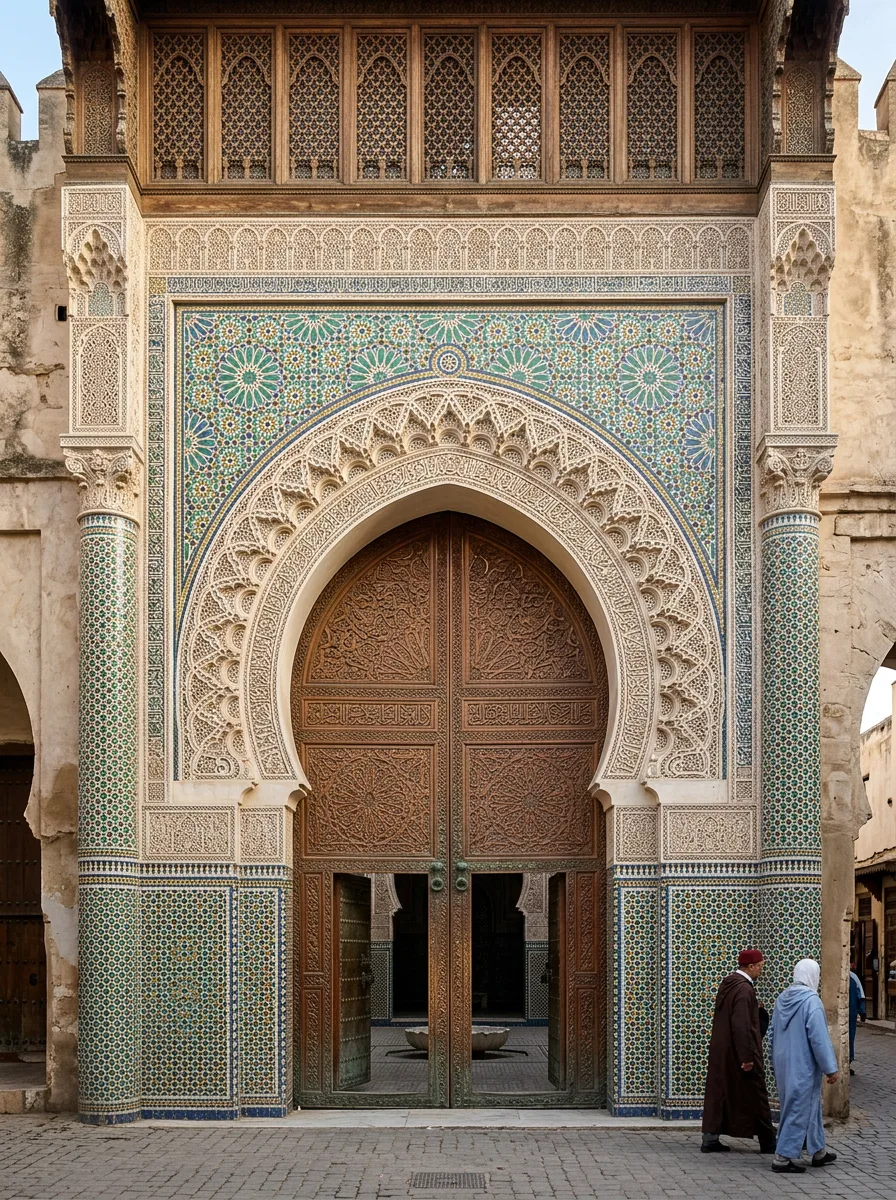
Bou Inania vs Al-Attarine Madrasa: Which Fes Marinid Jewel to See?

Landmark comparison · Fes el-Bali madrasas

Bou Inania vs Al-Attarine Madrasa: Which Fes Marinid Jewel to See?

The two finest Marinid madrasas in the Fes medina — the grand, mosque-crowned Bou Inania with its famous water clock, and the smaller, exquisitely refined Al-Attarine beside the Qarawiyyin. Here is how to choose, though both are close enough to see in one walk.

Fes el-Bali holds a remarkable cluster of madrasas — the 14th-century Quranic colleges built by the Marinid dynasty — and two stand above the rest. The Bou Inania Madrasa, founded around the 1350s by the Marinid sultan Abu Inan Faris, is the largest and grandest of them all. Unusually, it also served as a congregational mosque, so it has a minaret and a prayer hall in addition to the usual courtyard and student cells; its marble courtyard, dazzling zellij tilework, carved cedar and intricate stucco make it the showpiece of Marinid architecture, and the famous Dar al-Magana water clock sits on the wall of the lane opposite. The Al-Attarine Madrasa, founded a little earlier in the 1320s and named for the spice-and-perfume souk (attarine) beside which it stands near the Qarawiyyin, is smaller but exquisitely refined — a compact courtyard whose every surface, from the zellij dado to the carved plaster and cedar, is worked to a jeweller's finish. It is often called the most beautiful madrasa in miniature. They are within a short walk of each other, so for most visitors the real question is not which to skip, but which to linger in.

Option A

Bou Inania Madrasa

The largest and grandest Marinid madrasa — and a working mosque with a minaret

Best for

First-time visitors wanting the single must-see madrasa, and the Dar al-Magana water clock opposite

Full guide

Option B

Al-Attarine Madrasa

A jewel-box of zellij and carved cedar by the spice souk, beside the Qarawiyyin

Best for

Travellers who love refined detail and intimate, perfectly proportioned spaces

Full guide

Side-by-side breakdown

Bou Inania Madrasa vs Al-Attarine Madrasa

How the two stack up across the things that actually shape a trip — read down each column, or across each row.

Bou Inania MadrasaAl-Attarine Madrasa
Bou Inania Madrasa compared with Al-Attarine Madrasa
Size & grandeurBou Inania MadrasaThe largest and grandest Marinid madrasa — a spacious marble courtyard and prayer hallAl-Attarine MadrasaSmall and intimate — a compact courtyard, exquisitely proportioned rather than imposing
Date & founderBou Inania MadrasaFounded ~1350s by the Marinid sultan Abu Inan Faris (who gave it his name)Al-Attarine MadrasaFounded ~1320s under the Marinids, by the Attarine (spice & perfume) souk
Mosque or madrasaBou Inania MadrasaBoth — a rare madrasa that was also a congregational mosque, with a minaret and prayer hallAl-Attarine MadrasaA madrasa (Quranic college) in the classic form — courtyard, prayer room and student cells
Signature featureBou Inania MadrasaThe Dar al-Magana water clock on the wall opposite, plus the minaret and marble courtAl-Attarine MadrasaJewel-box decoration — intricate zellij, finely carved plaster and cedar at close range
DecorationBou Inania MadrasaDazzling zellij, carved cedar, deep stucco and marble — grandeur at scaleAl-Attarine MadrasaAmong the most refined zellij and stucco in Fes — detail you study inch by inch
SettingBou Inania MadrasaOn the Tala'a Kebira near Bab Boujloud, one of the main medina thoroughfaresAl-Attarine MadrasaTucked by the spice souk beside the Qarawiyyin mosque, deeper in the medina
AccessBou Inania MadrasaGenerally open to non-Muslim visitors despite its mosque function — a notable exceptionAl-Attarine MadrasaOpen to visitors as a historic madrasa; the adjacent Qarawiyyin mosque is not
Time & costBou Inania MadrasaA modest entry fee; allow 30–45 minutes to take in the courtyard, hall and clock viewAl-Attarine MadrasaA modest entry fee; 20–30 minutes is enough for this smaller, concentrated space
Who it suitsBou Inania MadrasaAnyone wanting the single must-see madrasa, with the bonus of the water clockAl-Attarine MadrasaLovers of fine craftsmanship who want an intimate, perfectly finished interior

Our verdict

Which should you choose?

If you only have time for one, make it the Bou Inania Madrasa: it is the largest and grandest, the only one that doubled as a congregational mosque, and the Dar al-Magana water clock sits just across the lane. Choose the Al-Attarine Madrasa when you want an intimate jewel of a building beside the Qarawiyyin, where the zellij and carved cedar reward close, unhurried attention. In truth they are a short walk apart in the heart of Fes el-Bali and each carries only a small entry fee, so the best plan is simply to see both — Bou Inania for grandeur and the clock, Al-Attarine for exquisite detail — ideally on the same medina walk.

Deep dives

Explore each destination in full.

FAQ

Frequently asked questions.

What is the difference between the Bou Inania and Al-Attarine madrasas?

Both are 14th-century Marinid madrasas (Quranic colleges) in the Fes medina, but the Bou Inania (founded around the 1350s by sultan Abu Inan) is the largest and grandest and uniquely also served as a congregational mosque, so it has a minaret and prayer hall. The Al-Attarine (founded around the 1320s, by the spice souk near the Qarawiyyin) is smaller but exquisitely refined — a jewel-box of zellij and carved cedar.

Which Fes madrasa is best to visit?

For most first-time visitors the Bou Inania is the must-see: it is the grandest, doubles as a mosque, and the famous Dar al-Magana water clock is on the wall opposite. The Al-Attarine is the better choice if you love refined detail in an intimate space. They are close together, so seeing both on one medina walk is the ideal.

Can non-Muslims enter the Bou Inania Madrasa?

Yes — although it functioned as a congregational mosque, the Bou Inania Madrasa is generally open to non-Muslim visitors, which makes it a notable exception among Fes's working religious buildings. By contrast, the nearby Al-Qarawiyyin mosque is not open to non-Muslims, though the Al-Attarine Madrasa beside it is.

What is the water clock in Fes?

The Dar al-Magana is a 14th-century water clock set into the wall of the lane opposite the Bou Inania Madrasa, on the Tala'a Kebira. Its row of wooden consoles and brass bowls is one of the curiosities of the medina; the exact workings are debated, but it remains a striking sight directly across from the madrasa.

How much time do I need for both madrasas?

Plan on about 30–45 minutes for the larger Bou Inania (including the courtyard, prayer hall and the water clock across the lane) and around 20–30 minutes for the more compact Al-Attarine. Both charge only a small entry fee, and since they sit a short walk apart in Fes el-Bali you can comfortably see both in a single morning or afternoon.

Ready to book?

Let a Marrakech atelier build your itinerary.

Tell us which destinations you want to combine and we'll send a written itinerary and a transparent quote within 24 hours.

Keep comparing — all destination comparisons
Book now